
Whether you are building a new luxury home, renovating a period property, or rewiring for high-speed home working, smart home automation, and 4K CCTV, structured network cabling is the foundational nervous system of your property. In the UK, the two primary Ethernet cable standards specified for residential and commercial installations are Category 6 (Cat6) and Category 6A (Cat6A Augmented). While both cables look identical to the untrained eye, their internal copper construction, shielding standards, bandwidth capacity, and installation costs differ significantly. In this definitive trade guide, certified cabling specialist Gary Pearce breaks down the exact technical differences to help you choose the right cable for your home.
⚡ The 10Gbps Distance Threshold
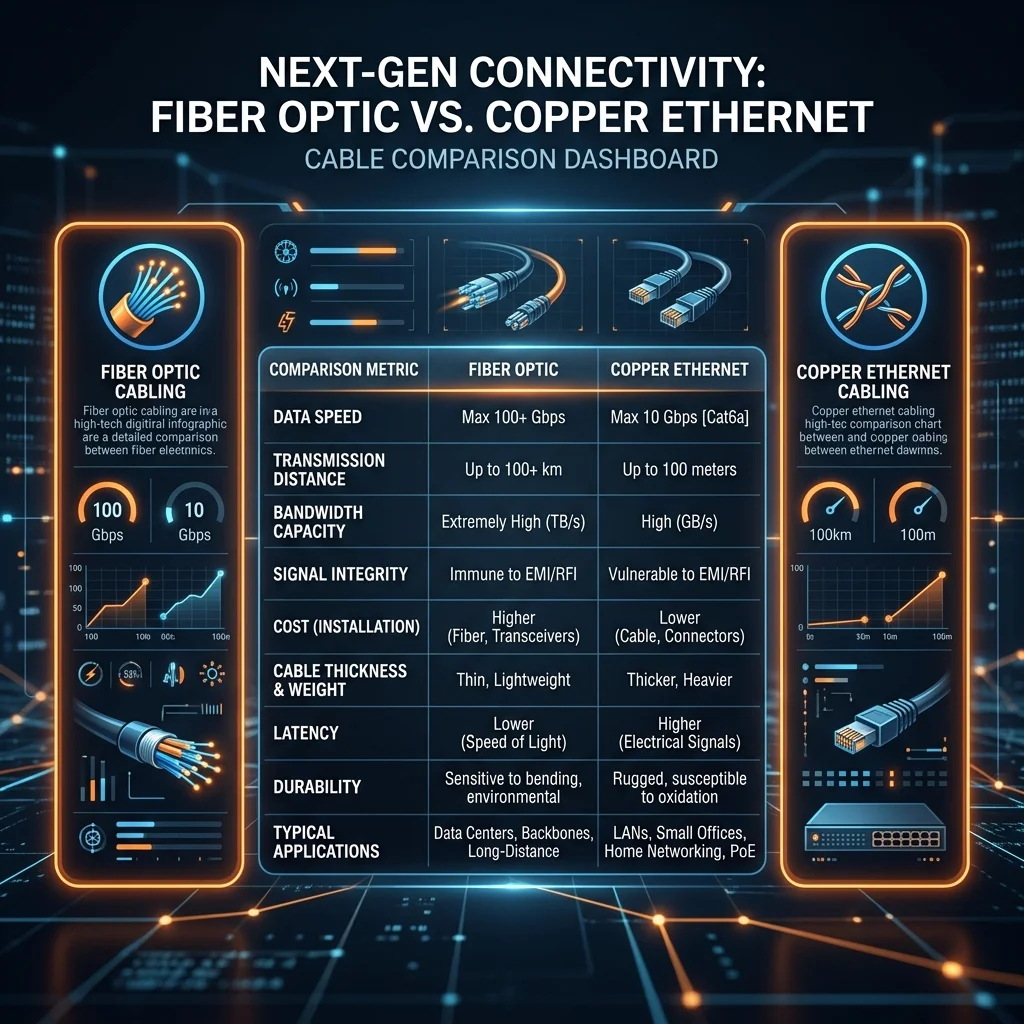
Both Cat6 and Cat6A are capable of transmitting blazing 10-Gigabit Ethernet (10GBASE-T). However, standard Cat6 can only sustain 10Gbps up to a maximum distance of 37 to 55 metres under ideal conditions, falling back to 1Gbps over longer runs. Cat6A, by contrast, operates at double the bandwidth (500MHz) and is certified to deliver full 10Gbps over the complete 100-metre (328ft) channel with zero packet loss.
1. Cat6 vs Cat6A: Technical Specification Benchmark
| Technical Parameter | Category 6 (Cat6) | Category 6A (Cat6A Augmented) |
|---|---|---|
| Frequency Bandwidth | 250 MHz | 500 MHz (Double the capacity) |
| Max Speed at 100m | 1,000 Mbps (1 Gbps) | 10,000 Mbps (10 Gbps) |
| Max Speed at < 37m | 10,000 Mbps (10 Gbps) | 10,000 Mbps (10 Gbps) |
| Cable Outer Diameter | 5.2mm – 6.0mm (Slim & Flexible) | 7.2mm – 8.8mm (Thick & Rigid) |
| Backbox Depth Required | 25mm or 35mm standard box | 35mm or 47mm deep backbox |
| Alien Crosstalk (ANEXT) | Moderate resistance | Near-Zero (Individual foil pairs) |
2. Alien Crosstalk & Foil Shielding
Cable Anatomy: Cat6 Plastic Cross-Spline vs Cat6A Shielded Foil Pairs
- • Outer diameter: 5.5mm (Flexible)
- • Fits standard 25mm shallow backboxes
- • 10Gbps supported up to 37–55 metres
- • Outer diameter: 7.5mm–8.5mm (Rigid)
- • Requires deep 35mm–47mm backboxes
- • 10Gbps guaranteed over full 100m channel
When dozens of network cables are bundled together inside a tight conduit, loft tray, or stud partition, electromagnetic signals can bleed from one cable into adjacent cables. This phenomenon is called Alien Crosstalk (ANEXT):
- Cat6 Architecture: Typically unshielded (UTP), utilizing an internal plastic cross-spline to separate the four twisted pairs. While sufficient for 1Gbps, at 10Gbps frequencies (above 250MHz), bundled Cat6 cables suffer packet loss from alien crosstalk.
- Cat6A Architecture: Manufactured as Shielded (F/UTP or S/FTP), where each twisted pair or the outer bundle is wrapped in aluminium Mylar foil. This creates an impermeable shield against electromagnetic interference (EMI) from mains 230V wiring and adjacent data streams.
3. Beware the Dangerous "CCA" Cable Scam
When purchasing network cable online, beware of ultra-cheap reels labelled "CCA" (Copper Clad Aluminium). CCA cables substitute pure solid copper conductors with cheap aluminium coated in a microscopic wash of copper:
Why CCA Cables Violate UK Building Regulations:
Our engineers install exclusively 100% Solid Bare Oxygen-Free Copper cable with Euroclass CPR fire certification.
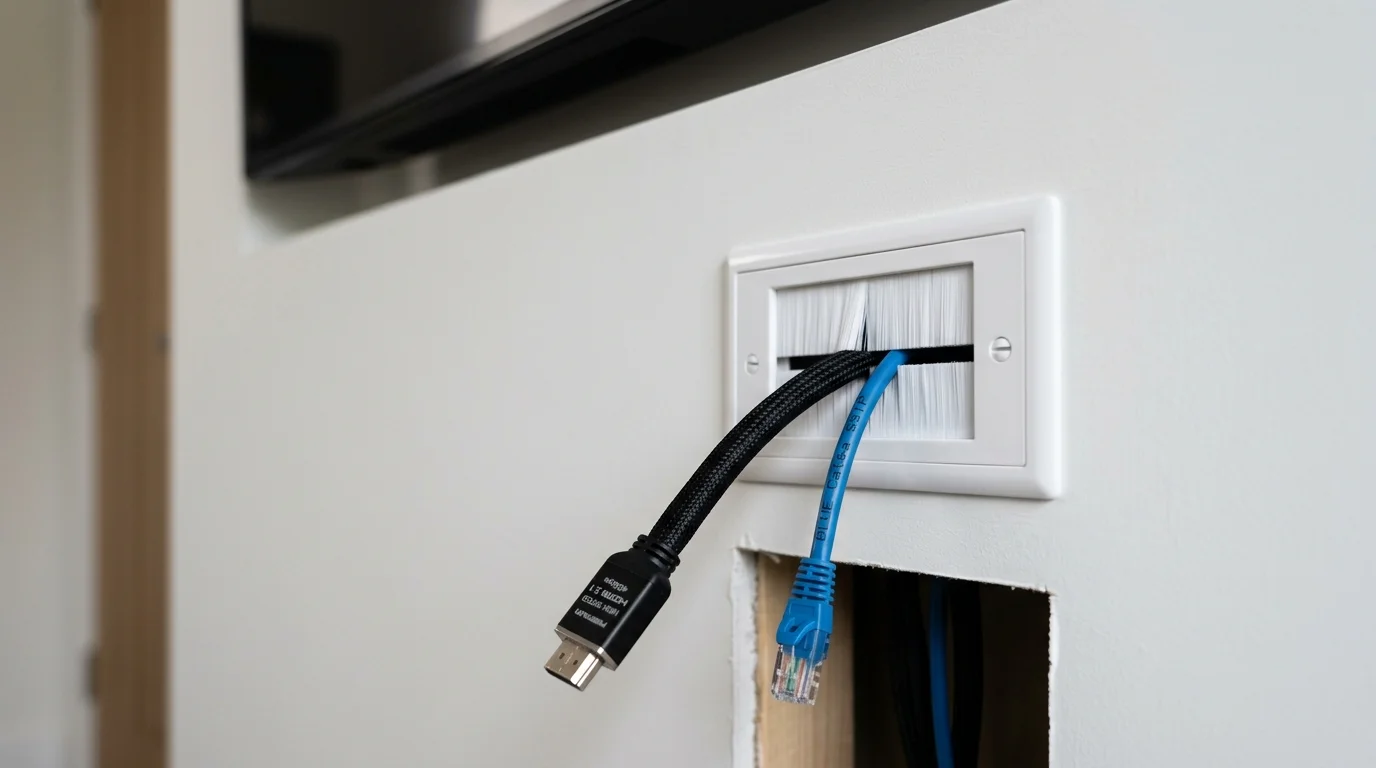
Bend Radii, 10Gbps Distance Limits & Alien Crosstalk Shielding
BLUF Direct Answer: Standard Cat6 supports 10Gbps speeds up to 35-55 metres in domestic settings, making it easier to pull through tight studs, whereas Cat6A features thick internal shielding and 500MHz bandwidth supporting 10Gbps across the full 100-metre standard with zero alien crosstalk.
When rewiring a home, choosing between Cat6 and Cat6A involves balancing future bandwidth against practical installation constraints. Cat6 cable is flexible, inexpensive, and easily supports 10 ultra-fast multi-gigabit throughput over domestic runs under 35 metres. For 95% of UK residential properties, high-quality solid copper unshielded Cat6 (U/UTP) is more than sufficient.
However, Cat6A operates at double the frequency (500MHz vs 250MHz) and incorporates internal pair separators and foil shielding (F/UTP). This makes Cat6A noticeably thicker (approx. 7.5mm vs 5.5mm diameter) with a much stiffer bend radius. It requires deeper backboxes (minimum 35mm to 47mm) and careful grounding of shielded drain wires to prevent ground loop hum.
| Specification | Cat6 (Solid Copper U/UTP) | Cat6A (Shielded F/UTP) |
|---|---|---|
| Operating Frequency | 250 MHz | 500 MHz |
| 10 Gigabit (10Gbps) Max Run | 35m - 55m (Sufficient for most UK homes) | Full 100 Metres Certified |
| Outer Diameter & Flexibility | 5.5mm (Highly flexible; easy pull) | 7.5mm (Stiff; requires 35mm+ backboxes) |
| Shielding Termination | Standard RJ45 crimp / toolless keystone | Requires 360-degree shielded jacks & earthing |
Garden Office & Outbuilding Broadband Method Decider
Find the optimal transmission medium between your main home and garden studio based on trenching practicality, line of sight, electrical earthing zones, and distance.
How to Terminate Cat6 and Cat6A Keystone Jacks Correctly
Professional data cabling punch-down and certification procedure.
Strip Outer Jacket Without Nicking Cores
Use a rotational cable stripper set to exact jacket depth to preserve insulation on all 4 twisted pairs.
Maintain Tight Pair Twists to Terminal Point
Do not untwist pairs more than 6mm before punch-down to eliminate Near-End Crosstalk (NEXT).
Punch Down to T568B Standard
Align color codes to the T568B convention (White/Orange, Orange, White/Green, Blue, White/Blue, Green, White/Brown, Brown).
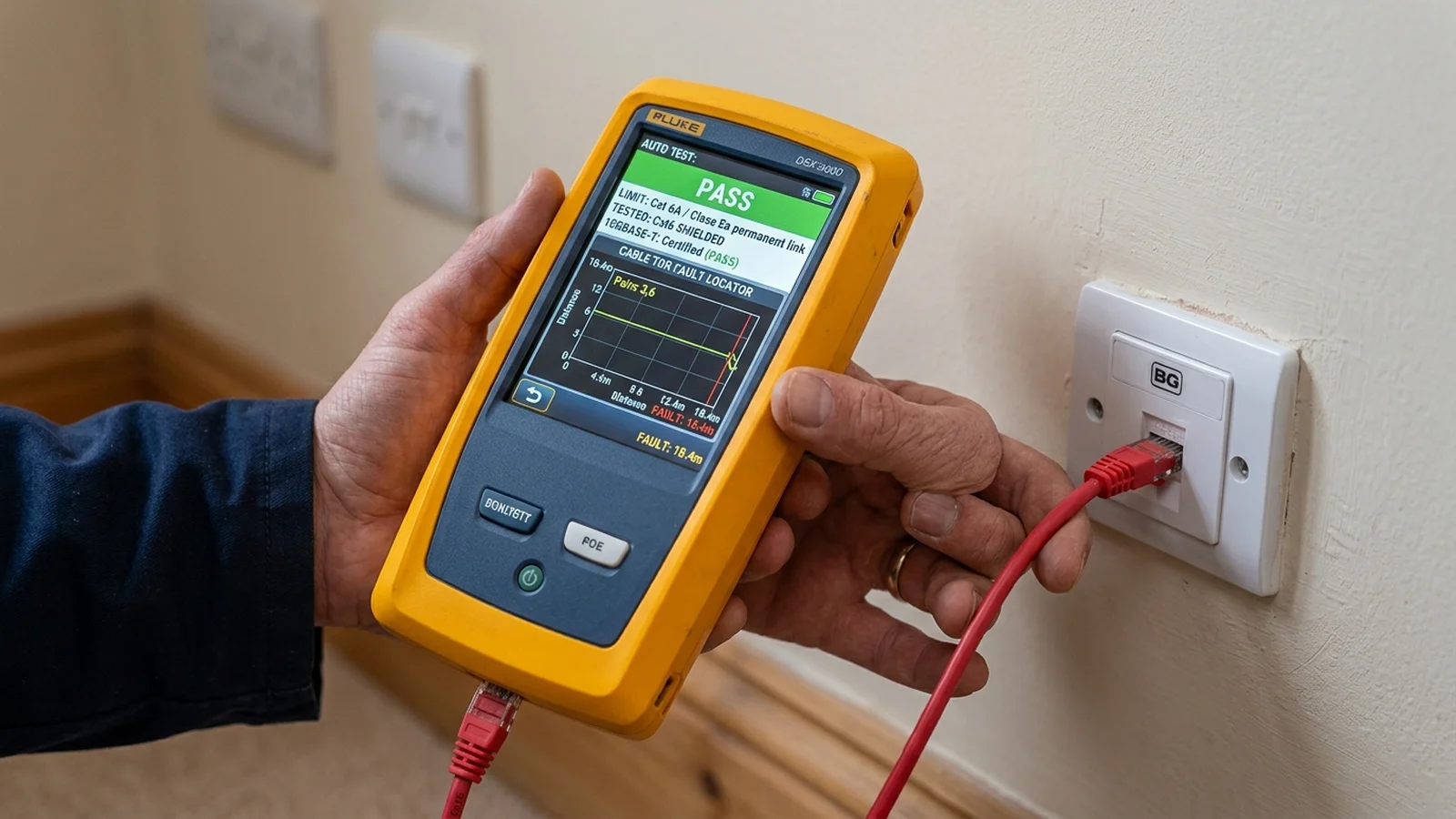
Verify Wiremap & Continuity with Fluke Tester
Plug in an enterprise cable certifier to verify pin-for-pin continuity, wiremap, and return loss.
4. Gary's Verdict: Which Cable Should You Choose?
- Choose Cat6 if: You are retrofitting an existing finished home where thin, flexible cable is needed to navigate tight stud walls and 25mm shallow backboxes. In 95% of typical UK homes where cable runs are under 35 metres, Cat6 delivers flawless 10Gbps speeds at lower cost.
- Choose Cat6A if: You are doing a ground-up new build, full renovation, or commercial office with cable runs exceeding 40 metres, or running data lines alongside high-voltage mains power. Cat6A is the ultimate future-proof investment for the next 25 years.
Learn how to power devices over data cabling in our PoE home installation guide, see outdoor rules in running Cat6 outside, or book our certified installers for structured data cabling services and professional home Wi-Fi installation across Yorkshire and Lancashire.