
The remote working revolution has transformed garden rooms, timber summerhouses, and insulated cedar pods into primary executive office spaces across the UK. However, for thousands of homeworkers, their dream garden retreat quickly becomes an infuriating source of technical stress when they discover that their home Wi-Fi signal fails to reach across the lawn. When you step inside a modern garden room, Zoom calls freeze, Microsoft Teams disconnects, and VPN speeds collapse to a crawl. In this comprehensive technical guide, lead networking engineer Gary Pearce explains why garden offices act as wireless "Faraday cages" and compares the two proven trade solutions: Subterranean Steel Wire Armoured (SWA) Cat6 Cabling and 60GHz Gigabit Point-to-Point Wireless Bridges.
🛡️ The Garden Pod "Faraday Cage" Effect
Modern garden buildings are built to high thermal efficiency specifications, lined with 100mm foil-backed rigid insulation (Celotex or Kingspan) and fitted with double-glazed, argon-filled Pilkington solar-control glass. While outstanding for thermal insulation, continuous aluminium foil is an electromagnetic barrier. High-frequency 5GHz Wi-Fi signals cannot penetrate aluminium foil or metallic glass coatings. The garden office acts as a Faraday cage, bouncing Wi-Fi signals off the exterior cladding.
1. Solution 1: Direct-Burial Steel Wire Armoured (SWA) Cat6 (The Gold Standard)
For permanent 100% guaranteed reliability, installing a physical hardwired Ethernet cable from your main house router to the garden office is the undisputed trade benchmark:
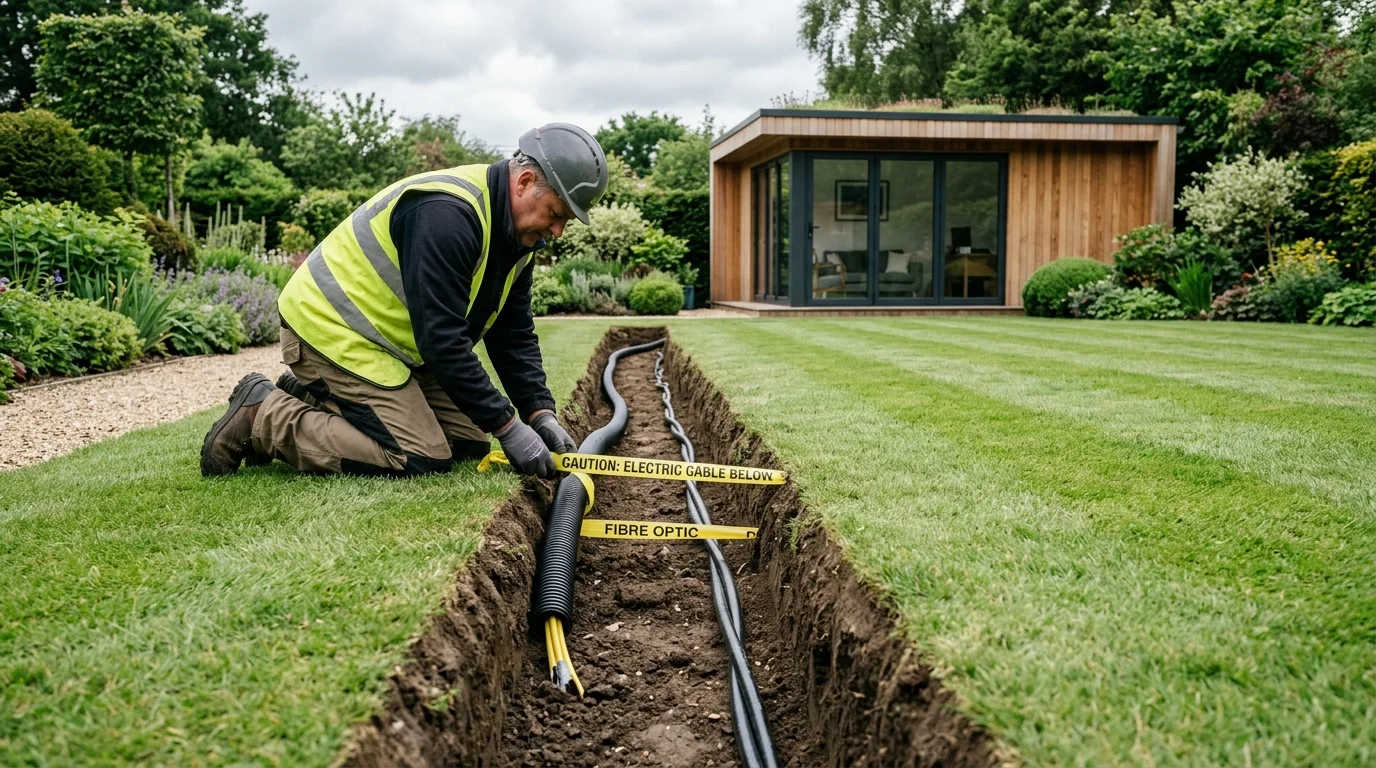
- Steel Wire Armour (SWA) Mechanical Shielding: We deploy heavy-duty exterior SWA Cat6 or Cat6A cable. Beneath the UV-resistant polyethylene outer sheath sits a continuous braid of high-tensile galvanised steel wire that protects the internal copper conductors from sharp garden spades, burrowing rodents, and root expansion.
- Trenching & Warning Tape: The cable is buried in a 450mm deep trench. A layer of pea gravel or sand cushions the cable, topped by bright yellow "Caution: Buried Data Cable Below" electrical marker tape 150mm above the run to warn future gardeners.
- Sub-1ms Latency: Delivering full 1,000Mbps (1Gbps) to 10Gbps throughput with literally 0.0ms of radio jitter, guaranteeing rock-solid 4K video conferencing, instant large file transfers, and zero dropouts.
2. Solution 2: 60GHz Point-to-Point Wireless Bridges (Zero-Dig Solution)
Subterranean SWA Cat6 Trench vs 60GHz Point-to-Point Wireless Beam
- • Buried at 450mm with yellow hazard tape
- • Galvanised steel braid defeats spades & rodents
- • 10Gbps guaranteed transmission with 0.0ms jitter
- • Wall-mounted compact optical dishes
- • Transmits 2Gbps through air across finished patios
- • Sub-2ms ping with automatic 5GHz storm backup
If you have recently invested thousands in luxury porcelain patio paving, manicured lawns, or mature landscaped gardens where digging a 30-metre trench is out of the question, an enterprise 60GHz Wireless Bridge (such as the Ubiquiti Wave Nano or MikroTik Wireless Wire) is the perfect alternative:
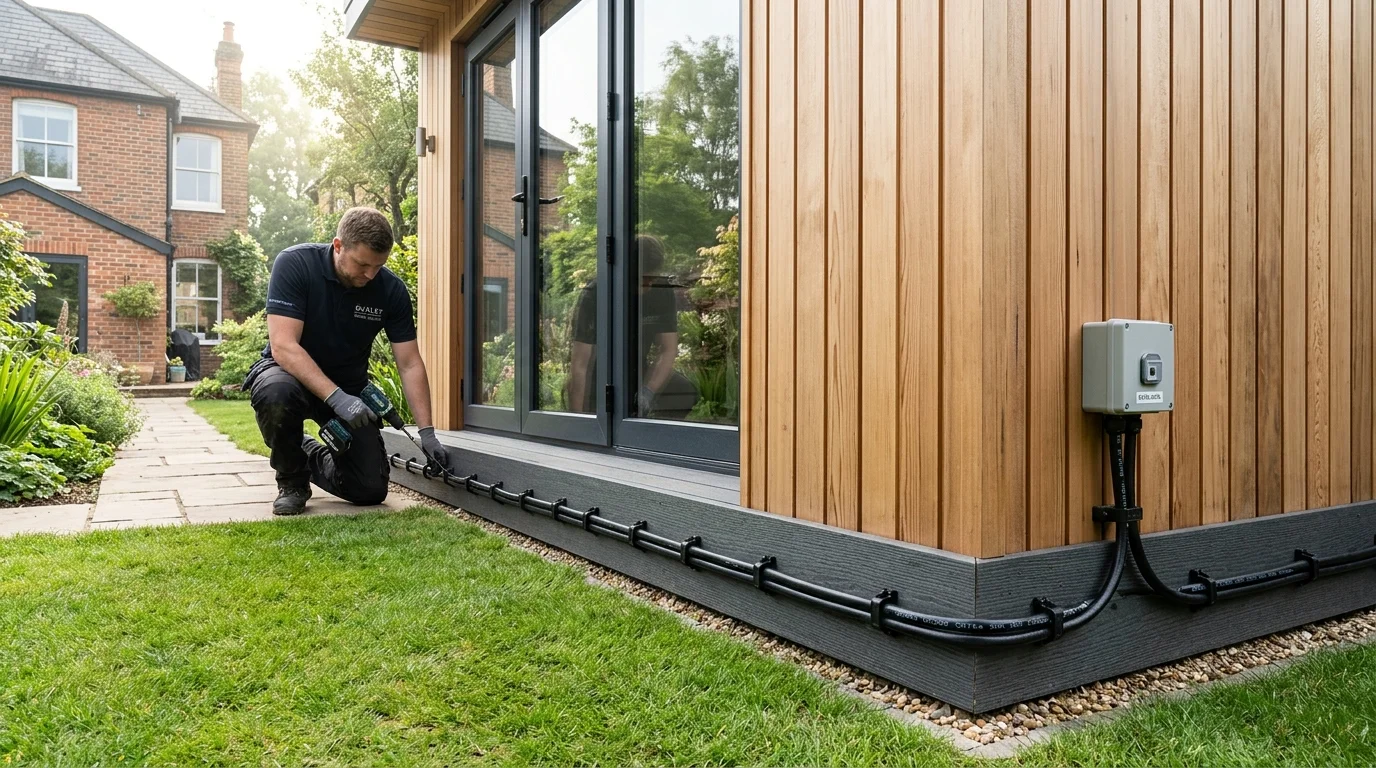
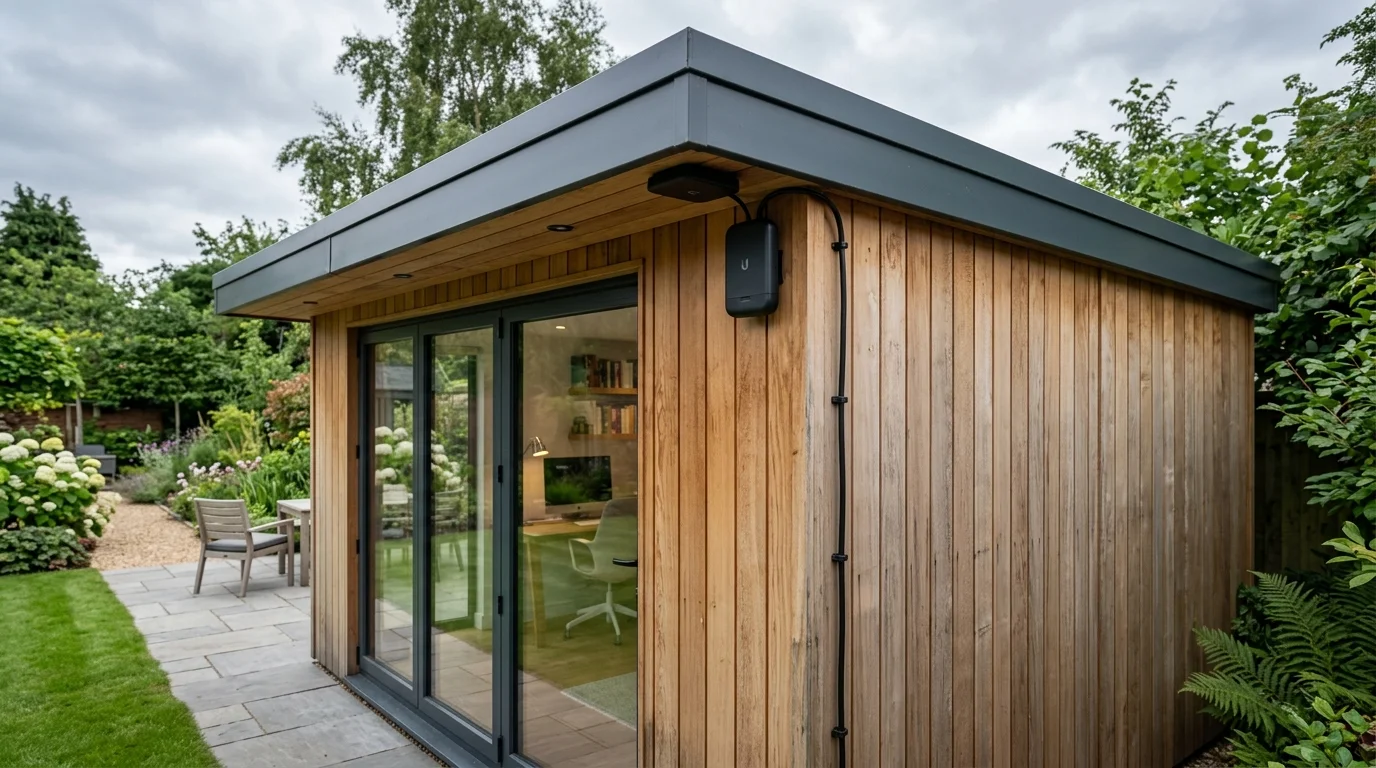
- Discreet Optical Alignment: Two compact radio units (measuring just 15cm across, roughly the size of a tea saucer) are mounted externally: one on the main house wall or soffit, and one on the garden office pod, with clear line-of-sight across the garden.
- Multi-Gigabit Throughput: Operating on the license-free 60GHz V-band with an automatic 5GHz failover backup, the wireless bridge transmits up to 2Gbps of data through the air, acting as an invisible high-speed optical fibre cable across your garden.
- Sub-2ms Ping: Latency is indistinguishable from a physical cable, fully supporting live VoIP calls and real-time remote desktop work.
3. Direct Comparison: SWA Cable vs 60GHz Wireless Bridge
| Criteria | Armoured Cat6 SWA (Hardwired) | 60GHz Wireless Bridge |
|---|---|---|
| Throughput Speed | 1,000 Mbps – 10 Gbps | 1,000 Mbps – 2 Gbps |
| Ping / Latency Impact | < 0.5 ms (Imperceptible) | 1.0 – 2.0 ms (Ultra-low) |
| Garden Disruption | Requires 450mm trench excavation | Zero Ground Disruption (Wall mounted) |
| Line of Sight Dependency | None (Travels underground) | Requires clear visual line of sight |
| Lifespan | 25+ Years | 10 – 15 Years (Outdoor electronics) |
Garden Office WiFi Engineering: Ground Potential Difference & SWA Cabling
BLUF Direct Answer: Connecting a garden room requires either direct-burial Cat6 SWA cable buried at 450mm with single-end earthing, pre-terminated armoured fiber optic to eliminate dangerous PME earth loop currents, or a 60GHz wireless bridge delivering ultra-fast multi-gigabit throughput with zero trench digging.
A frequent mistake in garden pod installations is running unarmoured Cat6 inside a flimsy garden hose or daisy-chaining cheap indoor Wi-Fi repeaters. Foil insulation, acoustic double glazing, and external cedar cladding in modern garden pods attenuate Wi-Fi signals by up to 35dB, rendering domestic indoor mesh nodes useless.
Furthermore, under BS 7671 electrical wiring regulations, if the garden office has an independent earth rod while the main house uses PME (Protective Multiple Earthing), running standard copper data cable can create dangerous circulating neutral-earth currents during electrical network faults. Using pre-terminated duplex singlemode armoured fibre provides 100% galvanic isolation, lightning immunity, and 10Gbps future-proofing.
| Connection Medium | Speed / Latency | Trenching Depth | Electrical Isolation |
|---|---|---|---|
| Armoured Cat6 SWA (Direct Burial) | 1 Gbps • < 0.5ms | 450mm under lawn; 600mm driveways | Requires single-end shield bonding |
| Armoured OS2 Singlemode Fibre | 10 Gbps • < 0.2ms | 350mm - 450mm or existing duct | 100% Galvanic Isolation (Zero earth risk) |
| 60GHz Wireless Bridge (PtP) | 1 - 2 Gbps • 1-2ms | Zero trenching (Rooftop mount) | 100% Isolated (Radio link) |
Garden Office & Outbuilding Broadband Method Decider
Find the optimal transmission medium between your main home and garden studio based on trenching practicality, line of sight, electrical earthing zones, and distance.
How to Get Reliable Gigabit Wi-Fi to a Garden Office
Step-by-step engineering guide for linking outbuilding broadband.
Audit Garden Landscape & Distance
Measure exact cable run length and check if trenching crosses flowerbeds or paved patios.
Check Electrical Earthing Regs (PME vs TT)
Consult electrician to verify whether main house and garden room share electrical earth or require optical isolation.
Dig 450mm Trench & Lay Warning Tape
Excavate a narrow 450mm trench, bed cable in soft sand, and place yellow 'Caution Data Cable' warning tape 150mm above.
Install Dedicated PoE Access Point in Studio
Mount a ceiling Wi-Fi 6/7 access point (e.g. Ubiquiti U6 Pro) to flood the garden office with 800Mbps wireless coverage.
4. Internal Pod Networking: Distributing Wi-Fi Inside the Room
Once your data feed arrives inside the garden room (via cable or wireless receiver), distributing connectivity cleanly requires two compact hardware components:
- Compact Gigabit PoE Switch: A small 5-port Power-over-Ethernet switch powers external devices and provides dedicated hardwired RJ45 ports for your PC dock, printer, and smart TV.
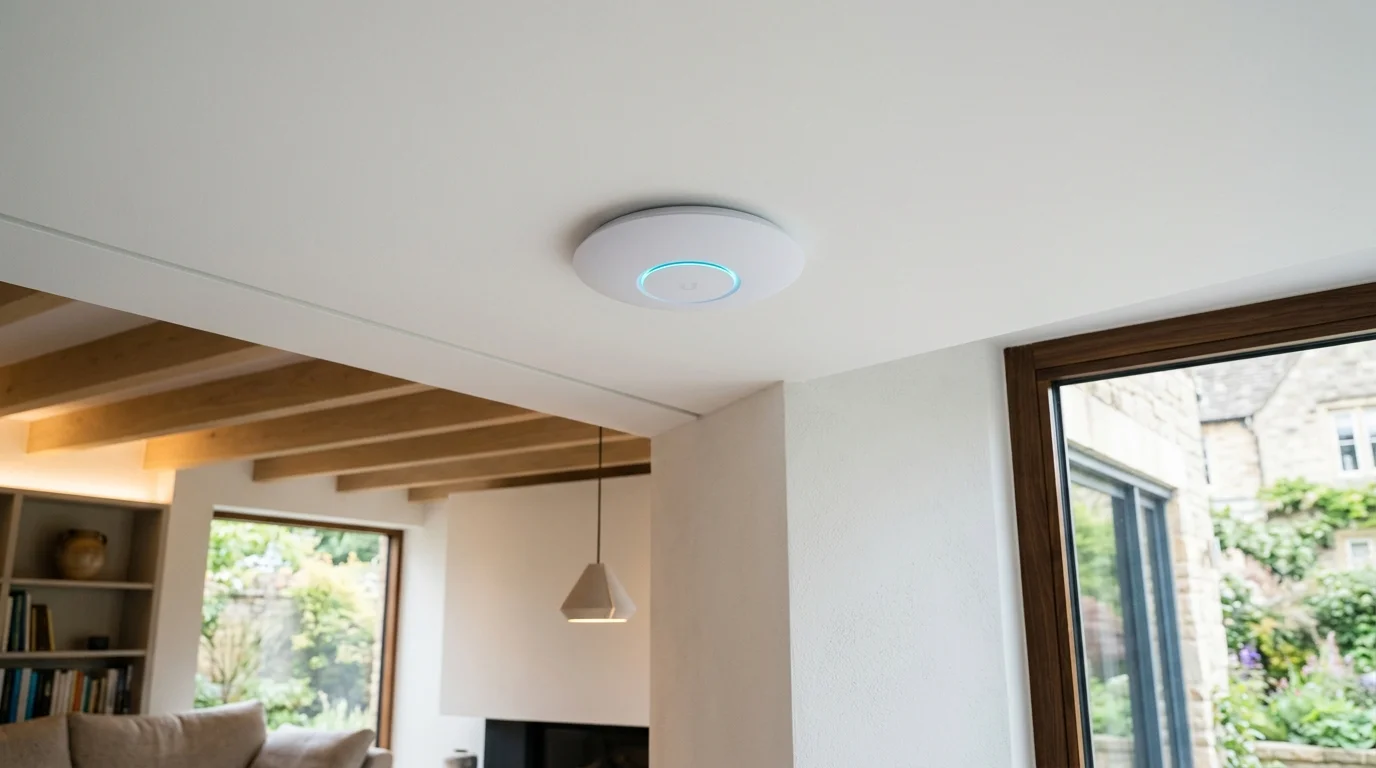
- Ceiling-Mounted Wi-Fi 6 Access Point: An architectural, low-profile access point (such as an Ubiquiti UniFi U6+) mounted flush to the ceiling provides blazing 800Mbps+ Wi-Fi inside the pod and extends coverage to your garden patio.
To understand cable specs, read Cat6 vs Cat6A data cabling and running external Cat6 cables safely. For whole-home coverage, see our mesh Wi-Fi vs access points guide. To book a professional garden survey, explore our professional Wi-Fi installation and structured data cabling services across Yorkshire and Lancashire.
Eliminating Zoom Dropouts & Jitter on Garden Office WiFi
BLUF Direct Answer: Reliable garden office wifi requires low jitter under 3ms. Standard powerline adapters fail across separate RCD consumer units. Hardwired Cat6 SWA or 60GHz wireless links guarantee uninterrupted Microsoft Teams, Zoom, and VoIP calls with zero packet loss.
Many remote workers try to get garden office wifi using domestic powerline adapters. These plug into mains sockets and transmit data over home electrical wiring. In theory, they sound simple. In practice, powerline plugs fail miserably in garden studios.
Your garden office is almost always wired through a secondary consumer unit with dedicated RCD trip switches. High-frequency network data cannot cross through electromagnetic circuit breaker coils cleanly. Heavy electrical loads like electric panel heaters, air conditioning units, and mini-fridges generate massive electrical noise. Every time your studio heater clicks on, your garden office wifi drops out, causing Zoom to freeze.
Wi-Fi range extenders suffer from an identical problem. Modern timber garden rooms are wrapped in foil-backed insulation boards (Kingspan, Celotex) and fitted with acoustic double glazing. This foil creates a metallic Faraday shield. A standard wireless router in your house cannot penetrate this shield. The signal bouncing into your garden pod is too weak to sustain video conferencing.
The permanent cure is mounting a dedicated Wi-Fi 6 ceiling access point inside the garden studio, fed by a solid copper Cat6 SWA cable from the main house. By broadcasting a clean 5GHz and 6GHz wireless network directly inside the room, your laptop connects at 900Mbps with sub-1ms ping. Video calls never stutter. Large cloud file backups finish in seconds.
| Garden Office WiFi Method | Zoom Call Latency (Ping) | Packet Drop Rate | Heater / Appliance Impact |
|---|---|---|---|
| Cat6 SWA + Internal Access Point | < 1 ms | 0.0% (Zero loss) | Immune to electrical noise |
| 60GHz Wireless Bridge (PtP) | 1 - 2 ms | < 0.1% | Immune (Radio transmission) |
| Mains Powerline Adapter Plugs | 25 - 90 ms (Spikes) | 8% - 15% (Heavy loss) | Freezes whenever heater cycles on |
| Indoor Wi-Fi Repeater / Booster | 35 - 75 ms | 12% - 25% | Blocked by foil insulation |