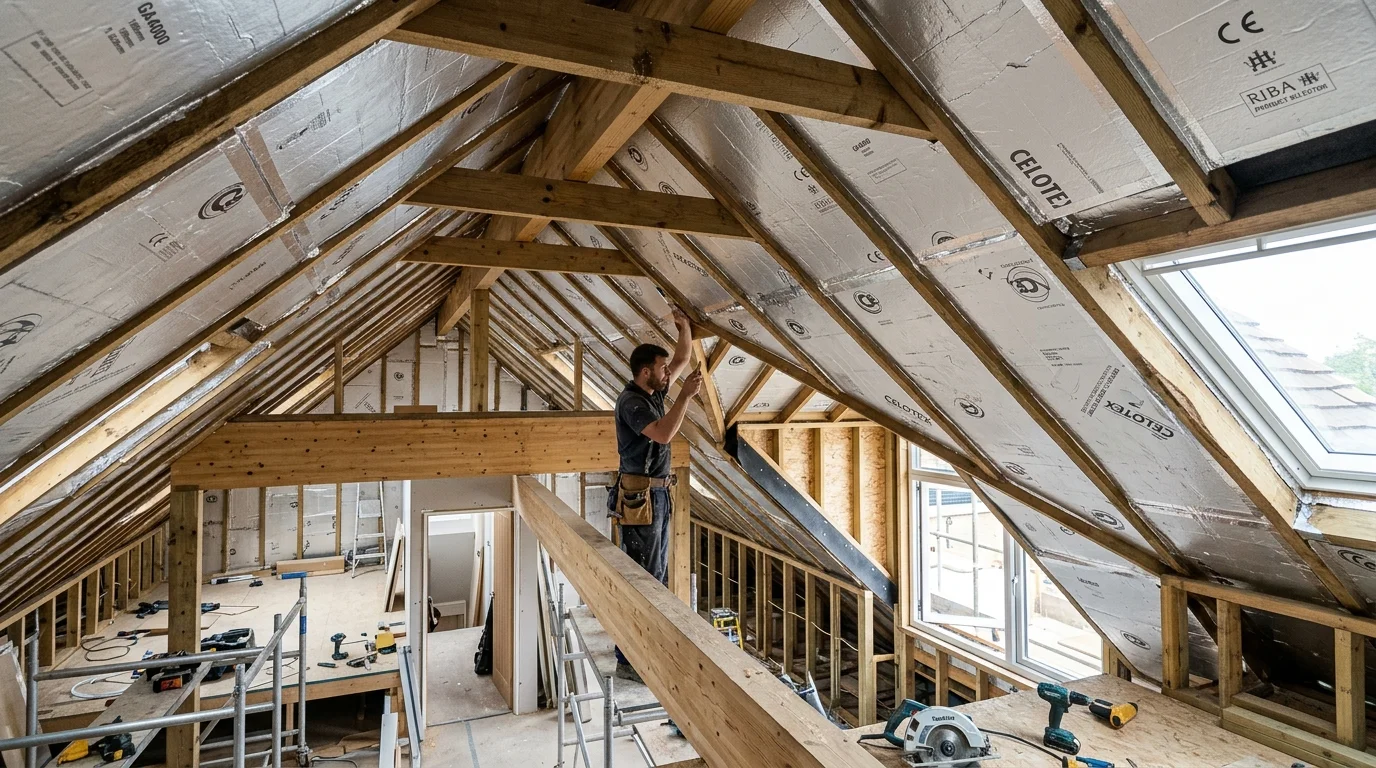

Few things in modern life are more frustrating than paying for a 500Mbps or 1Gbps full-fibre broadband package, only to experience sluggish 25Mbps speeds, endless buffering, and dropped video calls in your upstairs bedrooms or kitchen extension. For UK homeowners living in Victorian stone terraces, 1930s cavity semi-detached properties, or expansive barn conversions, overcoming signal dead zones is a major domestic headache. When seeking whole-home coverage, consumers inevitably face the central networking dilemma: should you buy a plug-in consumer Mesh Wi-Fi system (such as Amazon eero, TP-Link Deco, or Google Nest), or invest in professional Hardwired Access Points (APs) with PoE (such as Ubiquiti UniFi or DrayTek)? In this technical benchmark, lead networking engineer Gary Pearce reveals the empirical performance facts.
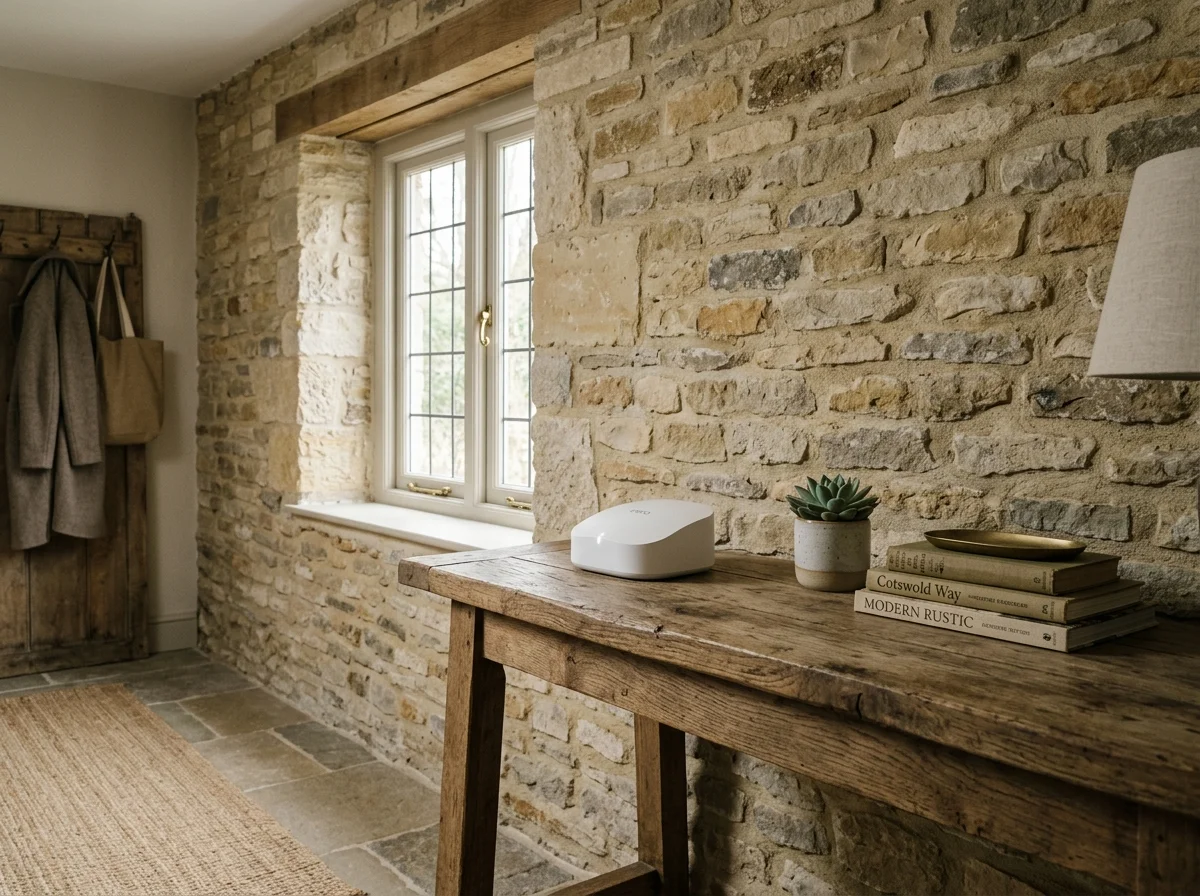
🧱 The 18dB UK Stone Wall Penalty
In typical American timber-frame homes where consumer mesh systems are designed, 5GHz Wi-Fi easily penetrates 100mm plasterboard stud walls. In Britain, however, interior walls are frequently 220mm solid engineering brick, dense thermalite blockwork, or 500mm Yorkshire gritstone. A single solid brick wall attenuates 5GHz radio signals by 12dB to 18dB, cutting throughput by over 75%. Two solid walls effectively kill high-speed Wi-Fi entirely.
1. The Wireless Backhaul Problem: Why Wireless Mesh Degrades
A consumer wireless mesh system consists of a primary router plugged into your broadband modem and several secondary satellite nodes placed around the house. The critical bottleneck is the Wireless Backhaul:
- Shared Radio Bandwidth: In dual-band mesh systems, the secondary node must use the exact same 5GHz radio to receive data from your laptop and transmit that data back to the base router. This immediately halves available speed.
- The Daisy-Chain Hop Penalty: If a signal has to hop from Node 1 to Node 2 and then to Node 3 in a long house or over an attic landing, latency (ping) doubles with every hop and packet jitter spikes, causing video call stuttering on Teams and Zoom.
2. Hardwired Access Points (PoE): Dedicated Gigabit Speed Everywhere
Throughput Attenuation: Consumer Mesh Backhaul vs Hardwired Copper Backbone
Secondary nodes share radio airwaves to receive and re-transmit data. Throughput halves with every hop, and speeds drop to 20Mbps through thick UK masonry.
Dedicated solid copper Cat6 carries data directly to the switch at 1Gbps. 100% of wireless radio spectrum is reserved for your phones and laptops.
Commercial networking takes an uncompromising approach: Hardwired Access Points with Power-over-Ethernet (PoE):
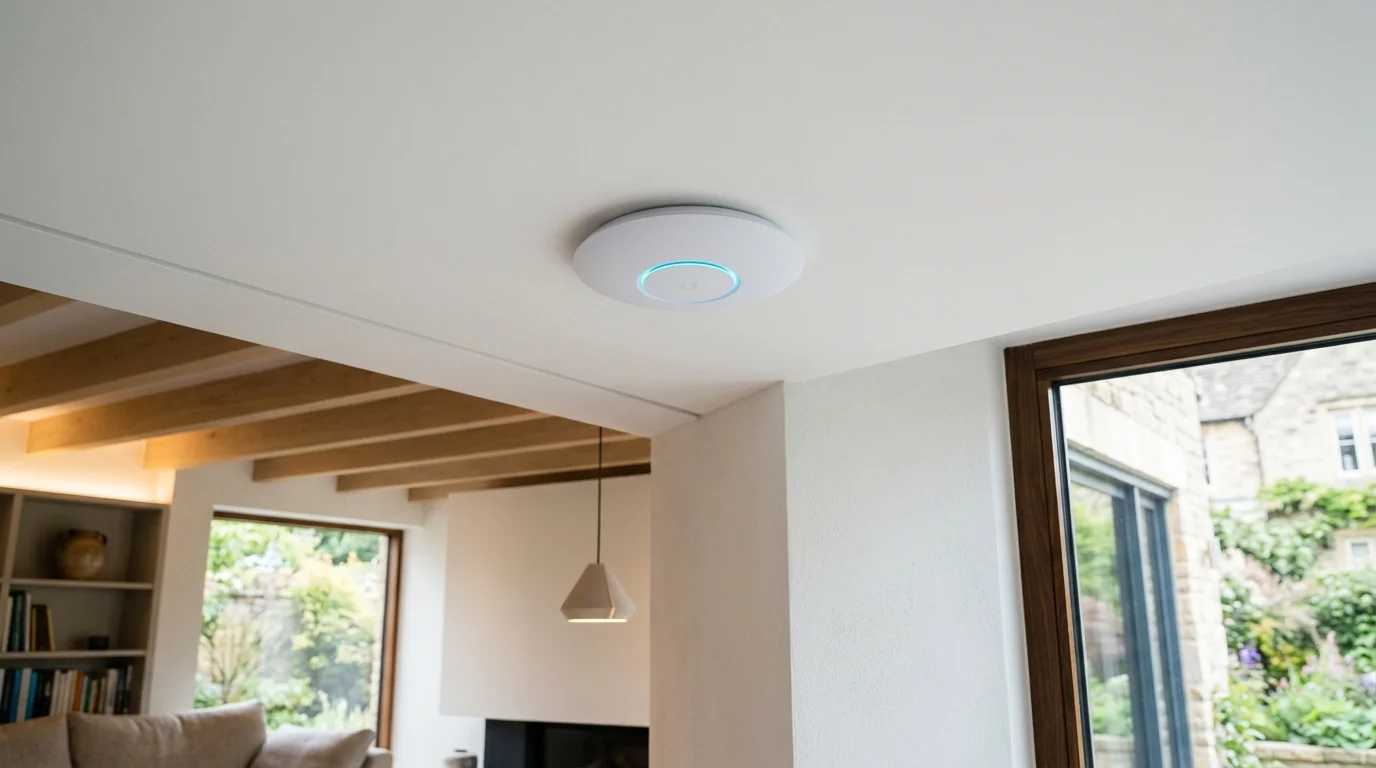
- Physical Copper Backbone: Solid copper Cat6 Ethernet cables are routed through lofts, floor voids, or external conduits, connecting each ceiling-mounted Access Point directly back to a central Gigabit PoE switch.
- Zero Airwave Sharing: 100% of the wireless radio spectrum is reserved exclusively for communicating with your smartphones, laptops, and tablets. The data travels back to the router over physical copper at 1,000Mbps, completely bypassing thick stone walls.
- Seamless 802.11k/v/r Roaming: As you walk from room to room, the centralized controller hands off your device from one AP to the next in under 10 milliseconds without a single dropped packet.
3. Real-World Field Benchmark: 20-Metre Distance Through 2 Brick Walls
| Networking System | Broadband Input | Speed at 20m (2 Solid Walls) | Ping / Latency | Zoom / Teams Stability |
|---|---|---|---|---|
| Standard ISP Router Alone | 500 Mbps | 12 – 28 Mbps (Dead Zone) | 65 – 120 ms | Frequent dropouts / buffering |
| Wireless Mesh (3x Deco / eero) | 500 Mbps | 85 – 140 Mbps | 28 – 45 ms | Occasional jitter on calls |
| Hardwired PoE Access Points (UniFi) | 500 Mbps | 480 – 500 Mbps (Full Speed) | 4 – 8 ms (Ultra-Fast) | Flawless 100% stability |
Backhaul Throughput: 5GHz Wireless Halving vs Gigabit Solid Copper
BLUF Direct Answer: Wireless mesh nodes sacrifice 50% of their radio bandwidth to communicate back to the main router over airwaves, whereas hardwired Power-over-Ethernet (PoE) access points utilize dedicated 1,000Mbps solid copper cables, delivering zero packet loss and full ultra-fast multi-gigabit throughput across multi-story homes.
Consumer wireless mesh systems (like Google Nest Wi-Fi or Amazon eero) work well in small, open-plan modern timber-framed homes. However, in traditional British properties with thick brick or stone interior dividing walls, the wireless signal between the mesh nodes drops substantially before it even reaches your laptop.
Because dual-band mesh nodes must use the same 5GHz radio to listen to client devices and relay data back to the base, available bandwidth is cut in half at every wireless hop. Enterprise-grade hardwired ceiling access points (such as Ubiquiti UniFi or TP-Link Omada) connect back to a central PoE switch over solid Cat6 copper, leaving 100% of their Wi-Fi 6/7 radios dedicated to delivering uncompromised 900Mbps+ speeds to phones and laptops.
| Performance Criterion | Wireless Mesh (2-3 Nodes) | Hardwired PoE Access Points |
|---|---|---|
| Backhaul Throughput | 150 - 300 Mbps (Over-the-air loss) | 1,000 Mbps Full Duplex (Solid Cat6) |
| Latency & Jitter Under Load | 15ms - 45ms (Spikes during streaming) | < 1ms (Rock-solid for gaming/calls) |
| Wall Penetration in Brick Homes | Poor (Attenuates through solid walls) | Flawless (Cable bypasses walls internally) |
| Power Delivery Mechanism | Requires 230V socket per node | PoE 48V (Zero mains sockets needed) |
Garden Office & Outbuilding Broadband Method Decider
Find the optimal transmission medium between your main home and garden studio based on trenching practicality, line of sight, electrical earthing zones, and distance.
How to Transition from Wireless Mesh to Hardwired PoE Wi-Fi
Upgrade path for high-performance whole-home networking.
Identify Central Wiring Hub Location
Select an under-stairs cupboard, utility room, or loft space to house a PoE network switch and router.
Run Solid Copper Cat6 to Ceiling Locations
Pull data cables through floor voids and stud walls to ceiling positions on Ground Floor and First Floor landing.
Mount Discreet Slimline Access Points
Fasten ceiling mount plates and click UniFi U6 or Omada EAP access points into place.
Configure Seamless 802.11k/v/r Roaming
Set identical SSIDs and encryption keys across all APs with fast roaming enabled for zero-drop phone handoffs.
4. The Hybrid Compromise: Mesh with Ethernet Backhaul
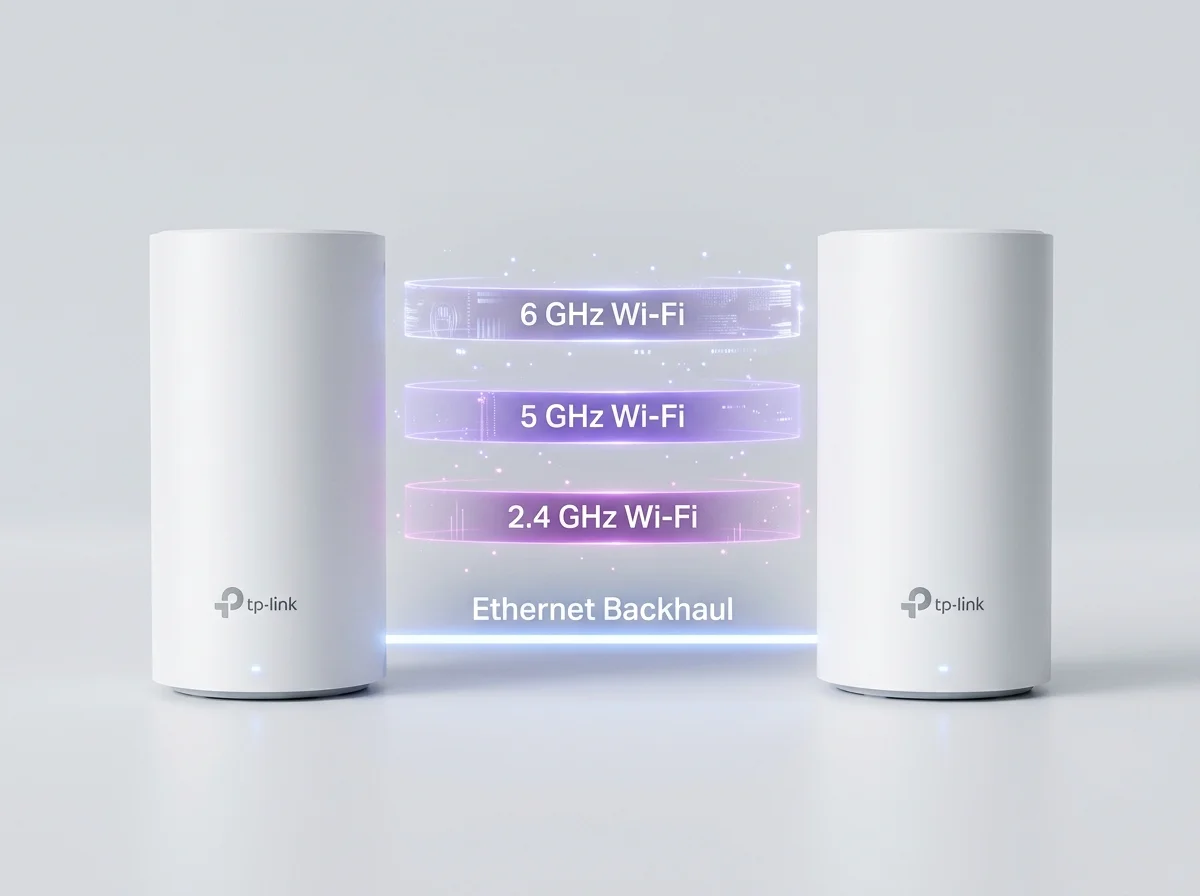
If you already own a premium mesh system (like eero Pro 6E or TP-Link Deco XE75), you do not need to replace it. Our engineers can install discrete Cat6 cabling from your main router to each satellite mesh node, enabling Ethernet Backhaul in the software settings:
This instantly transforms your consumer mesh units into hardwired access points, bypassing the wireless airwave penalty and delivering full line speeds to every corner of your property.
For outbuilding connectivity, see our garden office Wi-Fi guide. Learn about cabling standards in Cat6 vs Cat6A data cabling, or explore our professional home Wi-Fi installation services across Yorkshire and Lancashire.