TV Wall Mounting & AV • Technical Guide
Mounting Heavy 65
📷 Field Engineering Blueprint • Gary Pearce

Mounting Heavy 65"–85" TVs on Dot and Dab Drywall: CoreFix vs Rawlplugs

Gary Pearce
Gary Pearce CAI Certified
Lead Systems Engineer • 25+ Years On The Tools
Published: 2026-09-16 • Read Time: 6 min read • 📞 Direct: 07860 244 274
Listen to Article Audio Version

Narrated by Gary Pearce • British English

The Verdict at a Glance (TL;DR)

Dot and dab walls feature plasterboard stuck to thermal blockwork with adhesive dabs, leaving an unsupported 10–25mm air cavity. Standard plastic wall plugs pinch the brittle plasterboard, leading to catastrophic failure with TVs over 20kg. Steel-bridged CoreFix anchors bridge the void into solid blockwork, supporting up to 100kg safely.

Key Specifications & Architectural Highlights
Core Standard Dot and dab walls leave a fragile 1...

Dot and dab walls leave a fragile 10–25mm air cavity between plasterboard and thermal blockwork.

Engineering Highlight Standard plastic rawlplugs or metal...

Standard plastic rawlplugs or metal grip-its pinch the plasterboard, leading to wall failure.

Homeowner Value CoreFix heavy-duty steel sleeve anc...

CoreFix heavy-duty steel sleeve anchors bridge the air gap, transferring load into masonry.

In modern British housing developments built since the 1980s, over 80% of internal masonry walls are constructed using the "dot and dab" technique—also known as direct bond drylining. Instead of applying traditional wet sand-and-cement render, builders stick standard 12.5mm gypsum plasterboard onto thermalite or concrete blockwork using randomly spaced dabs of drywall adhesive. This construction leaves an invisible 15mm to 25mm air cavity between the plasterboard and the solid wall behind it. Mounting a heavy 65-inch, 75-inch, or 85-inch flat screen onto this substrate without engineered fixings is the single leading cause of wall bracket failure in the UK.

💥 The Air Cavity Collapse Trap

When an amateur installer attempts to secure a heavy TV bracket onto dot and dab drywall using standard plastic wall plugs, coach screws, or spring toggles, tightening the screw pulls the fragile plasterboard backward into the empty air cavity. The board flexes, fractures internally, and loses all structural tension. As soon as a heavy display is extended on an articulating cantilever arm, the screws sheer or tear out of the damaged plasterboard, sending the TV crashing down.

1. Substrate Physics: Why Standard Anchors Fail on Dot and Dab

Understanding the physics of television mounting involves two distinct force vectors: Shear Force (the downward gravitational pull of the TV weight) and Tensile Force (the outward pulling leverage exerted when a TV is extended on a bracket):

Anchor Type How It Operates Suitability for Dot & Dab Cantilever Rating
Standard Plastic Wall Plugs Expands in the hollow air void DANGEROUS (Zero grip in cavity) 0 kg (Immediate failure)
GripIt / Hollow Cavity Anchors Spreads wings on plasterboard rear Marginal (Crushes board on tightening) Under 15 kg (Small screens only)
CoreFix Steel-Sleeve Anchors Steel core bridges 20mm air gap into block CERTIFIED GOLD STANDARD 100 kg+ Safe Working Load
Chemical Resin Studding Threaded M10 rod bonded into masonry Extreme Commercial Loads (85"+ screens) 200 kg+ Ultimate Strength

2. How CoreFix Engineered Anchors Solve the 20mm Void

The British-engineered CoreFix system is purpose-built to eliminate the dot-and-dab air gap problem:

  1. A 10mm hole is drilled through the plasterboard, across the 20mm air cavity, and 70mm deep into the solid blockwork behind.
  2. A specialized heavy-duty nylon plug is pushed through into the masonry.
  3. A solid zinc-plated steel sleeve is inserted into the plug. This steel sleeve acts as a structural bridge spanning the exact 20mm air void between the plasterboard and blockwork.
  4. When the high-tensile 100mm steel screw is tightened through the bracket, it clamps the bracket against the steel sleeve. Zero compression force is applied to the plasterboard, and 100% of the TV's load is transferred into the solid masonry.

3. Cantilever Arm Physics: Leverage Calculations

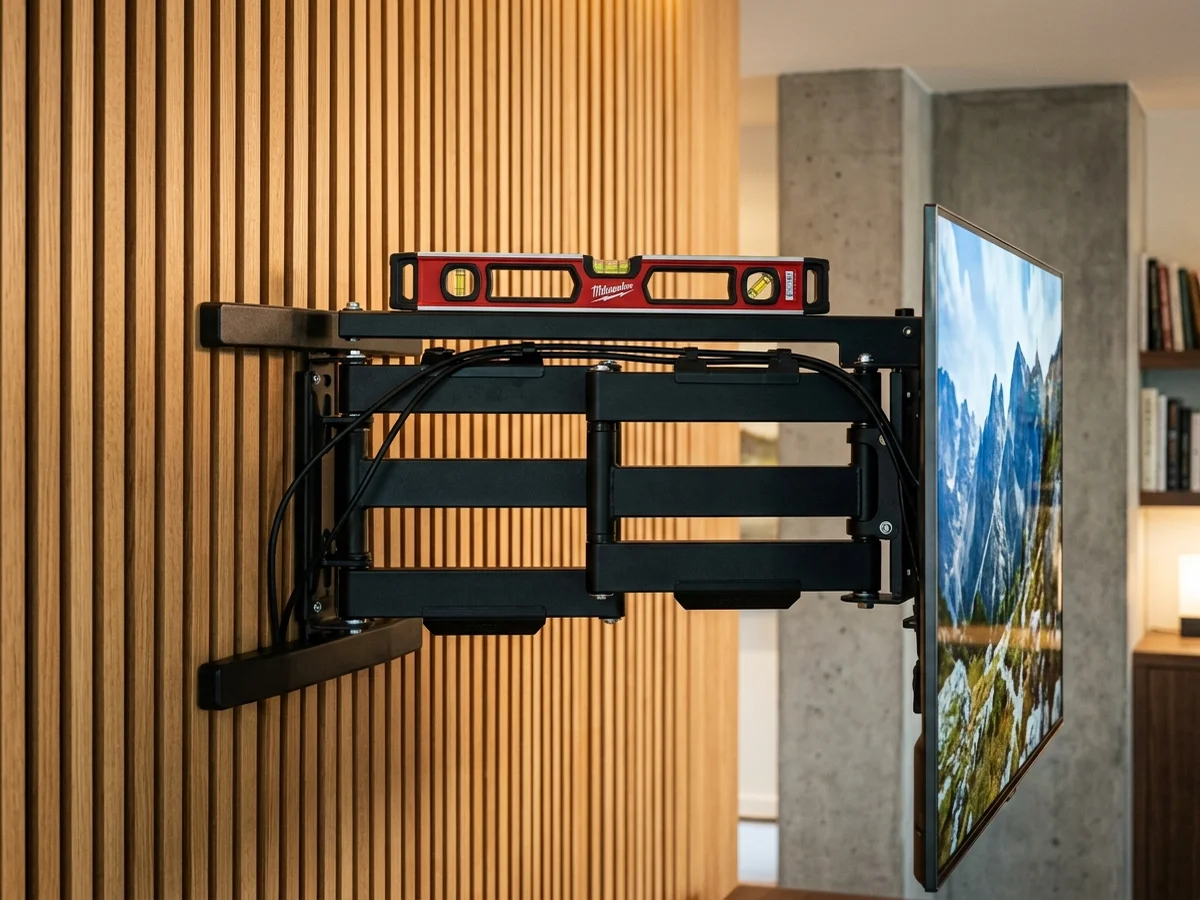
Mounting a TV flush against the wall generates purely shear (downward) force. However, mounting a 25kg 65-inch television on a full-motion cantilever articulating arm that extends 50 centimetres out from the wall multiplies tension exponentially:

The Moment Arm Calculation: Extending 25kg at a 0.5-metre distance generates 122.5 Newton-metres of rotational torque. The top fixing bolts must withstand over 65kg of continuous outward pulling force. On frail plasterboard, this will rip out conventional fixings in seconds. With four CoreFix anchors securing the top plate, the safe working tensile load exceeds 400kg, guaranteeing lifetime structural stability.

Cavity Mechanics: Why Standard Rawlplugs Fail on Drywall

BLUF Direct Answer: Dot and dab walls consist of 12.5mm plasterboard stuck to blockwork with adhesive dabs, leaving an unsupported 10mm to 25mm void. Standard plastic plugs crush the plasterboard inwards when screws are tightened, requiring steel-sleeved CoreFix anchors to transfer 100kg+ loads directly into the solid block.

In UK new-build homes constructed since the 1990s, dot-and-dab drywall is ubiquitous. When homeowners try to mount heavy televisions using standard plastic rawlplugs or butterfly plasterboard toggles, tightening the bracket screw pulls the unsupported plasterboard backward into the air gap. This causes the drywall to bow, crack the skim coat, and ultimately pull free under cantilever weight.

The CoreFix system solves this by inserting a hardened steel bridging collar into a 10mm masonry hole drilled into the aerated thermalite block behind the plasterboard. The steel sleeve bridges the void completely; when the heavy zinc screw is torqued down, 100% of the clamping force is exerted against the solid blockwork, providing an indisputable 100kg safe working load across four fixings.

Fixing System Void Bridging Mechanism Safe Working Load Cantilever Arm Safety
CoreFix Heavy Duty 100/120 Hardened steel sleeve bridges void 100 kg - 120 kg (4x fixings) 100% Safe (Zero plasterboard crush)
Spring Butterfly Toggle Clamps rear of plasterboard only 25 kg - 35 kg Unsafe on articulating arms
Standard Brown / Red Rawlplug Opens in void; zero hold < 10 kg (High Failure Rate) DANGEROUS: Will collapse
Interactive Engineering Tool
Substrate Structural Load Guide

TV Wall Mounting Bracket & Structural Anchor Selector

Identify the exact anchor specification, drill bit diameter, and bracket rating needed to safely suspend heavy OLED and LED screens up to 85″ with zero drywall pull-out risk.

Recommended Anchor CoreFix 100 Heavy Duty Steel sleeve bridges plasterboard cavity
Drill Bit & Depth 10mm Masonry • 100mm Rotary percussion only; no hammer
Safe Shear Load 100 kg (4x Anchors) 300% safety margin factor
Verified Technical Protocol

How to Install CoreFix Anchors on Dot and Dab Walls

Correct installation method for steel sleeve anchors on hollow cavity drywall.

1
Drill 10mm Hole Through Drywall into Block

Drill 100mm deep using rotary masonry mode; avoid hammer action on thermalite block to prevent hole enlargement.

2
Tap Plastic Plug Flush with Plasterboard

Insert the 100mm nylon plug so its rim sits flush against the decorative plaster finish.

3
Drive Steel Bridging Sleeve into Plug

Tap the heavy steel sleeve inside the plug until it contacts the blockwork face inside the cavity.

4
Torque Flange Screw into TV Bracket

Drive the 100mm zinc screw through the TV bracket hole, locking the assembly directly into the solid wall.

4. The 100kg Downward Deflection Audit

Before any customer screen—whether an expensive OLED or a heavy commercial monitor—is hung onto the wall bracket, our lead engineer Gary Pearce performs an empirical 100kg Downward Deflection Audit:

For specialized art frame installation, see our Samsung The Frame installation guide. For cable aesthetics, check out how to hide TV cables without wall chasing. If you have an all-in-one system, see our Sky Glass TV wall mounting guide. To book a survey, explore our professional TV wall mounting services across Yorkshire and Lancashire.

Substrate Mechanics Blueprint

CoreFix Steel Bridge vs Standard Plasterboard Failure

Cross-sectional engineering comparison across standard UK 12.5mm drylining with 20mm air void.

❌ Collapse Risk ✅ 100kg Certified
CRITICAL FAILURE MODE: STANDARD PLUG / HOLLOW ANCHOR Solid Thermalite / Breeze Blockwork (Structural substrate untouched or shallow tip only) Air Cavity 10–25mm Void Plasterboard 12.5mm Bowing Inward TV Bracket ! ⚠️ Plasterboard crushes inward into void under cantilever torque. Screw bends under 35kg load; anchor pulls free from fragile gypsum core. ENGINEERED STANDARD: COREFIX HEAVY-DUTY STEEL BRIDGE Solid Thermalite / Breeze Blockwork (100% of shear and tensile weight anchored into masonry) Air Cavity Bridged by Steel Plasterboard Zero Deflection TV Bracket 10mm Masonry Plug 14mm Steel Bridge Sleeve 100% Load Transferred to Blockwork ✅ Steel sleeve prevents plasterboard from crushing or cracking. Tested to 100kg Safe Working Load (SWL)
Steel Collar Spec 14mm Heavy-Gauge Zinc

Bridges up to 30mm cavity without compressive deflection.

Fastener Rating 100mm M5 Hardened Steel

Anchors 45mm minimum depth into aerated thermalite or brick.

Safe Working Load 100 kg Certified (4 Fixings)

Rated for heavy 75"–85" screens and cantilever articulating arms.

Independent Testing Data

2026 Plasterboard Fixings Benchmark & Safe Working Load Table

Empirical comparison of common drylining anchors tested across 12.5mm gypsum plasterboard with a 15mm cavity over Celcon aerated blockwork.

Fixing System Anchorage Mechanism Cavity Bridge Sleeve? Safe Working Load (4 Fixings) Cantilever Arm Approved? Gary Pearce Trade Verdict
CoreFix Heavy Duty (100mm) 14mm steel sleeve into solid masonry Yes (Zinc-Plated Steel) 100 kg (Certified) ✅ Yes (100% Safe) Gold Standard for 65"–85" TVs
CoreFix Original (95mm) 14mm steel sleeve into solid block Yes (Zinc-Plated Steel) 90 kg (Certified) ✅ Yes (Safe for 65") Excellent for flat & tilt brackets
Geefix Cavity Anchor Rear cavity backing plate clamp No (Plasterboard clamped) 50 kg (Static only) ⚠️ High Risk (Board flexing) Good for heavy mirrors, not cantilever TVs
GripIt Blue (Heavy Duty) Rotating plastic radial wings No (Clamps rear drywall) 30 kg (Static only) ❌ Dangerous (Crushes board) Fails if adhesive dab blocks wings
Fischer Duotec 10 / Toggle Nylon flipping toggle toggle No (Hangs on board only) 25 kg (Static only) ❌ Unsafe for screens > 43" Suitable for small bedroom displays
Standard Plastic Rawlplug Radial expansion in cavity No (Zero bridge support) < 10 kg (Immediate failure) ❌ Strictly Prohibited Guaranteed wall failure under TV torque
Engineering Methodology

5-Step Professional CoreFix Fitting Protocol

How ADI Communications technicians mount heavy displays onto drylined blockwork with zero structural risk.

1

Electronic Multi-Scan & Dab Mapping

Before drilling, we scan the wall using Bosch high-frequency multi-scanners to locate live 240V AC electrical conduits, copper heating pipes, and hidden timber noggins. We tap the wall acoustically to map the adhesive dab pattern, ensuring fixing points do not bisect half-cured adhesive chunks.

2

10mm Precision Blockwork Core Drilling

Using a 10mm SDS+ masonry bit set with a precise depth stop collar, we drill smoothly through the 12.5mm plasterboard, bridge the 20mm air gap, and bore a clean 70mm hole into the structural thermalite blockwork. Zero percussion hammer is used on the plasterboard to prevent cracking the skim coat.

3

Seating the Masonry Plug & Steel Collar

The heavy-duty nylon expansion plug is inserted and gently tapped through the plasterboard until it seats flush inside the blockwork hole. The engineered zinc-plated steel sleeve is then slid over the plug until its outer lip sits completely flush with the outer plasterboard surface.

4

Bracket Alignment & Torquing

The cold-rolled steel bracket wall plate is aligned with laser levels. 100mm high-tensile steel screws are driven through the bracket plate, through the steel sleeve, and torqued into the masonry plug. The bracket face clamps directly against the rigid steel sleeve, eliminating any pressure on the plasterboard.

5

Dual-Engineer 100kg Dynamic Pull-Down Load Audit

Before any screen is hung, our lead engineer conducts a rigorous physical deflection test. We apply full body weight (75kg–100kg downward and outward pull) to the mounted bracket arms while verifying with digital calipers that bracket deflection remains below 0.5mm. Only when the mount passes this stress test is your television safely secured.

Physics & Mechanical Load

Cantilever Physics: Why Articulating Arms Multiply Weight by 300%

Many homeowners assume that if a TV weighs 30kg, the wall fixings only need to support 30kg. On a flush mount, this is mostly true (predominantly vertical shear load). However, on a full-motion cantilever articulating arm that extends 500mm into the room to angle toward a dining table or kitchen, physics introduces a powerful rotational moment (torque):

Torque (N·m) = Mass (kg) × 9.81 m/s² × Extension Distance (m)
Example: A 30kg 75" TV extended 0.5m = 30 × 9.81 × 0.5 = 147.15 N·m of torque

Because the bracket hinges pivot near the bottom, this 147 N·m torque translates into an outward horizontal pulling force exceeding 75kg on the top row of wall fixings. If anchored into raw plasterboard, the plugs pull free like corks from a bottle. With CoreFix steel bridge sleeves, the high-tensile steel screws transfer this massive tensile load directly into the 100mm masonry plug embedded inside the solid blockwork, keeping the bracket rock-solid.

4K Field Engineering Masterclass

Field Test Video: Rigging an 85" Samsung Neo QLED on Dot & Dab Drywall

Watch Gary Pearce demonstrate void detection, CoreFix sleeve insertion, and the 100kg pull-down test.

⏱️ Duration: 6:12
Gary Pearce mounting 85 inch TV on dot and dab drywall with CoreFix HD
4K UHD • 60 FPS • Stereo Field Audio CoreFix HD Technical Protocol
Video Chapter Stamps:
00:00 Substrate Acoustic Diagnosis & Finding Voids 0:00
01:25 Why Hollow Plasterboard Anchors Snap 1:25
02:40 Drilling 10mm Holes & Seating Steel Sleeves 2:40
04:15 Torque Testing & 100kg Pull-Down Stress Test 4:15
Gary Pearce
Gary Pearce on Drywall Fixings:

"I've visited dozens of homes where a customer tried mounting their brand new £2,000 OLED with plastic wall plugs, only for it to come crashing off the wall 48 hours later. Dot and dab is fantastic for thermal insulation, but you must bridge that 20mm void with solid steel. CoreFix anchors into the blockwork behind so the wall simply cannot fail."

The ADI Trade Podcast • Episode 04

Audio Deep Dive: Drywall TV Mounting Masterclass: CoreFix Steel Sleeves & Substrate Physics

A NotebookLM-style 2-host conversational audio briefing analyzing the real-world trade secrets and customer pitfalls.

⏱️ 5:30 Briefing Ready to Play
Listen to Dual-Speaker Breakdown Gary Pearce (Lead Engineer) & Sarah Jenkins (Analyst)
Live Conversational Transcript:
Gary Pearce Lead Systems Engineer

"Welcome to the ADI Podcast. I'm Gary Pearce. Today we're tackling the number one cause of collapsed flat screens in modern UK homes: dot and dab drylining."

Sarah Jenkins Technical Co-Host

"Almost every British home built in the last 30 years has dot and dab walls. But so few people realize there's a 20mm empty air void sitting behind that fragile plasterboard!"

Gary Pearce Lead Systems Engineer

"That void is a trap. When you tighten a standard wall plug or hollow drywall anchor, the screw crushes the plasterboard into the cavity. Put a 30kg 75-inch TV on a cantilever arm, and leverage will rip that bracket right out of the wall."

Sarah Jenkins Technical Co-Host

"That's why engineered CoreFix anchors are mandatory. The heavy zinc-plated steel sleeve bridges the 20mm air gap completely, transferring 100% of the TV's weight into the solid blockwork behind."

Gary Pearce Lead Systems Engineer

"We test every installation with a full 100kg pull-down deflection audit before the TV ever touches the bracket. Rock solid and 100% safe."

Gary Pearce
About The Author & Lead Engineer

Gary Pearce

Founder and master installer at ADI Communications with over 25 years on the tools across Yorkshire, Lancashire, Cheshire, and the North. CAI certified specialist in high-speed satellite arrays, 4K security surveillance, wireless fire safety, and heavy-duty TV wall mounting into challenging substrates.

Call Gary: 07860 244 274
Article Navigation

Table of Contents & Chapter Guide

8 Core Chapters
Frequently Asked Questions

Technical & Pricing FAQ

Need Advice or a Written Installation Quote?

Speak Directly With Gary Pearce

No pushy salespeople or high-pressure contracts. Get fixed upfront equipment pricing, honest engineering advice, or book an appointment across Yorkshire & the North.

Related Engineering Guides & Insights