TV Aerial Signal Problems Explained: Diagnose No Signal, Pixelation, Coax Faults & Amplifier Problems

TV Aerial & Signal Fault Finder
Enter your UK postcode to check if your nearest Freeview transmitter or relay has planned engineering works, see which compass direction your roof aerial should point, and check if local wind gusts or high atmospheric pressure are affecting reception today.
Likely Causes and Safe Next Steps
These are possibilities based on your answers, not a confirmed diagnosis. Several physical causes can produce the same symptoms on a digital receiver.
Only check accessible indoor connections. Do not climb onto a roof, work near overhead power lines, open mains-powered electrical equipment, or handle outdoor wiring in unsafe conditions.
1. Common TV Aerial & Coax Faults: Symptom vs Root Cause Matrix
Unlike old analogue television — which gradually faded into “snowy” static as a cable deteriorated — digital Freeview (DVB-T and DVB-T2) operates on a strict digital cliff effect. Your television picture will look crystal clear right up until the Modulation Error Ratio (MER) drops below roughly 20 dB, at which point the picture violently fractures into mosaic blocks, squeaks, or drops to a black “No Signal” banner.
Before paying for parts you do not need or wiping your channel list with repeated retunes, compare your symptoms in the trade diagnostic table below:
| Observed Symptom | Scope | Most Likely Physical Cause | Safe First Check / Trade Fix |
|---|---|---|---|
| “No Signal” / Black Screen | 1 TV Only | Wrong TV input selected, pulled-out coaxial fly-lead, or detached wire inside the room's Belling-Lee wall socket. | Check TV is on DTV / Freeview source; swap the fly-lead; book socket repair (From £55+VAT). |
| “No Signal” / Black Screen | All TVs | Switched-off 12V masthead power supply unit (PSU), dead loft distribution amplifier, or snapped main aerial coax. | Check for an unplugged 12V power box behind any TV or in the loft before calling an engineer. |
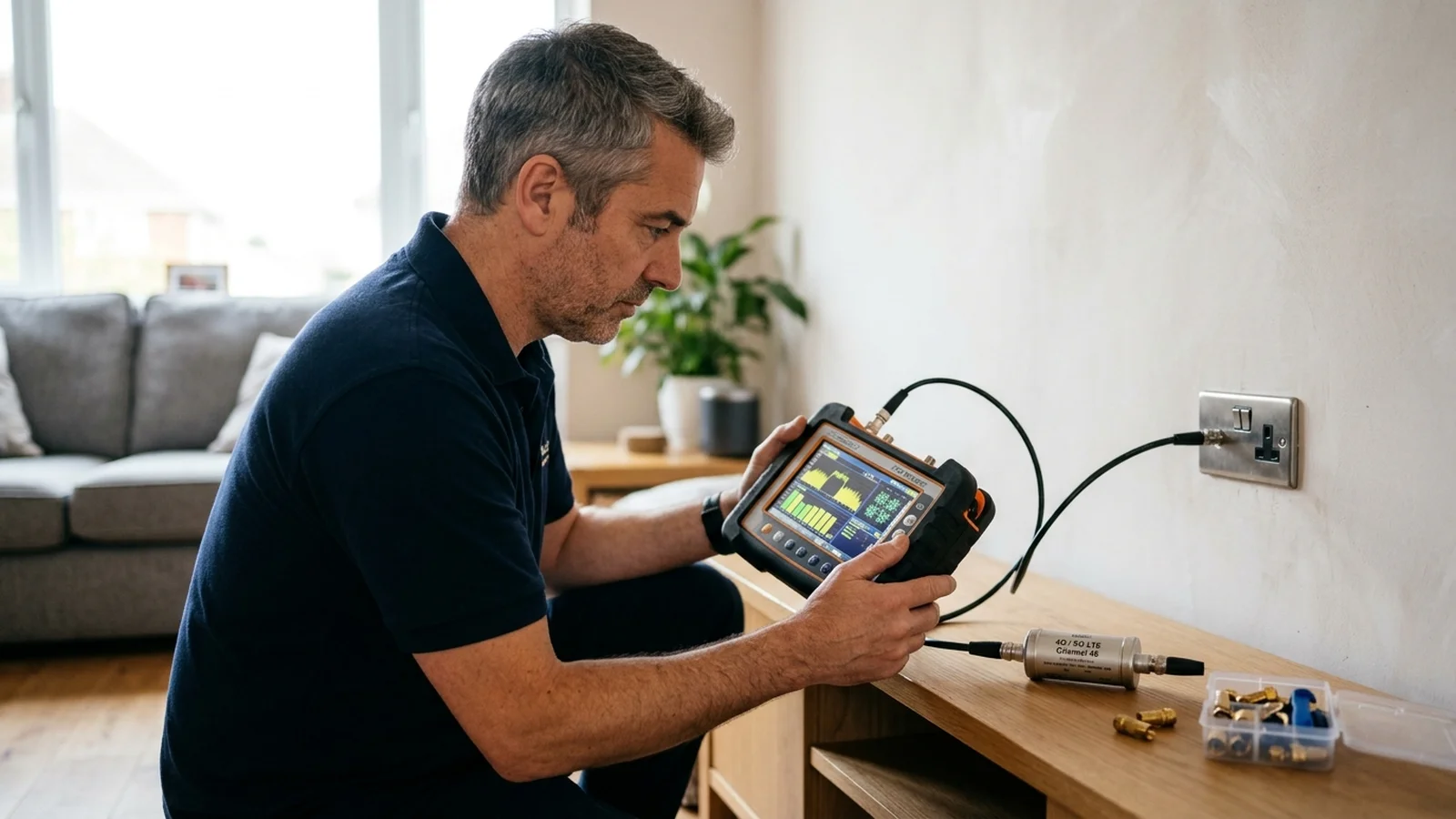
| Freezing, Mosaic Blocks & Audio Squeaks | 1 or All TVs | Marginal signal level, 4G/5G mobile mast breakthrough (Ch48), or amplifier overload saturating the tuner. | Do not blindly add a booster. Test signal MER and fit a Ch48 LTE filter if mobile noise is present. |
| Specific Channels Missing (e.g. BBC or ITV/C4) | 1 or All TVs | Kinked coaxial cable creating a frequency notch (standing wave), out-of-band old grouped aerial, or weak HD multiplex. | Compare whether the same channels are missing on other TVs. Avoid auto-retuning during bad weather. |
| Signal Fails in Rain or High Winds | All TVs | Rainwater wicking down cracked external coax cable (capillary action), or loose chimney bracket moving in gusts. | Inspect indoor coax plug for damp or green copper corrosion. Replace external coax with Webro WF100. |
2. How to Distinguish a Single-TV Fault from a Whole-House Distribution Fault
When customers ring Gary Pearce reporting that their television has lost Freeview reception, the single most diagnostic question we ask is: “Do you have another television in the house, and is that one working?” Comparing one outlet against another immediately cuts the troubleshooting path in half.
Why One Television Fails While Others Work
If the living room TV has a rock-solid picture on all channels while the kitchen or upstairs bedroom TV says “No Signal”, your roof aerial is working properly. The fault is isolated to the signal branch feeding that single room:
- •Hollow Plastic Fly-Leads: Thin white moulded patch leads bought from supermarkets have poor braiding and snap internally when furniture is pushed back against the wall plate.
- •Loose Belling-Lee Wall Outlet: Behind the faceplate, the solid copper core may have slipped out of the saddle clamp, or a stray strand of copper braid is touching the centre pin and shorting out the signal.
- •Passive Splitter Loss: Splitting an aerial cable with an unpowered Y-splitter cuts the signal in half (-3.5 dB to -4 dB per leg), pushing the longer bedroom cable run over the digital cliff.
Why All TVs Lose Signal at the Same Time
When every television in the house goes blank simultaneously, the fault lies in the shared upstream infrastructure. In over 60% of multi-room callouts we attend across Yorkshire and Lancashire, the roof aerial itself is still intact — the culprit is power:
- •Unplugged 12V Masthead Power Supply: Many homes have a weatherproof masthead amplifier strapped to the aerial pole outside. It gets its 12V DC power up the coax cable from a small plastic power box plugged into a wall socket behind one of the TVs. If someone unplugs that box to plug in a vacuum cleaner or games console, an unpowered masthead amp acts as a total signal blocker for the whole house.
- •Failed Loft Distribution Amplifier: Multi-room amplifiers in the loft run 24/7 for years. When their internal capacitor power supply dries out, all 4, 6, or 8 room outputs die together.
- •Apartment / Communal IRS Fault: If you live in a block of flats, check with a neighbour before booking. See our Communal Aerial & IRS Systems guide to separate a flat socket issue from a building headend fault.
3. Should You Fit a TV Signal Booster? (Why Amplifiers Often Make Reception Worse)
When a television picture starts freezing or breaking into squares, the most common DIY reaction is to buy a plug-in “high-gain signal booster”. However, an amplifier must never be recommended or fitted automatically. In digital television engineering, too much signal is just as destructive as too little signal.
Modern Freeview HD tuners are designed to operate within a specific incoming power window — ideally between 48 dBµV and 65 dBµV at the wall socket. Here is why adding a booster blindly often destroys your reception:
Cross-Modulation Clipping
If you live within 10–15 miles of a major high-power transmitter like Emley Moor or Winter Hill, your raw aerial signal may already be 68–72 dBµV. Adding a 15 dB booster pushes the level above 85 dBµV, saturating the TV's front-end tuner into severe pixelation or total blackout.
Garbage In, Louder Garbage Out
A plug-in booster behind the television cannot magically recreate digital packets lost in a rotten roof cable or misaligned aerial. It amplifies the electrical noise floor and impulse interference by the exact same amount as the TV signal.
Overcoming Splitting Loss
Amplification is genuinely helpful when you have a clean, high-MER signal at the aerial (verified by meter) that needs to be distributed across 4 to 8 rooms in a large house, compensating for splitter and long-cable attenuation.
Trade Rule: Never Stack Two Boosters in Series
We frequently visit homes where an existing masthead amplifier on the chimney is already boosting the signal, and the homeowner has plugged a second indoor retail booster into the living room socket. Cascading two domestic amplifiers almost guarantees intermodulation distortion. Always check signal power and MER with a spectrum analyser before adding gain.
4. Damaged Coax Cables, Weather Faults & 4G/5G Mobile Mast Interference
External television aerials and coaxial downleads endure harsh British weather year-round — from summer UV radiation baking cable jackets on south-facing roofs to winter gales and driving rain. Understanding how physical cable decay and radio interference behave helps explain intermittent faults:
- 1. Water Ingress & Capillary Action in Coaxial Cable Cheap “contract-grade” low-loss coax has hollow air channels inside its plastic dielectric. When the outer PVC sheath cracks on roof tiles or at the aerial dipole junction box, rainwater gets sucked into the cable and travels all the way down inside the braiding into your living room. Over weeks, the copper turns into green verdigris powder, corroding the wall plate and even dripping water into the back of the TV tuner. We strip out waterlogged cables and install CAI-benchmarked Webro WF100, which uses gas-injected closed-cell foam that physically blocks water migration, finished with exterior silicone drip loops.
- 2. High Winds, Loose Brackets & Tree Foliage Shadowing If your Freeview picture breaks up only on windy days, either the aerial bracket/lashing wire has worked loose on the chimney, allowing the boom arm to swing off-beam, or mature trees along the transmitter sightline are swaying into the UHF path. Wet leaves absorb and scatter UHF radio waves far more heavily than bare winter branches.
- 3. 4G (800MHz) & 5G (700MHz) Mobile Mast Breakthrough Following the UK 700MHz clearance programme, 5G mobile networks transmit right down to 703 MHz — immediately adjacent to Freeview UHF Channel 48 (690 MHz). Older wideband aerials were designed to receive up to Channel 68 (854 MHz), meaning they act as high-gain antennas for nearby 4G and 5G phone masts. When a local mast powers up, it floods unshielded coax and masthead amplifiers, causing sudden picture breakup. Fitting a high-rejection Channel 48 LTE/5G filter ahead of any amplifier resolves this cleanly.
Diagnosing Freeview Pixelation, LTE 5G Interference & Waterlogged Coax
Watch Gary Pearce explain how 700MHz 5G mobile towers overwhelm masthead boosters and how capillary water action inside degraded brown coax destroys digital signal quality.
Common TV Aerial Faults by UK Property Type
How your home is wired determines where coaxial and distribution faults typically hide:
Victorian / 1930s Terrace & Semi
Usually features external surface-clipped coax running over slate or clay roofs directly into rooms.
1970s–1990s Detached / Multi-Room
Frequently fitted with a masthead amplifier outside and a 12V PSU behind the main lounge TV.
Modern New-Build Estates (2010s+)
Pre-wired with internal coax wall plates ending as bare un-terminated cables coiled in the loft.
Apartments & Communal Flats
Fed from a shared IRS multiswitch riser cupboard via a triplexed TV/FM/Sat wall plate.
5. FM & DAB Radio Faults vs Freeview TV — And When to Call an Engineer
Homeowners with hi-fi tuners or AV receivers often wonder whether a crackling FM radio or silent DAB tuner is connected to their TV reception fault. While Freeview TV, FM radio, and DAB digital radio can be combined onto a single coaxial downlead using a loft diplexer or triplexer, they operate on completely different frequency bands:
- • FM Radio (VHF Band II, 88–108 MHz): Requires a horizontally or circularly polarised Band II dipole or multi-element FM aerial. Connecting an FM tuner into a standard UHF TV aerial socket without a diplexed FM aerial will give weak, hissing reception.
- • DAB Digital Radio (VHF Band III, ~217–230 MHz): Uses vertically polarised Band III signals. Like digital TV, DAB suffers from a digital cliff effect — producing “bubbling mud” audio or total silence when signal quality drops.
- • Freeview Digital TV (UHF Band IV/V, 470–694 MHz): Uses smaller UHF director elements aligned to your regional TV transmitter. If both your TV and radio outlets fail together, check for a shared distribution amplifier power fault or severed main drop cable.
When to Stop Guessing and Call an Engineer with a Spectrum Analyser
A television's built-in 0–100% signal bar is only a rough guide and cannot show you why a signal is failing. When Gary Pearce attends a fault, we connect a calibrated Promax HD Ranger digital spectrum analyser directly to your wall socket and aerial feed. Within seconds, the live constellation diagram and spectrum trace reveal the exact signal level in dBµV, the Modulation Error Ratio (MER in dB), Pre- and Post-Viterbi Bit Error Rates (BER), and any 4G/5G mobile carrier spikes — allowing us to fix the real fault on the first visit without guesswork.
Two Real UK Diagnostic Scenarios: How Spectrum Testing Solved It
Why measuring dBµV and MER saves homeowners from replacing working aerials unnecessarily.
Unplugged 12V Masthead PSU Behind Bedroom TV
Customer Symptom: All four televisions in a detached house suddenly displayed “No Signal” after a bedroom was redecorated. Customer assumed the roof aerial had failed and requested a new aerial quote.
Gary's Diagnosis: Promax meter test at the lounge socket showed 18 dBµV (dead line) with zero DC line voltage. Traced the coax to the spare bedroom where the 12V masthead power supply had been unplugged behind a wardrobe and its F-lead pulled loose. Re-terminated with Cabelcon compression plugs and restored 12V power.
5G Mast Overload Compounded by Retail Booster
Customer Symptom: BBC and ITV HD channels freezing every evening. Homeowner had fitted a 20 dB plug-in retail signal booster, which caused almost all channels to drop out completely.
Gary's Diagnosis: Spectrum trace revealed a massive 88 dBµV 700MHz 5G mobile mast carrier 250 metres away, which the customer's plug-in booster was amplifying to over 100 dBµV, crushing the TV tuner. Removed the retail booster, fitted a CAI-benchmarked Ch48 LTE low-pass filter, and replaced the perished fly-lead with screened Webro WF100.
TV Aerial Repair, Socket & Installation Costs
All diagnostic visits and installations are carried out personally by Gary Pearce using CAI-benchmarked equipment and double-screened Webro WF100 copper coaxial cable:
Replacing a broken Belling-Lee wall socket, fitting compression F-connectors, or adding a Ch48 5G filter.
- ✓ Screened Metal Faceplate
- ✓ Cabelcon Compression Plugs
- ✓ Promax Signal Level Check
Full spectrum analyser fault finding, storm realignment, 12V masthead PSU replacement, or coax splice repair.
- ✓ DVB-T2 MER/BER Meter Test
- ✓ Bracket / Mast Realignment
- ✓ Loft Amplifier Diagnostics
Complete benchmarked high-gain Freeview HD aerial installation with 5G filtering and Webro WF100 downlead.
- ✓ Heavy-Duty Galvanised Bracket
- ✓ Pure Copper Webro WF100
- ✓ 1-Year Parts & Labour Warranty
Frequently Asked Questions
Practical engineering answers on diagnosing Freeview signal loss, pixelation, coax faults, and amplifiers.
Why does my TV say No Signal in one room while other TVs in the house work?
When only one TV loses signal while other televisions in the house continue working normally, the main roof aerial is working. The fault lies in that specific room's signal path: a kinked coaxial fly-lead, a loose Belling-Lee wall socket, a disconnected drop cable in the loft splitter, or a failed output port on a multi-way distribution amplifier.
Will adding a TV signal booster fix picture pixelation and freezing?
Not automatically, and in many cases a booster makes pixelation worse. If the picture is breaking up because of a damaged coaxial cable, loose connector, 4G/5G mobile mast interference, or an already strong signal (above 70 dBµV), adding an amplifier will overload the television tuner and amplify the noise alongside the signal.
Why have all the TVs in my house lost Freeview signal at the same time?
When every television in the property loses reception simultaneously, the cause is always a shared component. The most frequent culprit is a 12V masthead amplifier power supply unit (plugged into a mains socket behind one of the TVs) or a powered loft distribution amplifier that has been unplugged, switched off, or failed electrically.
Why does my TV picture break up only when it rains or during strong winds?
Weather-related TV reception faults point to physical external degradation. If reception drops during heavy rain, water is likely entering a cracked outdoor coaxial cable or unsealed aerial balun box and wicking down the copper braiding. If breakup occurs in strong winds, the aerial bracket or mast is flexing out of alignment or foliage is swaying across the transmitter line of sight.
Should I retune my Freeview TV when channels start pixelating or disappearing?
No. You should avoid running an automatic retune during a temporary signal drop or atmospheric weather event. If the signal is weak when you retune, the television will fail to lock onto the affected multiplexes and delete those channels from your TV guide completely, making it harder to tell when the signal returns.
How can I tell if a 4G or 5G mobile mast is interfering with my TV aerial?
4G (800 MHz) and 5G (700 MHz) mobile transmissions sit immediately above the UK Freeview broadcast band (470–694 MHz, up to Channel 48). If an older wideband aerial or masthead amplifier picks up strong mobile signals, it saturates the receiver, causing blockiness on higher-frequency multiplexes. Fitting a CAI-benchmarked Channel 48 LTE low-pass filter before any amplifier blocks mobile breakthrough.
Why is there green powder or damp inside my TV aerial coax plug?
Green powder (verdigris) inside a coaxial plug or wall socket is a classic sign of rainwater ingress. Cheap air-spaced RG6 cable acts like a hosepipe when its outer jacket cracks on the roof, drawing rainwater down inside the cable right into the back of your television. The waterlogged cable must be replaced with foam-filled Webro WF100 coaxial cable with a proper exterior drip loop.
Do FM and DAB radio aerials use the same cable and frequencies as Freeview TV?
No. FM radio broadcasts on VHF Band II (88–108 MHz), DAB digital radio uses VHF Band III (around 217–230 MHz), and Freeview TV uses UHF (470–694 MHz). Unless your property uses a diplexer or triplexed communal distribution system sharing one downlead, a TV aerial will not provide proper FM or DAB reception.
Verified
Gary Pearce
Director & Senior Telecommunications Engineer • ADI Communications
Gary Pearce founded ADI Communications in 1999 and has personally completed over 3,500 domestic and commercial digital aerial, coaxial distribution, Starlink, data cabling, and security installations across Yorkshire and Lancashire. Qualified in NVQ Level 1–3 Aerials & Satellite, NVQ Level 3 Data Cabling, and backed by £10 Million Public Liability Insurance.