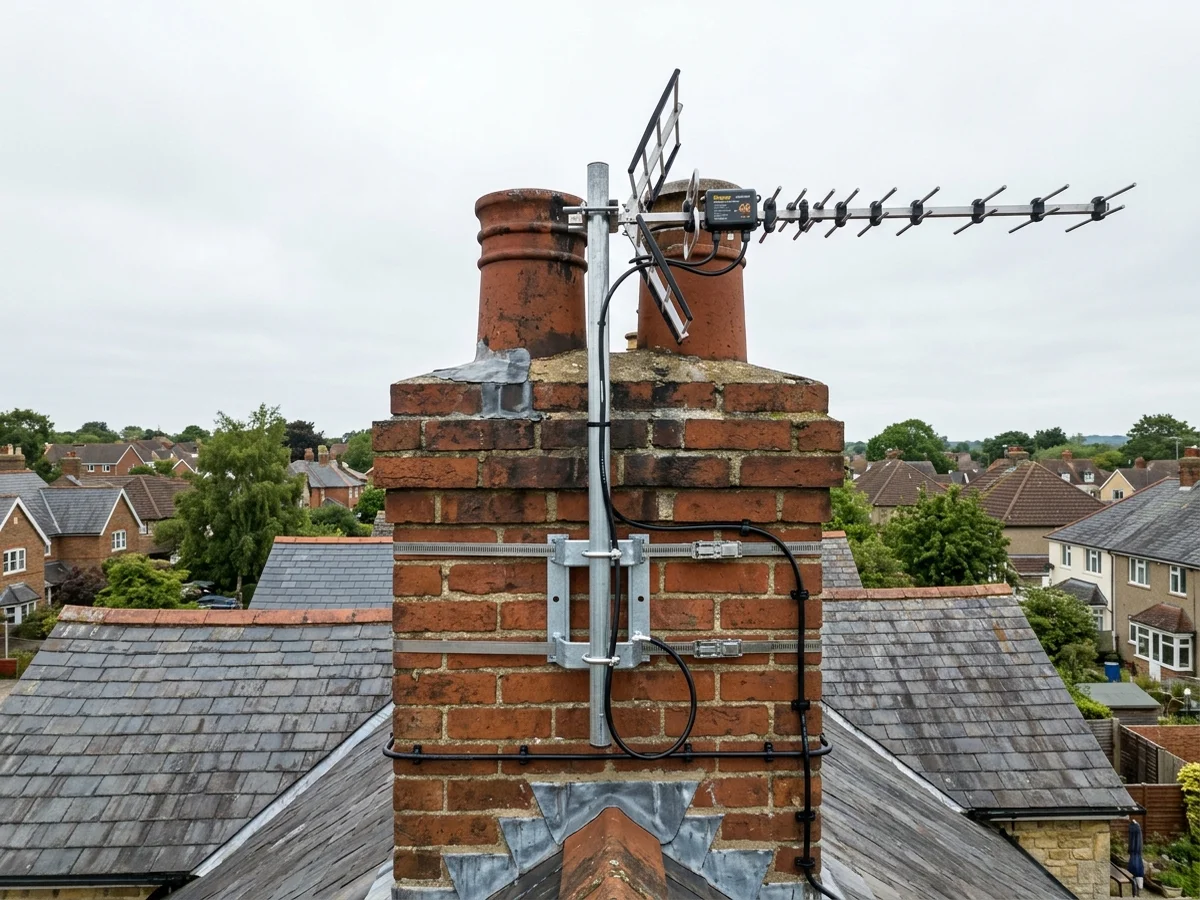

When installing a digital Freeview television aerial on a UK property, one of the first questions homeowners ask is: "Can I just put the aerial inside the loft so it isn't visible on the roof?" The appeal of a loft aerial is obvious: it preserves the clean architectural exterior of your home, prevents visual clutter in conservation areas, and is completely protected from 80mph winter storms and corroding rainwater. However, from a radio frequency (RF) engineering perspective, mounting an aerial inside an attic introduces significant signal attenuation and electromagnetic interference. In this technical comparison, lead certified aerial engineer Gary Pearce explains the exact trade trade-offs between lofted and external roof-mounted TV aerials.
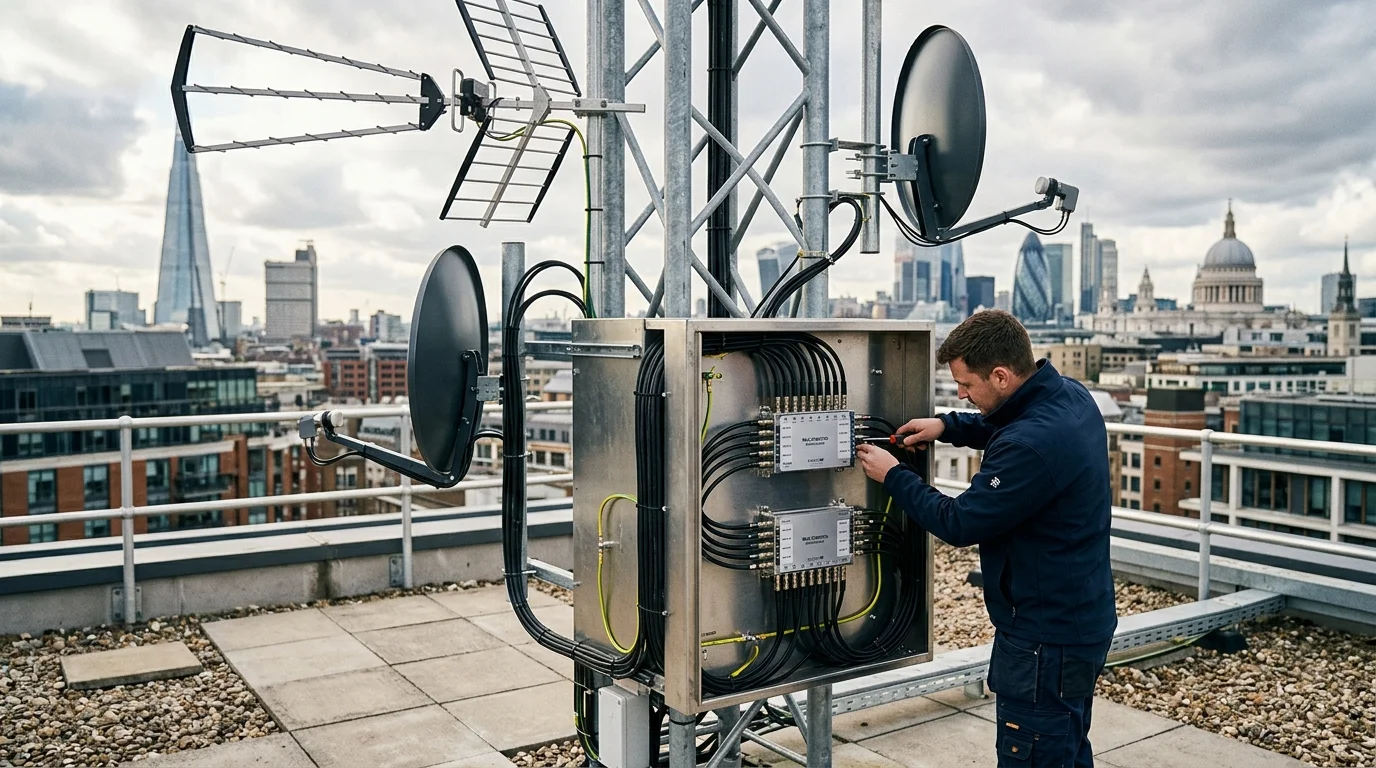
🏠 The Roofing Material Attenuation Penalty
Radio waves travelling through the air from a terrestrial TV broadcast mast (such as Emley Moor or Winter Hill) lose substantial power when passing through a roof. Standard dry concrete or slate tiles absorb 3dB to 6dB of signal (cutting signal power by half). More critically, wet roof tiles after rainfall attenuate signal by 8dB to 12dB, and modern foil-backed roof insulation or metallic solar panels block 15dB to 25dB, completely wiping out digital Freeview reception.
1. Direct Comparison: Loft vs Roof-Mounted Aerials
| Criteria | Lofted Attic Aerial | External Roof / Chimney Aerial |
|---|---|---|
| Signal Strength | Reduced by 3dB to 15dB (Roof attenuation) | 100% Full Unobstructed Signal Strength |
| Weather Impact | Heavy rain on tiles can cause pixelation | Unaffected by surface tile moisture |
| Storm Lifespan | 20+ Years (Zero wind/water exposure) | 10–15 Years (Galvanised components) |
| Visual Aesthetics | 100% Invisible from the street | Visible mast on roof or chimney stack |
| RF Electrical Noise | High (Close to solar inverters & wiring) | Isolated far above domestic wiring noise |
2. When Is a Loft Aerial Suitable?
Roof Material Attenuation: Signal Loss (dB) Through Different Roofing
A loft aerial can deliver perfect HD reception under specific conditions:
- Strong Signal Zone: Your property is within 15 miles of a primary high-power broadcast mast with direct line-of-sight.
- Traditional Roofing Felt: The roof utilizes standard bitumen felt and dry tiles, with zero foil-backed insulation boards or metallic solar panels.
- Conservation Areas: Listed buildings or strict conservation heritage streets where local planning forbids external antennas.
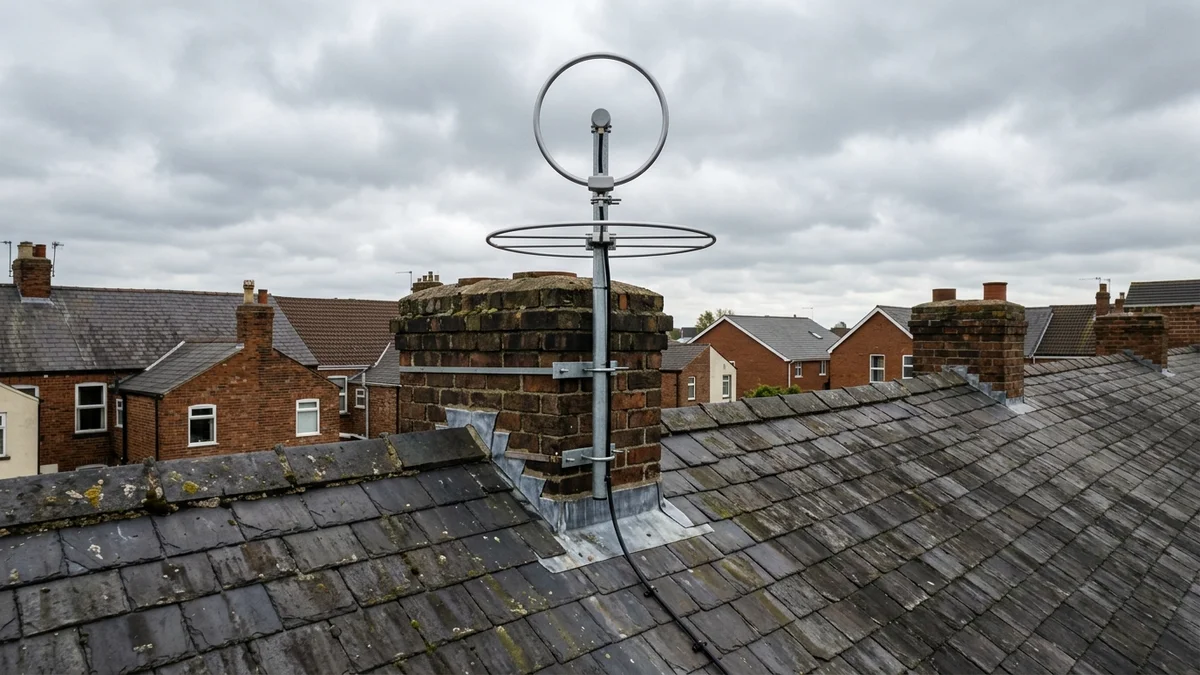
RF Signal Attenuation: Modern Foil Insulation & Wet Roof Tiles
BLUF Direct Answer: Loft aerials avoid outdoor weathering but suffer 6dB to 15dB signal loss from clay roof tiles, increasing to over 25dB of fatal attenuation when passing through modern foil-backed Kingspan insulation or Breathable Membrane (vapour barriers), making an external roof aerial essential for glitch-free Freeview.
While installing an aerial inside a loft eliminates ladder climbing and protects the aluminium elements from corrosion, modern building regulations mandate foil-faced insulation boards and solar-reflective roof underlays. Aluminium foil acts as a Faraday shield, reflecting Freeview UHF broadcast waves away from the aerial elements.
Additionally, during rainy weather, saturated clay roof tiles absorb high-frequency electromagnetic waves, causing signal power to fluctuate between morning and evening. External roof or chimney aerials receive an unobstructed Line-of-Sight (LOS) signal path, ensuring steady modulation error ratio (MER) above 28dB for flawless 4K/HD Freeview reception.
| Roof & Substrate Factor | Loft Aerial Impact | External Roof Aerial Impact |
|---|---|---|
| Foil Insulation / Kingspan | -25dB to -40dB (Signal blocked) | 0dB (Zero obstruction) |
| Wet Slate / Clay Tiles | -6dB to -12dB attenuation | Negligible impact |
| Weather & Gale Wear | Protected; 20+ year lifespan | Exposed to 80mph winds (Requires steel mast) |
| Pixelation & Picture Drop | Common during rainstorms | Rock-solid broadcast lock |
Starlink & Aerial Structural Mount & Gale Tolerance Calculator
Calculate the required steel mast gauge, bracket standoff clearance, and lashing cradle tension needed to withstand up to 90mph UK Atlantic storm gusts with 0.0° beam deflection.
How to Test if a Loft Aerial Will Work in Your House
Checklist to determine whether a loft aerial is viable or an external aerial is mandatory.
Check for Foil-Backed Roof Insulation
Inspect attic rafters; if silver foil insulation or reflective multi-foil quilt is fitted, a loft aerial cannot receive UHF signal.
Measure Distance to Nearest TV Transmitter
Check distance on the Ofcom transmitter map; locations over 15 miles from the main mast generally require roof mounting.
Audit Signal Strength with Calibrated Meter
Plug a digital signal meter into a test aerial in the attic to verify signal exceeds 50 dBuV with MER > 26dB.
3. When Is an External Roof Mount Mandatory?
An external chimney or gable mount is non-negotiable if:
- Solar PV Panels: Modern solar micro-inverters emit high-frequency harmonic RF noise that severely degrades digital TV signals inside attic spaces.
- Foil Insulation (Celotex): Attics converted into bedrooms lined with foil-faced insulation reflect TV signals like a solid sheet of metal.
- Medium or Fringe Signal Zones: In rural valleys or fringe reception areas across Yorkshire and Lancashire, only an external high-gain aerial cleared above the roofline can deliver the minimum 45dBµV signal required for reliable Freeview reception.
For pricing information, see our 2026 TV aerial installation cost guide. To learn how to eliminate mobile interference, read our guide on 4G and 5G mobile interference, or book our professional TV aerial installation team for an on-site spectrum signal test.