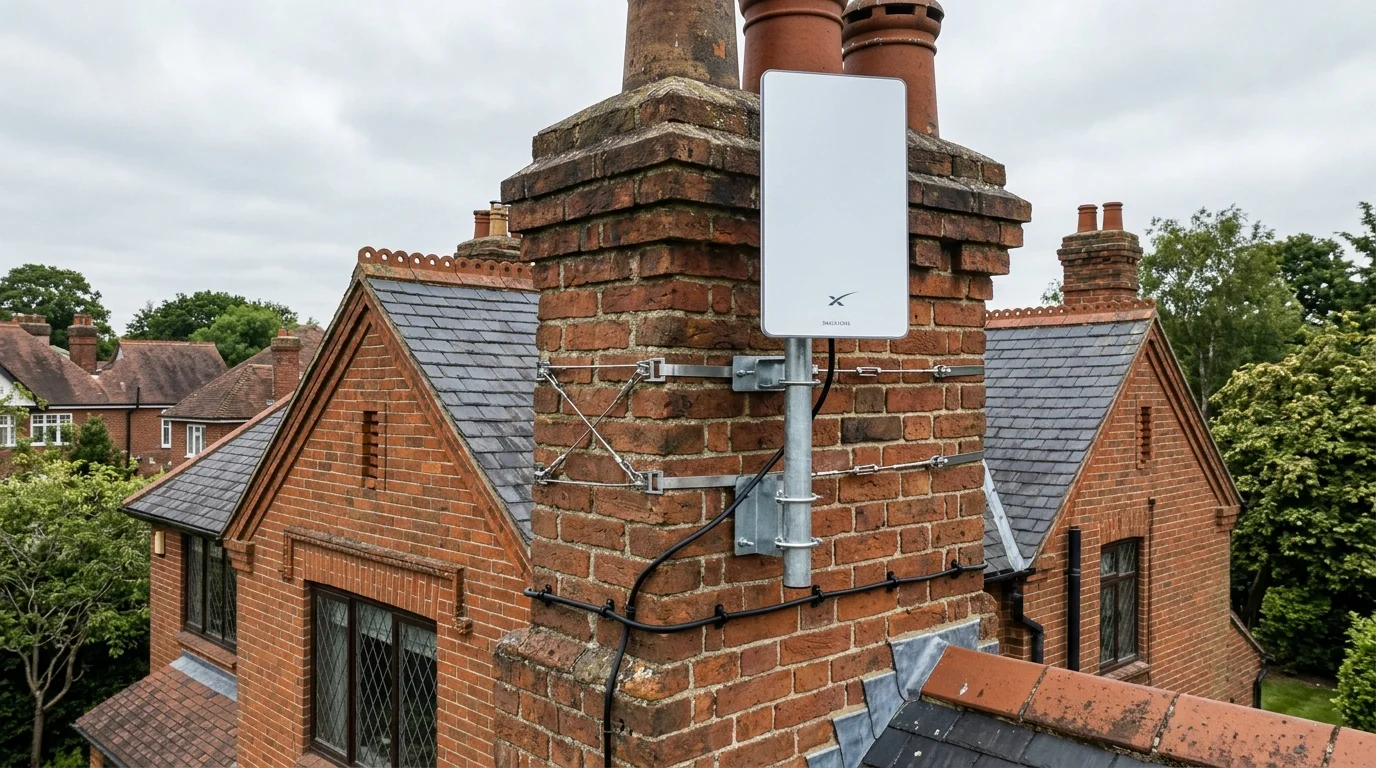

When installing a SpaceX Starlink dish on a UK residential property, choosing the correct mounting location is the single most important decision for both signal quality and structural longevity. A poorly mounted dish will experience signal dropouts from roof gables or mature trees, and more dangerously, can rip out mortar, crack roof slates, or bend under heavy winter gales. In this comprehensive engineering guide, lead systems engineer Gary Pearce compares the two premier UK mounting architectures: the Zero-Drill Chimney Lashing Cradle and the Heavy-Duty Galvanised Pennine Apex Bracket.
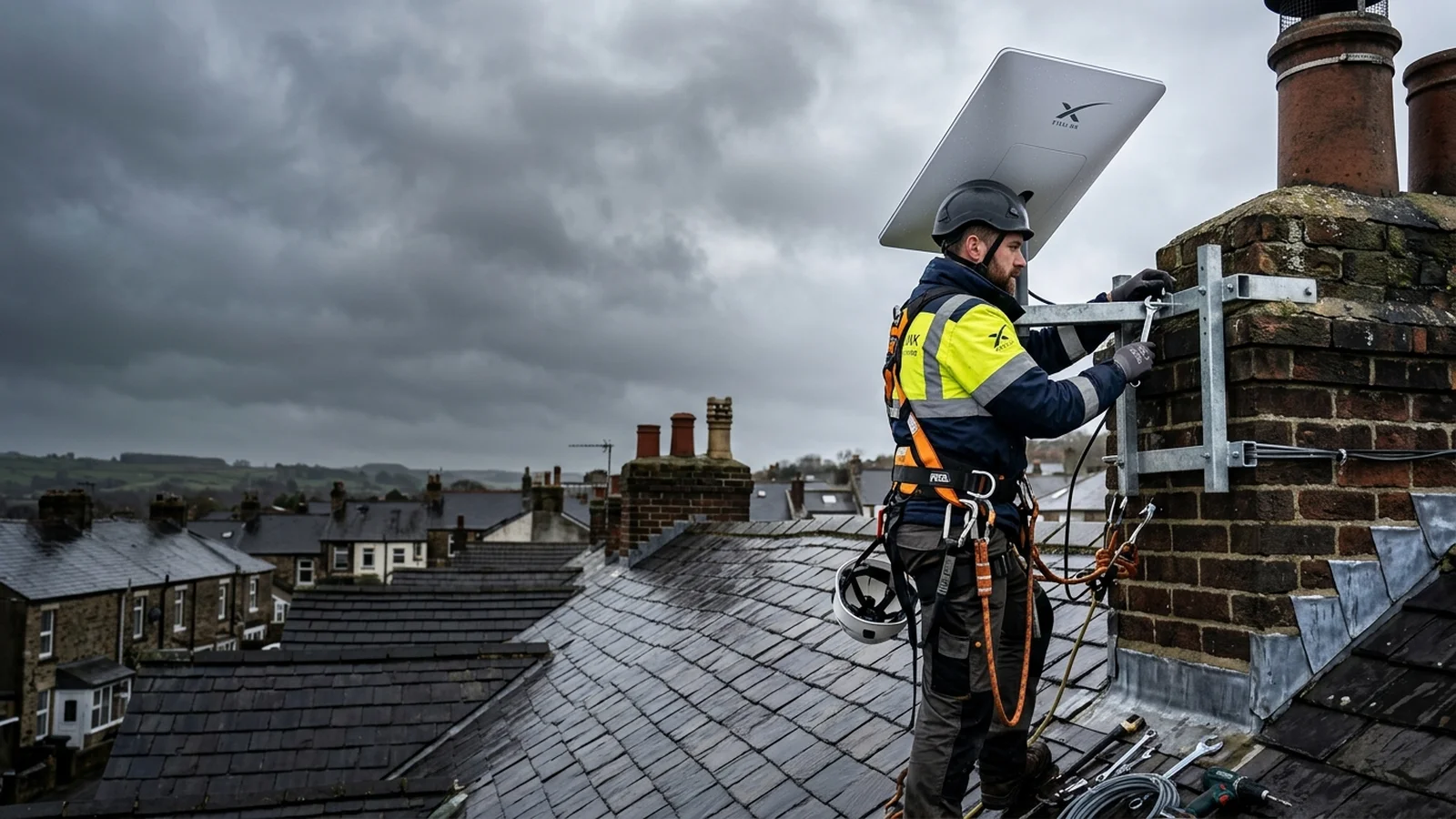
🛡️ The Non-Drill Principle for UK Roofs
Never allow an installer to drill directly through slate or concrete roof tiles. Drilling roof penetrations invalidates roof warranties, creates permanent leak points, and risks catastrophic water ingress into roof timbers. Professional CAI-certified engineers always secure mounting brackets using high-tensile chimney cradles or structural gable end masonry.
1. The Double Chimney Lashing Cradle: Engineering Gold Standard
For UK homes with an active or decorative masonry chimneystack, a double chimney lashing bracket is universally considered the best mounting method. Rather than drilling into fragile lime mortar or historic brickwork, the bracket relies on high-tensile galvanised or stainless steel 7-strand wire that wraps completely around the perimeter of the stack.
- Even Load Distribution: The steel wire pulls against heavy-duty galvanized corner plates, distributing the lateral wind torque across 6 to 10 brick courses simultaneously. This eliminates localized stress points.
- 360-Degree Clear Sky View: Being positioned at the highest apex of the building guarantees an unobstructed 110-degree field of view to the northern sky, clearing surrounding gables, neighbouring properties, and tree lines.
- Zero Drilling Required: Completely non-invasive. When the tenant or homeowner moves, the lashing wire can be unbolted in minutes, leaving the chimney brickwork in factory-original condition with zero holes.
2. The Heavy-Duty Gable Apex Bracket: When Chimneys Aren't Available
Roof Mounting Architecture: Chimney Cradle vs Gable Apex Bracket
- • 100% Zero-Drill: Zero tile or mortar holes
- • Unobstructed 360-degree panorama of northern sky
- • Fully compliant with UK conservation area rules
- • Anchored into structural gable masonry with M10 bolts
- • 18" standoff clears guttering and roof overhangs
- • Essential for modern homes lacking a chimney stack
Many modern homes, timber-framed properties, or bungalows built after 1980 lack a chimney stack, or have a decommissioned decorative stack unsuitable for wind loading. In these situations, the engineered solution is a Heavy-Duty Galvanised Pennine Apex Bracket:
- Structural Masonry Anchoring: The bracket is secured into the solid structural brick or blockwork of the gable end wall using M10 heavy-duty shield anchors or chemical resin studs.
- Gutter Clearance Standoff: Featuring a 12-inch to 18-inch standoff clearance, the bracket easily clears fascias, soffits, and guttering, rising vertically past the roofline without touching the tiles.
- Vibration Isolation: Because the bracket anchors into the dense main structural gable wall rather than roof rafters, micro-vibrations from high winds are completely absorbed by the building foundations, ensuring silent operation inside attic bedrooms.
3. Direct Engineering Comparison Matrix
| Criteria | Double Chimney Lashing | Gable Apex Bracket |
|---|---|---|
| Roof Penetrations | 0 (Completely Non-Drill) | 0 (Wall Mounted Only) |
| Wind Load Rating | Rated to 90mph gales | Rated to 105mph+ storm gusts |
| Sky Clearance | Unrivalled 360-degree panorama | Excellent (if gable faces clear sky) |
| Mast Specification | 1.5" or 2" heavy alloy / steel | 2" heavy-gauge galvanised steel |
| Heritage Suitability | Fully Conservation Compliant | Requires discreet powder coating |
4. Mast Diameter Physics: Why 2-Inch Steel is Mandatory
A common DIY mistake is mounting a Starlink dish onto a flimsy 1.25-inch lightweight aerial pole. While a television aerial has low wind resistance, a Starlink Gen 3 panel is a solid flat surface measuring 59cm x 38cm. In a 60mph Pennine gust, this creates substantial cantilever torque.
A 1.25-inch pole flexes and vibrates in high winds. Even a microscopic deflection of 2 degrees causes the phased-array beam to misalign with tracking satellites, triggering temporary packet loss and jitter spikes. We use exclusively 2-inch heavy-gauge galvanised steel or seamless structural alloy poles with custom CNC-machined Starlink pipe adapters, eliminating pole sway entirely.
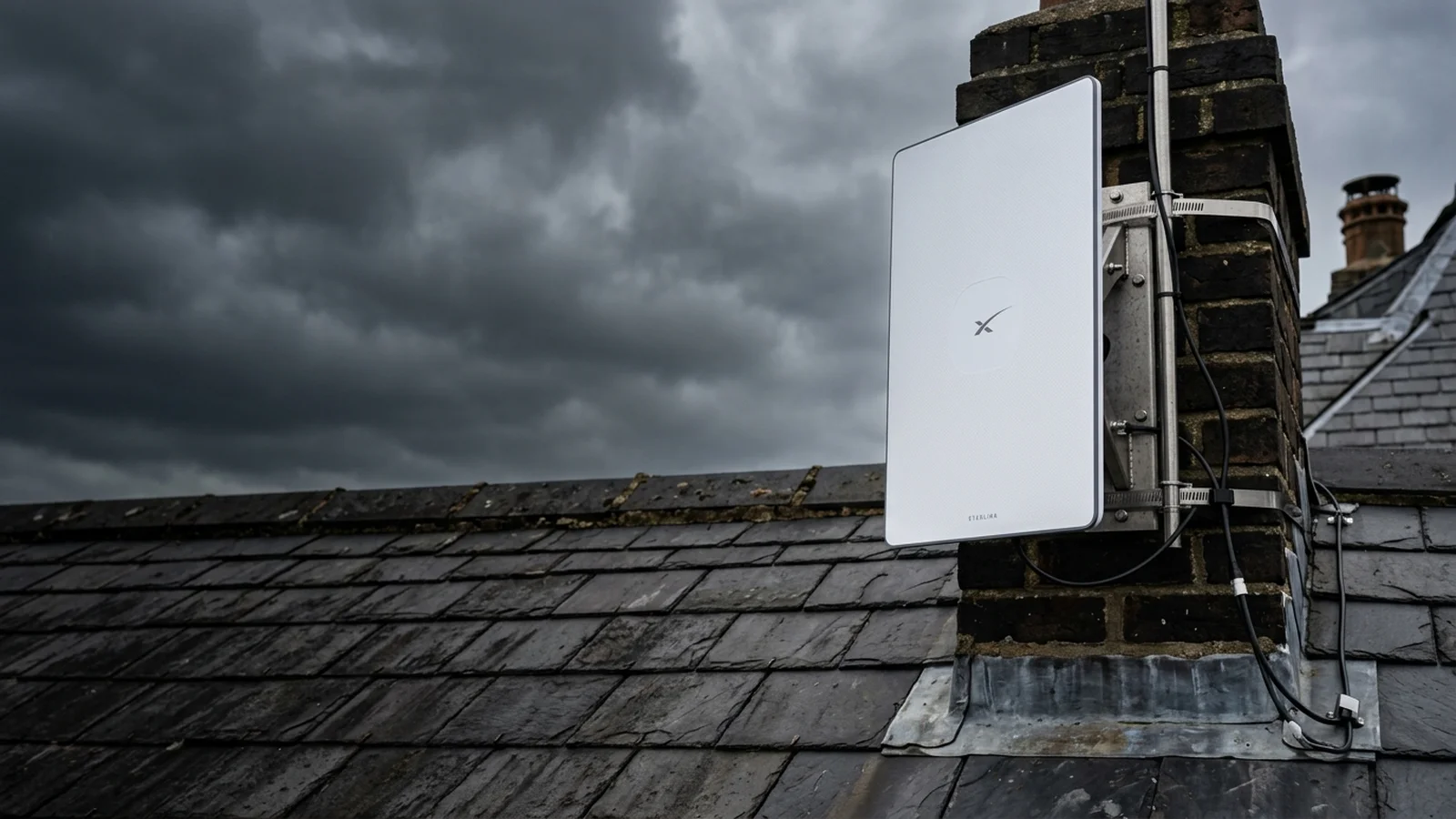
Structural Comparison: Lashing Cradles vs Gable Apex Standoffs
BLUF Direct Answer: Chimney lashing cradles offer 100% non-invasive mounting with zero tile penetrations and maximum roof clearance, whereas gable apex standoff brackets provide superior structural rigidity on houses with modern timber trusses or weak, deteriorating chimney stacks.
Choosing between a chimney mount and a gable apex bracket depends primarily on chimney mortar condition, tree canopy height, and roof pitch. On listed properties or slate roofs where drilling into natural stone or tiles invalidates homeowner insurance, a double stainless steel lashing wire cradle is the gold standard.
However, if a chimney exhibits loose pointing, cracked flaunching, or shared flues with a neighbour, anchoring heavy steel brackets into the end gable brickwork using M10 shield expansion bolts or chemical resin studs is the safer, permanent alternative. Heavy-duty 18-inch Pennine standoff brackets clear fascia boards and plastic guttering without cutting.
| Evaluation Criterion | Chimney Lashing Cradle | Gable Apex Standoff Bracket |
|---|---|---|
| Drilling Required | Zero (Non-invasive) | Yes (4x M10 masonry shield anchors) |
| Elevation & Sky View | Maximum (Apex of building) | Good (Side-elevation standoff) |
| Suitability on Old Mortar | Requires 6+ solid brick courses | Bypasses chimney completely |
| Typical Installation Time | 1.5 - 2 Hours | 2 - 2.5 Hours |
Starlink & Aerial Structural Mount & Gale Tolerance Calculator
Calculate the required steel mast gauge, bracket standoff clearance, and lashing cradle tension needed to withstand up to 90mph UK Atlantic storm gusts with 0.0° beam deflection.
How to Select and Install the Right Starlink Roof Mount
Diagnostic protocol for choosing between chimney lashing and gable bracket mounting.
Inspect Chimney Stack Condition
Examine brickwork pointing and pot flaunching; if mortar is crumbling, avoid lashing and choose gable apex.
Calculate Standoff Clearance
Measure gutter and bargeboard overhang to ensure bracket clears fascias by at least 100mm.
Tension Lashing Wire Evenly
Tighten eye-bolts with calibrated torque to prevent cracking chimney corners while eliminating mast wobble.
Verify 360-Degree Azimuth Clearance
Check app obstacle map to confirm the dish clears ridgelines and nearby tree canopies.
5. Cable Drop Safety: Preventing Flapping Against Slates
Regardless of whether you choose a chimney cradle or apex bracket, how the cable travels down to the entry point is vital:
- Never let cable rest freely on slates: Wind will cause the cable to whip against sharp slate edges, cutting through the outer jacket within months.
- Stainless lead clips or catenary wire: The cable should be tensioned along the bracket arm and routed down through the soffit or secured tightly to the mortar joints using UV-rated masonry clamps.
- Drip loop at point of entry: As detailed in our guide on routing Starlink cable through brick walls, create a 100mm U-bend loop to shed water.
Discover more about winter performance in our report on Starlink in high winds and snow, learn how to distribute signal throughout your home with our Starlink bypass mode mesh Wi-Fi guide, or book a site survey with our professional Starlink installation team.