How to Get Ethernet to an Upstairs Bedroom Without Running Cables Through the House
By Gary Pearce
Senior Telecommunications & Network Cabling Engineer • 25+ Years On The Tools • £10M PLI
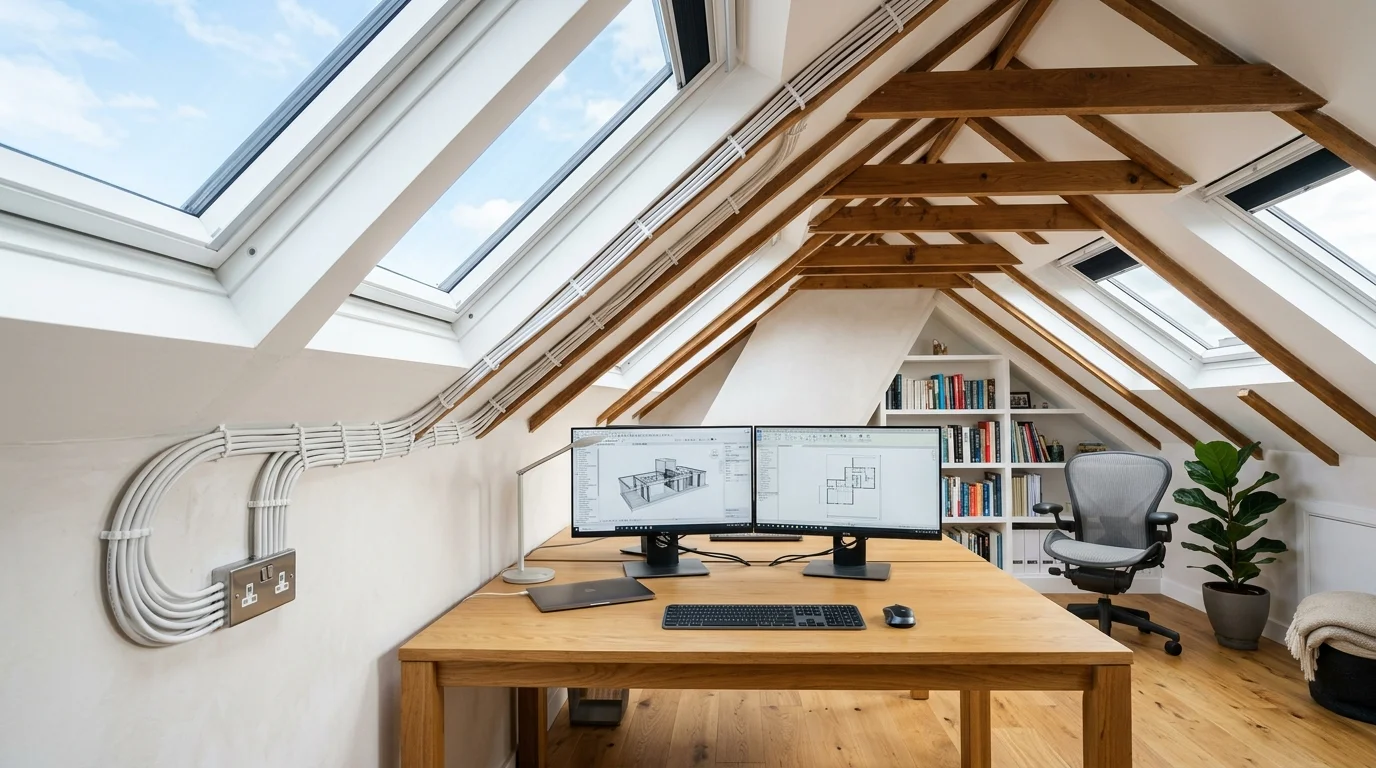
The Indoor Cable Trap: Why Trailing Ethernet Up The Stairs Fails
Whether you have recently set up a dedicated work-from-home office, a high-end gaming PC rig, or a PlayStation 5 in an upstairs bedroom, Wi-Fi through modern UK building structures frequently disappoints. Solid masonry partition walls, foil-backed Celotex ceiling insulation, and timber joist sandwiches attenuate 5GHz and 6GHz wireless frequencies, resulting in random packet drops, high ping jitter, and throttled download speeds during video conferences or competitive online gaming.
The temporary homeowner reaction is often purchasing a 30-metre yellow or blue Ethernet patch lead from an online retailer and draping it across the living room carpet, up the stair risers, and along the landing. Within days, this creates an unsightly trip hazard, triggers household arguments, gets chewed by family pets, and suffers internal copper fatigue as bedroom doors repeatedly crush the flat jacket against the door jamb.
Fortunately, professional network engineers do not route data cables across living spaces. By understanding the four proven physical containment methods available in UK residential architecture, you can achieve a flawless, rock-solid gigabit connection upstairs while keeping your interior completely immaculate.
The Upstairs Gaming (PS5, Xbox, PC) & Remote Work Latency Reality
Most homeowners who contact us for domestic data cabling aren't just looking for web browsing. They have specific high-bandwidth or latency-critical applications in an upstairs room:
Competitive Upstairs Gaming
In titles like Call of Duty: Warzone, EA FC 25, Fortnite, or Valorant, Wi-Fi micro-bursts and bufferbloat cause 80ms–150ms ping spikes. A dedicated physical Cat6 line locks your local gateway ping to 0.3ms–0.8ms with strictly 0% packet loss.
Upstairs Home Office / Zoom Calls
Foil-backed loft insulation and upstairs floorboards cause random audio cut-outs on Microsoft Teams and corporate VPN dropouts when someone downstairs streams 4K video. A hardwired port provides dedicated, unshared bandwidth.
Trade Fact: You cannot fix wireless physical physics with a £30 Wi-Fi booster. Physical copper is the only guaranteed way to transmit 1,000Mbps continuously without environmental interference.
Method 1: The External UV Cat6 Run (The Professional Trade Standard)
Across the UK, the overwhelming majority of professional data cabling installations to upstairs bedrooms utilize the external perimeter route. Rather than navigating through decorated ceilings, lifting fitted carpets, or drilling through floor joists, the engineer treats the exterior cavity wall as the primary containment highway.
Here is how Gary Pearce executes this installation cleanly:
- 1. Discreet Ground-Floor Exit: We locate the broadband router (BT Smart Hub, Sky Max, Virgin Media Hub, or Vodafone). Directly behind or adjacent to the router at skirting board level, a 10mm hole is drilled through the inner leaf and outer brickwork using low-vibration SDS+ diamond masonry bits, angled 5 degrees downward to ensure moisture can never travel inward.
- 2. Heavy-Duty UV PE Cable Specification: Standard grey or white indoor PVC cable degrades rapidly under British sunlight and cracks in winter frost. We exclusively install Webro 23AWG 100% solid bare copper Cat6 encased in heavy-duty black UV-stabilised polyethylene (PE). This cable is fully rated for direct outdoor exposure for over 25 years.
- 3. Invisible Alignment Along Masonry: The black cable is routed neatly along external brick mortar joints, or tucked invisibly behind rainwater downpipes and soil stack pipes. High-grade UV-resistant nylon cable clips with hardened steel pins are spaced every 300mm to eliminate cable sag.
- 4. Upstairs Bedroom Entry & Drip Loop: At the upstairs bedroom location, we drill into the room at skirting height. On the exterior facade, a downward drip loop is formed so rain drips harmlessly to the ground, and an IP66 silicone-sealed wall entry grommet is fitted.
- 5. Flush RJ45 Euro-Module Wall Plate: Inside the bedroom, the solid copper cable terminates into a flush or surface-mounted single or twin RJ45 Cat6 Euro-module socket. You plug your PC, console, or switch into a clean wall socket exactly like a mains plug.
This method delivers 100% full line speed (1Gbps, 2.5Gbps, or 10Gbps), introduces zero ping jitter, requires zero plaster repair, and leaves your hallway and stairs completely untouched.
ADI Engineering Video: External Cat6 Routing & Euro-Module Termination
Watch Gary Pearce demonstrate a complete residential installation: low-vibration core drilling behind a ground-floor router, vertical containment behind rainwater downpipes, silicone drip loops, and RJ45 punchdown termination.
Method 2: The Loft Cavity Drop (Invisible Internal Riser Route)
For homeowners living in Conservation Areas, Grade II listed buildings, or properties where exterior cable runs are prohibited by front-elevation covenants, the internal loft riser route provides a completely invisible alternative.
Most UK houses feature vertical utility boxing running from the ground floor up into the roof space. This boxing typically conceals central heating flow and return pipes, waste soil stacks, or utility meters. A professional installer routes low-smoke zero-halogen (LSZH) Cat6 up inside this vertical pipe chase directly into the attic.
Once the cable reaches the loft, it traverses across the roof joists to a point directly above the target bedroom wall. In homes with timber-stud plasterboard partition walls, we drill through the top wooden noggin / wall plate and drop the cable down inside the hollow cavity wall, retrieving it at standard socket height with a magnetic cable fish tool. The result is a factory-fitted finish with zero cables visible inside or outside the property.
Listen to Gary Pearce's Technical Field Debrief
Short on time? Play this technical audio overview. We break down external UV Cat6 clipping, why Powerline fails across separate 32A consumer unit ring mains, and when MoCA 2.5 over TV coax is the best solution.
Method 3: MoCA Adapters Over Existing Coaxial TV Aerial Cabling
Many UK homes built between 1980 and 2015 were pre-wired with brown or white coaxial cables running from a loft aerial splitter to wall plates in upstairs bedrooms and the ground-floor lounge. If your target bedroom already has a coaxial TV aerial point, you can convert it into an ultra-fast data link without running any new wires using MoCA (Multimedia over Coax Alliance) adapters.
MoCA 2.5 adapters send high-frequency radio data packets across the existing copper core of the coaxial cable. Because quality coaxial cable (such as CAI-benchmarked WF100) features dense copper foil and braid shielding, it is completely immune to electrical noise. MoCA 2.5 delivers real-world throughput up to 2,500Mbps (2.5Gbps) with typical latency under 2ms.
How to install MoCA: You connect an Ethernet patch cable from your downstairs router into the first MoCA adapter, which plugs into the living room coaxial socket. In the upstairs bedroom, you plug the second MoCA adapter into the aerial wall socket, and take an Ethernet cable from the adapter directly into your PC or gaming console.
Method 4: Powerline Adapters — Why They Often Disappoint in UK Homes
Powerline networking adapters (such as TP-Link AV1000 or Devolo Magic) are heavily marketed in retail stores as the simplest way to get internet upstairs. They promise gigabit speeds through standard electrical wall sockets. While they can function adequately in small single-floor apartments, they frequently fail to deliver reliable performance in British two-storey and three-storey houses.
The fundamental trade problem is the UK electrical wiring standard. Under BS 7671 electrical regulations, downstairs socket circuits and upstairs socket circuits are wired on separate 32A ring mains connected to independent breakers on the consumer unit.
For data to travel from your downstairs router to an upstairs bedroom, the high-frequency signal must travel all the way back to your fuse box, jump across the dual-RCD busbars, and travel back out along the second ring main. This circuitous path introduces heavy signal attenuation. Furthermore, noisy switch-mode power supplies (such as cheap mobile phone chargers, microwave ovens, fridge compressors, and EV chargers) inject severe electrical noise into the mains wiring, causing sudden speed collapses from 300Mbps down to 20Mbps and inducing ping spikes that ruin online gaming.
The £80 Powerline Regret
Almost 40% of the homeowners Gary visits for domestic cabling had already bought a £70–£90 Powerline kit that they were preparing to return to Amazon. When you factor in the frustration of dropped connections and constant rebooting, spending a modest amount more for a permanent, Fluke-certified physical cable install is vastly better value.
Two Domestic UK Case Studies: How Gary Solved It
Real domestic examples showing how we route Ethernet to upstairs rooms without damaging interiors.
Upstairs Teenager Gaming PC Setup
Customer Struggle: Customer’s son had severe lag (120ms ping spikes) playing competitive shooters in an upstairs back bedroom over Sky Wi-Fi Max. Hallway was newly carpeted and decorated; mother refused trailing cables.
Gary's Solution: Drilled low-vibration 10mm hole out through cavity brickwork directly behind living room TV unit. Routed Webro black 23AWG UV PE Cat6 tightly behind a black cast-aluminium rainwater downpipe up the rear gable, entering the bedroom directly behind the desk into a flush twin RJ45 Euro-module faceplate.
NHS Telehealth Home Office Drop
Customer Struggle: Solid 9-inch stone front facade located within a strict Conservation Area covenant. The customer required completely secure, zero-fail Ethernet for an NHS video triage workstation upstairs.
Gary's Solution: Utilized the internal ground-floor utility cupboard containing the central heating soil stack. Ran low-smoke zero-halogen (LSZH) Cat6 vertically up the internal pipe chase into the loft, routed along roof timbers, and dropped down inside the bedroom plasterboard stud wall using magnetic fish rods.
Upstairs Ethernet Installation Costs (From £120 + VAT)
Unlike nationwide directory subcontractors who quote low and add hidden fees on arrival, Gary Pearce provides fixed, transparent pricing backed by 25+ years hands-on experience:
1x Single RJ45 point from downstairs router to upstairs bedroom via external downpipe containment.
- ✓ Webro 23AWG Solid Cat6
- ✓ Silicone Drip Loops
- ✓ Flush Euro Wall Plate
2x Independent RJ45 lines to a dual faceplate for gaming console + work PC simultaneously.
- ✓ Dual Webro Cat6 Solid Cable
- ✓ Twin Euro-Module Plate
- ✓ Zero Desktop Switch Needed
100% invisible internal containment through pipe chases into roof void and down hollow stud walls.
- ✓ LSZH Internal Cable
- ✓ Magnetic Wall Fishing
- ✓ Zero Exterior Drilling
Upstairs Connectivity Benchmark: How the 5 Methods Compare
To help you decide which solution matches your property and technical requirements, here is the empirical trade comparison based on hundreds of physical home audits across Yorkshire and Lancashire:
| Method | Real-World Speed | Gaming Ping / Jitter | Interior Disruption | Trade Reliability |
|---|---|---|---|---|
| 1. External Solid Cat6 Run | 1,000 – 10,000 Mbps | < 1 ms (Flawless) | Zero (Clipped outside) | ★★★★★ (100% Gold Standard) |
| 2. Internal Loft Cavity Drop | 1,000 – 10,000 Mbps | < 1 ms (Flawless) | Minimal (Inside hollow walls) | ★★★★★ (Invisible Finish) |
| 3. MoCA Over Coax Aerial Cable | 1,000 – 2,500 Mbps | 1 – 3 ms (Very Low) | Zero (Uses existing coax) | ★★★★☆ (Excellent if coax exists) |
| 4. Tri-Band Wi-Fi 6E/7 Mesh Node | 250 – 600 Mbps | 8 – 25 ms (Mild Jitter) | Zero (Wireless) | ★★★☆☆ (Dependent on floor joists) |
| 5. Powerline Electrical Adapters | 25 – 120 Mbps | 15 – 80 ms (Unstable Spikes) | Zero (Plug-in) | ★★☆☆☆ (High Failure Rate) |
Find the Best Ethernet Route for Your Home
Select your property type below to see Gary Pearce's recommended containment method:
Recommended Solution:
External Cat6 Route (Recommended): Drill out behind the ground-floor router, run black UV PE Cat6 up the gable or rear wall alongside downpipes, and drill into the bedroom for a flush RJ45 socket. Zero indoor damage, 1,000Mbps guaranteed line speed.
Hardware Standards: Rejecting Copper-Clad Aluminium (CCA)
When having a data cable installed, the physical specification of the cable itself determines whether your network lasts for decades or fails after eighteen months.
Uncertified handymen and cheap online sellers frequently supply Copper-Clad Aluminium (CCA) cabling. CCA consists of a cheap aluminium core coated with a microscopically thin wash of copper. Aluminium is brittle, has high electrical resistance, snaps under external temperature swings, and fails British Standards (BS EN 50173 / BS 6701).
ADI Communications strictly installs Webro 23AWG 100% Solid Bare Copper cabling. Solid copper offers minimal DC loop resistance, supports full Power-over-Ethernet (PoE+ and PoE++), and guarantees full 10-Gigabit bandwidth. Every single cable run installed by Gary Pearce is electronically certified using digital time-domain reflectometry (TDR) analyzers, verifying pin-to-pin continuity and zero packet attenuation.
Professional Data Cabling Installation Across Yorkshire & Lancashire
Need an Ethernet socket professionally run to an upstairs bedroom, gaming room, or garden office? Gary Pearce provides turnkey physical installations with zero trailing wires:
All installations backed by £10 Million Public Liability Insurance and fitted with CAI-benchmarked equipment.
Frequently Asked Questions
Clear, practical answers on routing Ethernet to upstairs bedrooms without internal disruption.
What is the best way to get Ethernet upstairs without trailing cables through the house?
The most effective and durable method is an external Cat6 cable run. A professional engineer drills out from behind your ground-floor router, routes heavy-duty black UV-stabilised Cat6 cable up the outside wall along mortar lines or downpipes, and drills back into the upstairs bedroom to a flush RJ45 wall socket. This provides guaranteed gigabit speeds with zero hallway disruption.
Will running an Ethernet cable on the outside wall look ugly?
No. Professional installers use rugged black UV-resistant polyethylene (PE) Cat6 cable clipped discreetly alongside rainwater downpipes, soil stacks, or tucked tightly into mortar seams. Once clipped neatly, the cable is virtually invisible from street level.
Why do Powerline adapters often perform poorly in UK homes?
In modern UK homes, upstairs and downstairs plug sockets are wired on separate electrical ring mains connected to different circuit breakers or RCDs in the consumer unit. Data signals struggle to cross between these separate circuits, causing severe speed degradation and latency spikes.
Can I use existing TV aerial coaxial cables to get wired internet upstairs?
Yes. If your bedroom already has a TV aerial wall socket connected to your main living room, you can install MoCA 2.5 (Multimedia over Coax) adapters. These adapters transmit encrypted data over 75-ohm coaxial cable at speeds up to 2.5Gbps with ultra-low latency.
How much does it cost to have an Ethernet cable professionally run upstairs in the UK?
A typical professional external Cat6 cable installation to an upstairs bedroom, including diamond core drilling, exterior UV cable clipping, weatherproofing grommets, and a flush RJ45 Euro-module faceplate, typically costs between £120 and £195 + VAT depending on property size and routing complexity.
Does an external Ethernet cable cause cold draughts or rain leaks?
No. Entry and exit holes are drilled at a downward angle through the masonry to prevent water tracking inwards. Each hole is fitted with a sealed silicone cable entry grommet and an exterior downward drip loop.
Can I use flat Ethernet cables under bedroom carpets instead?
Flat cables can be tucked under carpets around perimeter tack strips, but they lack internal shielding and are easily crushed by foot traffic or hoovering. For permanent gigabit reliability, round 23AWG solid copper cable is far superior.
What download speed and ping will I get in my bedroom with a hardwired cable?
With a hardwired Cat6 connection to your main router, you will receive 100% of your broadband package speed (up to 1,000Mbps on full fibre) with sub-1ms ping to the router, eliminating gaming lag and video call buffering.
Can you route more than one Ethernet cable to the upstairs bedroom?
Yes. Gary Pearce frequently installs twin Cat6 (dual RJ45) faceplates in upstairs bedrooms, allowing homeowners to connect both a gaming console and a work PC directly into the network without needing an external desktop switch.
How long does a professional external Ethernet installation take?
A standard external Cat6 installation from a ground-floor router to an upstairs bedroom typically takes between 90 minutes and 2 hours, including end-to-end Fluke continuity testing.
Ready for Flawless Gigabit Speeds in Your Bedroom?
Speak directly with Gary Pearce. No call centre queues or commission-based sales reps. Get honest advice, transparent pricing, and clean, invisible cable routing.