When investing in a flagship 65-inch, 77-inch, or 85-inch flat screen, deciding whether to purchase an OLED (such as an LG G4/C4 or Sony Bravia 8) or a QLED / Mini-LED (such as a Samsung Neo QLED or Sony Bravia 9) is only the first step. The physical mounting requirements, chassis fragility, thermal dissipation properties, and bracket physics differ drastically between these two display technologies. In this engineering guide, lead installer Gary Pearce examines the structural considerations required to mount each display safely on UK walls.
⚠️ The Ultra-Thin OLED Glass Fragility Hazard
The top half of modern OLED panels measures just 4 millimetres in thickness—thinner than a standard smartphone. Attempting to lift an OLED display by grasping the top glass corners creates immense rotational torque that can micro-fracture the internal OLED glass substrate. Never allow a single installer to lift an OLED over 55 inches; two engineers must lift exclusively from the reinforced bottom chassis.
1. Structural Comparison: OLED vs QLED Chassis Physics
Understanding the mechanical construction of your television dictates bracket selection and wall anchorage:
| Engineering Factor | OLED Displays (LG, Sony, Panasonic) | QLED / Mini-LED Displays (Samsung, Hisense) |
|---|---|---|
| Panel Thickness | Ultra-thin (3.8mm to 5mm top blade) | Uniform thick chassis (25mm to 35mm) |
| Total Weight (65") | 16.5 kg – 22 kg (Lighter) | 24 kg – 32 kg (Heavier backlight array) |
| VESA Mounting Location | Low-slung (Bottom 1/3 of chassis) | Centred (Standard vertical balance) |
| Heat Sensitivity | High (Heat accelerates organic burn-in) | Low (Inorganic quantum dot resilience) |
| Flush Mounting | Zero-gap on Gallery Edition (G-Series) | Flush on The Frame; 15mm gap standard |
2. The Low-Slung VESA Trap on OLED Televisions
Chassis Geometry: Low-Slung OLED VESA vs Centred QLED VESA Heights
VESA mounting holes positioned in bottom third of chassis. Reusing an existing QLED bracket forces the OLED 25cm too high, causing severe neck craning.
VESA mounting holes dead centre. Heavier chassis (up to 35kg) requires high-tensile CoreFix anchors to resist cantilever extension torque.
One of the most frequent mistakes made by DIY installers is miscalculating wall bracket height when switching between QLED and OLED. On a QLED screen, the four VESA bolt holes are typically positioned dead centre on the rear chassis. On an OLED screen, because the upper half of the panel is paper-thin glass, all motherboard electronics, power supply units, and VESA screw sockets are concentrated in a plastic housing in the bottom third of the screen.
If you replace a QLED with an OLED on the exact same wall bracket, your TV will sit 20 to 30 centimetres higher on the wall than before, resulting in painful upward neck craning. Always measure from the bottom VESA hole to the bottom bezel edge before drilling your wall plate.
3. Heat Dissipation & Burn-In Prevention Behind OLEDs
OLED screens rely on organic compounds that emit light when electrical current passes through them. Excessive trapped thermal heat behind the panel accelerates organic degradation and significantly increases the risk of permanent image retention (burn-in):
- Avoid Recessed Alcove Traps: Never recess a standard OLED into a tight plasterboard alcove without at least 50mm of perimeter ventilation on all four sides. Trapped hot air acts as an incubator, degrading the panel.
- Fireplace Proximity: Avoid mounting OLEDs close to working log burners or open fires. For safety margins, read our guide on mounting TVs above fireplaces safely.
- Aluminium Thermal Heatsinks: High-end OLEDs (like the LG G4 and Sony A95L) incorporate an aluminium vapour chamber heatsink behind the panel, allowing tighter flush mounting while maintaining safe operating temperatures.
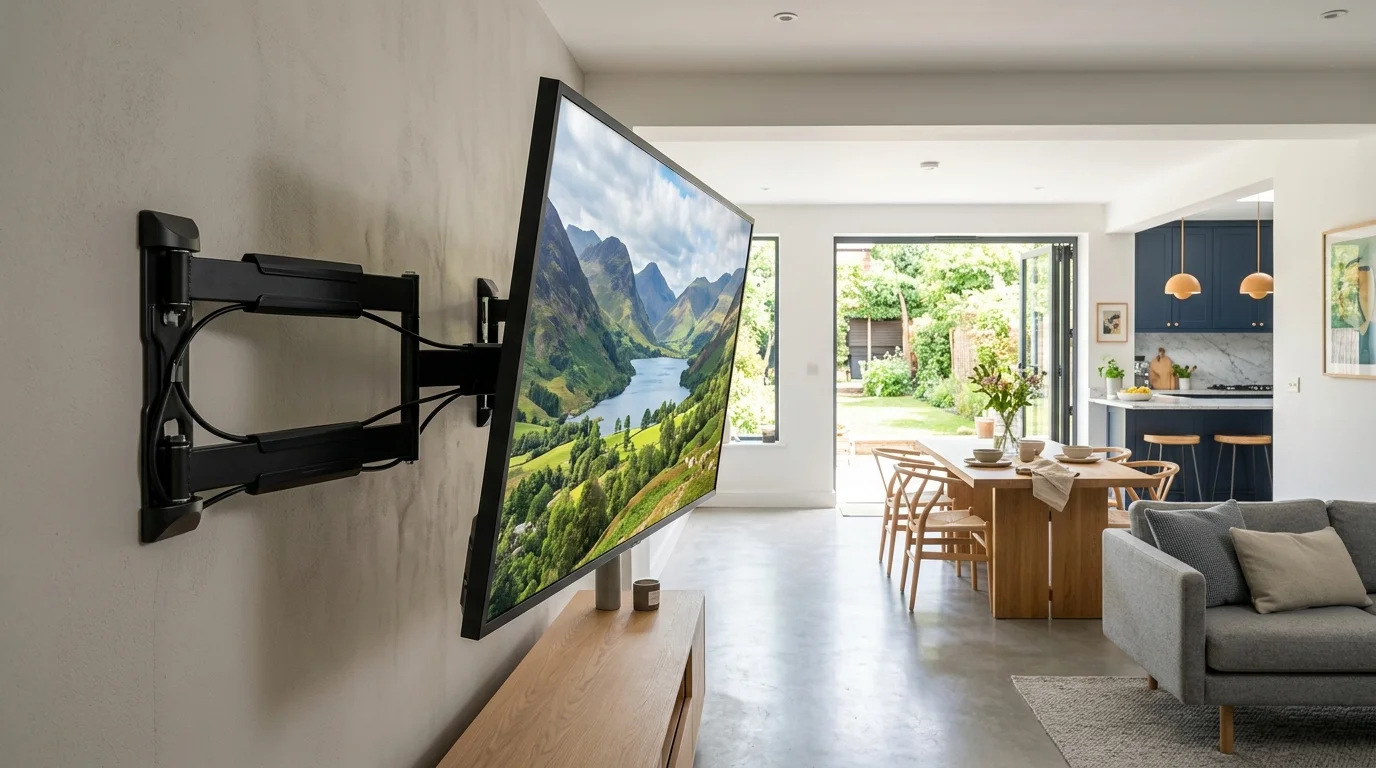
Structural Flexure, Heat Dissipation & Cantilever Load Factors
BLUF Direct Answer: OLED TVs feature ultra-thin 4mm glass panels where mounting brackets attach to a low chassis box, making them vulnerable to glass flexure on long articulating cantilever arms, whereas QLED displays feature thick rigid frames that distribute weight evenly across standard VESA plates.
Mounting an LG OLED or Sony QD-OLED requires meticulous mechanical attention. Because OLED glass panels lack a rigid rear metal frame, moving an extended dual-arm cantilever bracket by grabbing the top glass edge can cause micro-fractures in the panel matrix, resulting in permanent dead pixel lines or panel failure.
In contrast, Samsung QLED and Neo QLED televisions are heavier (often 25% heavier than equivalent OLEDs) due to their full-array local dimming (FALD) backlight assemblies. They generate substantial rear heat, requiring at least 25mm of rear wall clearance to maintain adequate passive convective airflow and prevent thermal throttling of image processors.
| Engineering Attribute | OLED (LG G4/C4, Sony A95L) | QLED (Samsung QN90D, TCL) |
|---|---|---|
| Panel Rigidity | Ultra-thin glass; flexure risk | Rigid boxed chassis |
| VESA Mounting Position | Lower third of screen chassis | Centred vertically on rear panel |
| Weight (65-inch Model) | 18 kg - 22 kg | 24 kg - 30 kg (FALD backlights) |
| Recommended Bracket Type | Ultra-slim flush or wide-backplate tilt | Heavy-duty dual-arm articulating cantilever |
TV Wall Mounting Bracket & Structural Anchor Selector
Identify the exact anchor specification, drill bit diameter, and bracket rating needed to safely suspend heavy OLED and LED screens up to 85″ with zero drywall pull-out risk.
How to Safely Mount an OLED or QLED Television
Safe handling and structural mounting guide for high-end television panels.
Check VESA Bolt Depths with Spacers
Measure M6 or M8 bolt penetration depth into the screen chassis; use supplied nylon spacers to prevent bottoming out against internal OLED motherboards.
Secure Wall Plate with Anchor Span
Fix the steel wall plate across two studs or into masonry using at least four CoreFix or Fischer plugs.
Two-Person Safe Panel Lift
Lift OLED panels by holding the lower chassis box—never grip the thin upper glass corners.
Level with Calibrated Spirit Level
Adjust bracket fine-tuning screws until horizontal level reads 0.0 degrees across the screen width.
4. Bracket Selection: Ultra-Slim Fixed vs Full-Motion Cantilever Arms
Choosing the right bracket type depends on your display technology:
- For OLEDs (Gallery / C-Series): Low-profile flat or tilting brackets (such as Sanus Super Slim) keep the display sleek and close to the wall. If using an articulating arm, choose one with a wide dual-arm scissor mechanism so pushing or pulling the screen doesn't flex the fragile glass.
- For Heavy QLEDs: Because 75" and 85" Mini-LED displays weigh up to 35kg, extending the screen 50cm out on a cantilever arm creates enormous rotational torque on wall fixings. On dot and dab walls, engineered CoreFix anchors are mandatory, as explained in our dot and dab wall mounting guide.
For art-focused installations, review Samsung The Frame installation secrets. For heavier integrated displays, see our Sky Glass TV mounting guide. To book a professional mounting survey, explore our professional TV wall mounting services across Yorkshire and Lancashire.