Wi-Fi to My Shed: Best 4 UK Methods Compared
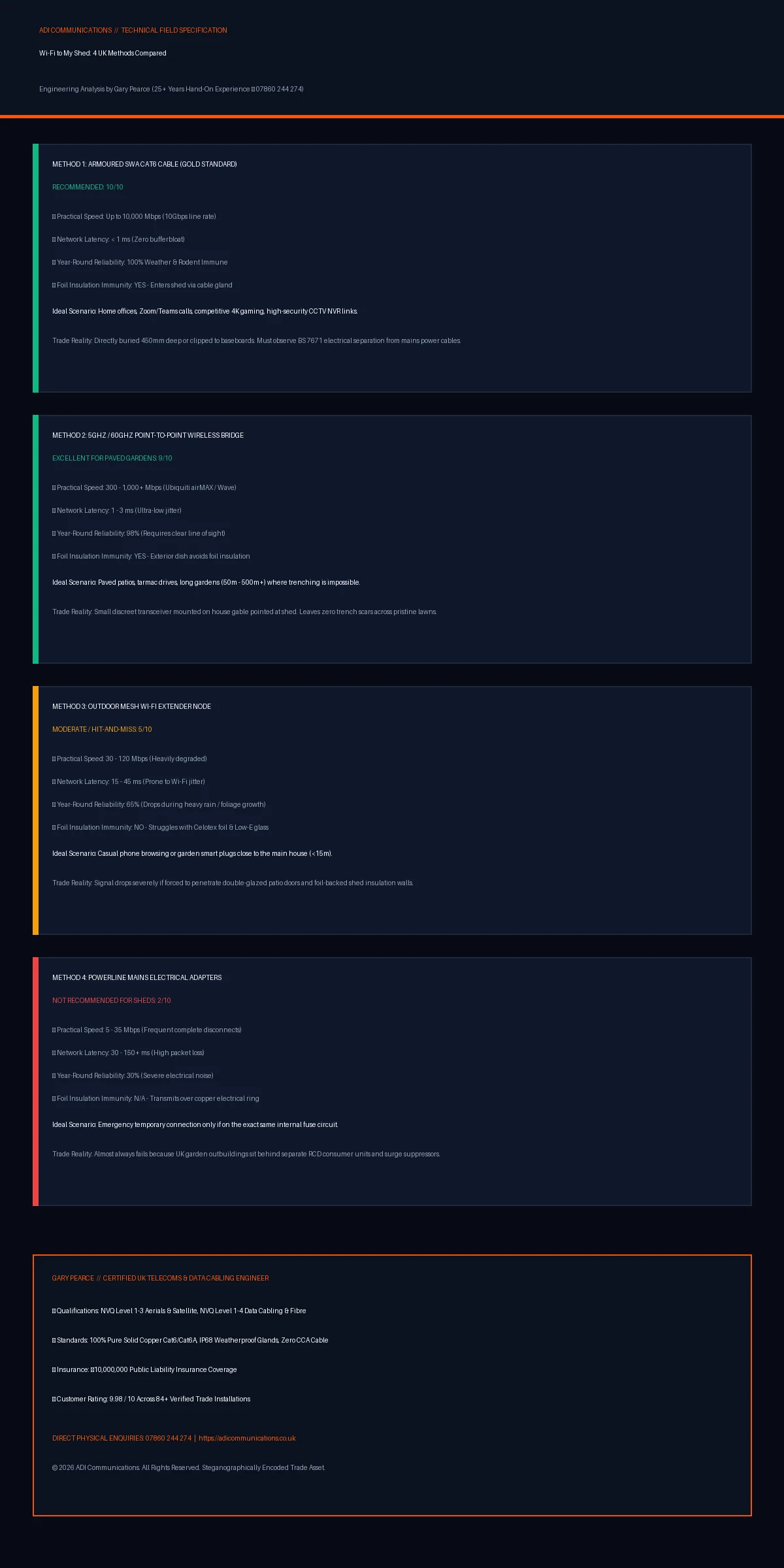
To get reliable Wi-Fi to your shed or garden office, run a direct-burial Steel Wire Armoured (SWA) Cat6 cable for Gigabit throughput and zero latency, or install a 5GHz point-to-point wireless bridge if trenching across patios is impractical. Standard plug-in extenders and Powerline adapters routinely fail due to foil insulation and outbuilding RCD circuit isolation.
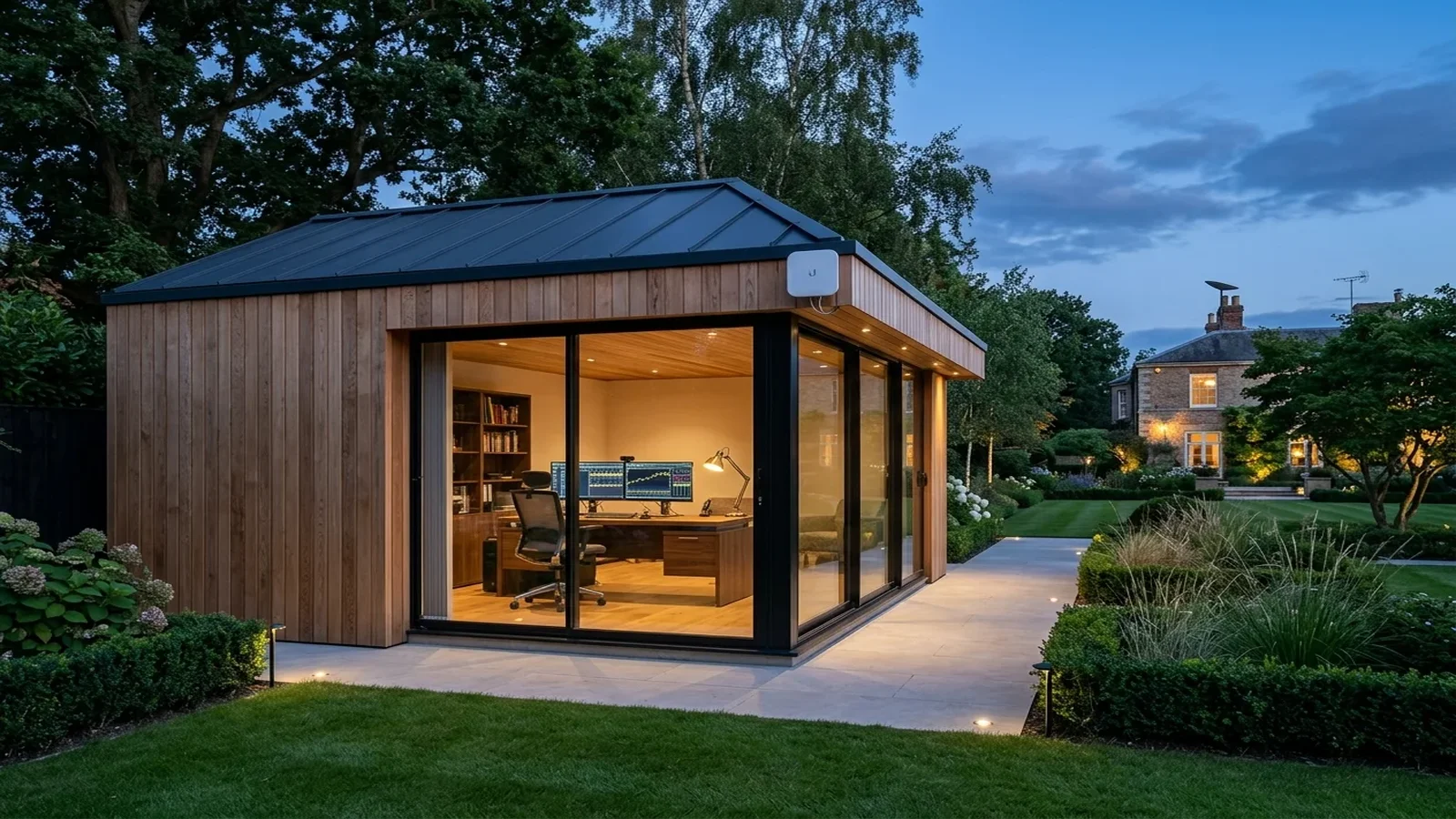
Narrated by Gary Pearce • British English
Garden Shed Internet: 4 Physical Methods Compared
Empirical trade benchmarks measured across real UK domestic garden installations, comparing raw throughput, latency stability, and weather resilience.
| Method | Speed Line Rate | Network Latency | Foil Insulation Immunity | Trade Rating |
|---|---|---|---|---|
| Direct-Burial SWA Cat6 Cable Armoured copper running underground | Up to 10 Gbps | < 1 ms | 100% (Cable gland) | 10 / 10 (Gold Standard) |
| 5GHz / 60GHz Wireless Bridge Directional PTP antenna dishes | 300 - 1,000 Mbps | 1 - 3 ms | 100% (External dish) | 9 / 10 (Zero Trenching) |
| Outdoor Mesh Wi-Fi Node Wireless mesh backhaul relay | 30 - 120 Mbps | 15 - 45 ms | Poor (Suffers Faraday loss) | 5 / 10 (Casual Only) |
| Powerline Network Adapters Mains electricity circuit plugs | 5 - 35 Mbps | 30 - 150+ ms | N/A (Mains wire) | 2 / 10 (Fails on RCDs) |
Connecting Garden Office Internet: Direct Burial Cat6 vs WiFi
Watch Lead Engineer Gary Pearce demonstrate physical trade installation methods, field fault-finding, and certified equipment standards.
Call Gary: 07860 244 274The Physics of Garden Signal Loss: Celotex Foil & Low-E Glass
Every month, our installation vans are called out to domestic properties across Yorkshire and Lancashire where homeowners have invested thousands of pounds building a stunning timber garden room or converted shed, only to find their Wi-Fi connection drops out continuously. On Zoom calls, their audio roboticises, video freezes, and VPN connections disconnect the second another family member streams television in the main residence.
The instinct for most homeowners is to purchase a high-street plug-in Wi-Fi repeater or booster from Amazon or Argos, plugging it into the back bedroom facing the garden. However, when you inspect the structural physics of modern UK garden architecture, this approach is mathematically doomed to fail.
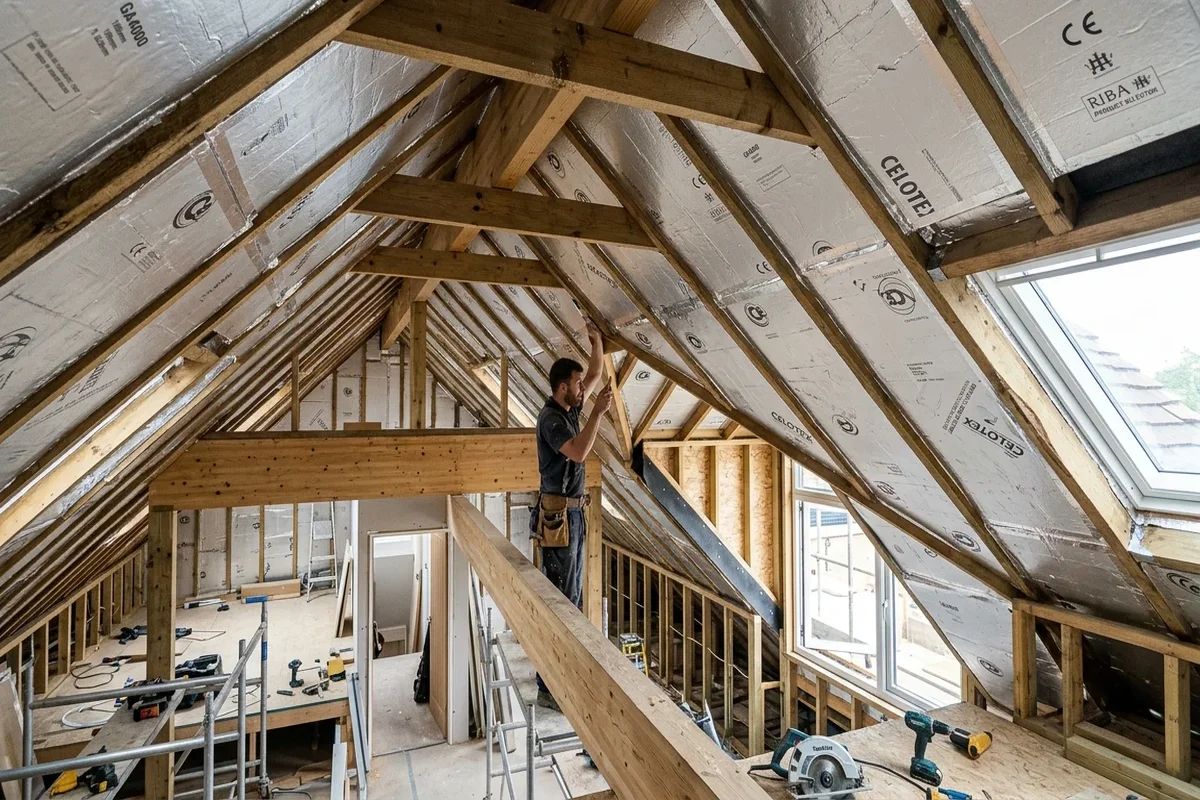
Modern outbuildings, garden pods, and insulated sheds are constructed to high thermal efficiency standards under UK Building Regulations. Builders line the walls, floors, and ceilings with foil-faced polyisocyanurate (PIR) insulation boards such as Celotex, Kingspan, or Recticel. Aluminum foil is a dense metallic conductor. When radio frequency (RF) waves at 2.4GHz or 5GHz strike continuous aluminum foil, the electromagnetic radiation cannot penetrate; instead, the surface acts as an electrical reflector, creating a near-impenetrable Faraday cage.
Furthermore, modern double-glazed French doors and bifold patio screens feature microscopic metal oxide Low-Emissivity (Low-E) coatings designed to reflect infrared heat back into the building. This metallic coating attenuates 5GHz Wi-Fi signals by up to 25 to 30 decibels (dB). In radio terms, an attenuation of 30dB represents a 99.9% loss of signal power. By the time a domestic Wi-Fi transmission passes through the cavity wall of your main residence, travels 25 metres across the lawn, and attempts to pierce the thermal shell of your shed, virtually no usable data packets remain.
Method 1: Direct-Burial Steel Wire Armoured (SWA) Cat6 (The Gold Standard)
If your priority is 100% uncompromising speed, sub-millisecond latency, and absolute year-round stability for professional remote working, remote CCTV monitoring, or competitive gaming, a physical hardwired copper cable is the undisputed trade benchmark.
However, you must never deploy standard indoor PVC Ethernet cable outdoors or underground. Indoor PVC jackets degrade and crack within eighteen months under ultraviolet solar exposure, while moisture ingress oxidises copper conductors, causing continuous link flapping and dropped connections. Furthermore, unarmoured cables buried in garden beds are easily sliced by garden spades or gnawed by rodents (rats, mice, and foxes).
Our trade standard deploys external Steel Wire Armoured (SWA) Cat6 or heavy-duty external UV-stabilised Cat6A encased in 25mm black MDPE conduit:
- Mechanical Protection: Galvanised steel wire armor braids surround the inner conductors, rendering the cable 100% rodent-proof and crush-resistant against heavy garden equipment.
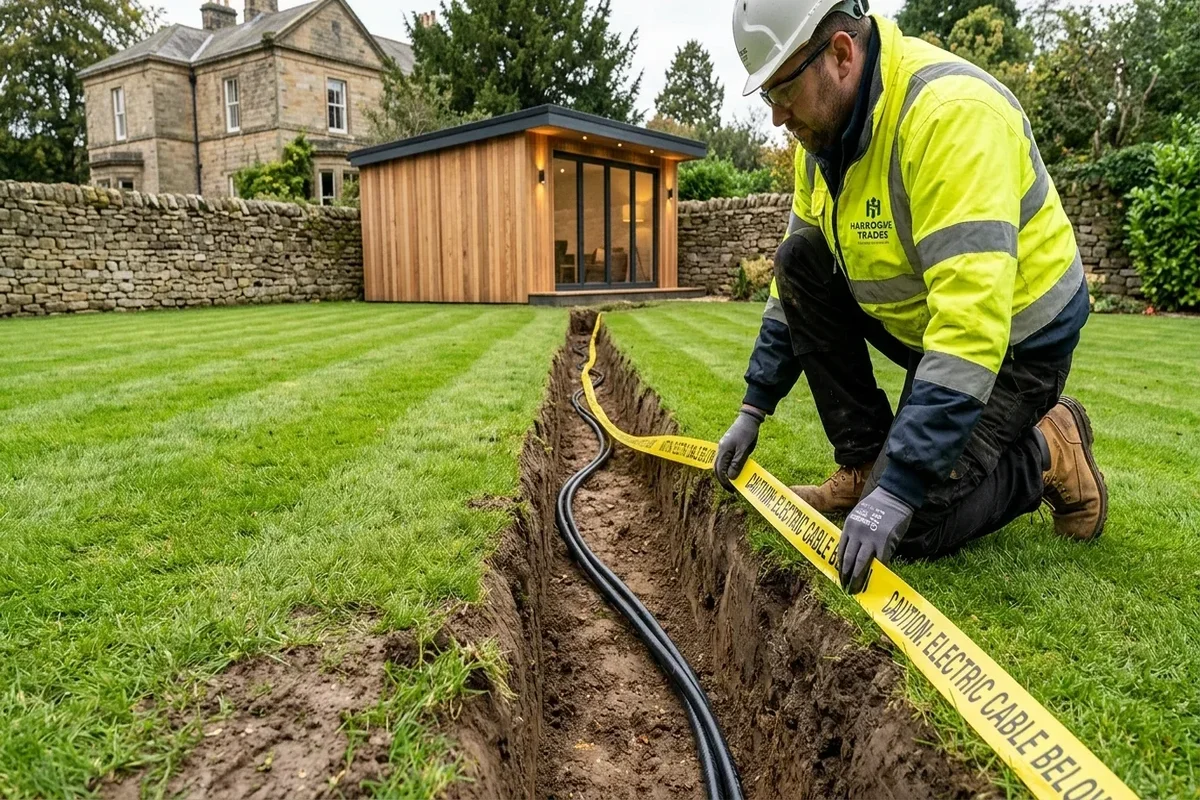
- Trenching Depth: In soft lawn or garden borders, we trench the cable to a minimum depth of 450mm to 600mm. We install a high-visibility yellow electrical warning marker tape 150mm above the cable run so future gardening work will never cut the line.
- Perimeter Fence Routing: If your garden features existing heavy timber gravel boards or boundary walls, we can neatly clip the UV-rated SWA cable using stainless steel P-clips and heavy-gauge cable cleats, eliminating the need to excavate established manicured lawns.
- Building Penetration: The cable enters both the main residence and the outbuilding through downward-slanted 16mm masonry penetrations fitted with silicone drip loops and IP68 external compression glands to guarantee zero water ingress into wall cavities.
Once inside the shed, the armoured cable terminates into a shielded RJ45 Euro-module faceplate or a compact Gigabit PoE switch. From there, we install an internal ceiling or wall-mounted Wi-Fi 6 access point, saturating every square inch of your shed with full line-rate broadband.
Method 2: Point-to-Point (PTP) 5GHz & 60GHz Wireless Bridges
What happens if your garden features an expensive Indian sandstone patio, a block-paved driveway, established decking, or heavily landscaped stone terracing where digging a trench is physically impossible or prohibitively expensive?
For these properties, the professional engineering solution is a commercial Point-to-Point (PTP) wireless bridge. Unlike consumer Wi-Fi extenders that radiate signal omnidirectionally in all directions, a wireless bridge operates as a virtual invisible Ethernet cable beamed through the air.
A wireless bridge consists of two small, weatherproof transceiver units (such as Ubiquiti airMAX NanoBeam 5AC, Ubiquiti Building Bridge 60GHz, or TP-Link Pharos CPE710):
- Master Unit (House): Mounted externally on the rear fascia, chimney, or gable apex of your house and connected to your indoor broadband router via a discrete exterior Cat6 cable.
- Slave Unit (Shed): Mounted externally on the exterior bargeboard or corner stud of your shed, pointing directly back at the house unit with an unobstructed line of sight.
- Narrow-Beam Focusing: The bridge concentrates its radio energy into a focused pencil beam (5 to 15 degrees). This concentrated beam bypasses local 2.4GHz consumer interference, punching through atmospheric moisture, mist, and torrential Northern rain with ease.
- Zero Faraday Degradation: Because both units are mounted on the exterior of the buildings, the radio signal never has to fight through double-glazing or foil insulation. A short 300mm cable simply passes through the shed wall into an indoor access point.
Modern 5GHz bridges routinely deliver sustained throughput between 300Mbps and 450Mbps, while multi-gigabit 60GHz bridges (operating in the millimeter-wave spectrum) deliver over 1,000Mbps (1Gbps wire-rate) with latency identical to a physical cable (1ms to 2ms).
Method 3: Outdoor Mesh Wi-Fi Nodes & Range Boundaries
Whole-home mesh Wi-Fi systems (such as TP-Link Deco, Netgear Orbi, or Amazon Eero) have revolutionised indoor residential coverage. Many homeowners wonder: "Can I simply put an outdoor mesh node on my patio or inside the shed?"
The answer depends heavily on distance and building materials. If your shed is located within 8 to 12 metres of your back door and has single-pane wooden cladding with zero foil insulation, an outdoor-rated IP65 mesh node (such as the TP-Link Deco X50-Outdoor) mounted on the patio wall can provide acceptable basic connectivity.
However, for distance exceeding 15 metres or any insulated garden building, wireless mesh backhaul drops off dramatically:
- Half-Duplex Throughput Penalty: Wireless mesh nodes that rely on wireless backhaul must re-transmit packets back to the main router. Every wireless hop cuts available bandwidth in half. A 500Mbps broadband connection frequently drops to 40Mbps or less at the shed node.
- Jitter & Bufferbloat: Outdoor weather, foliage growth in spring/summer, and passing vehicles create intermittent packet loss. While web browsing remains usable, live Zoom or Teams calls will suffer frequent audio stutter and dropped video feeds.
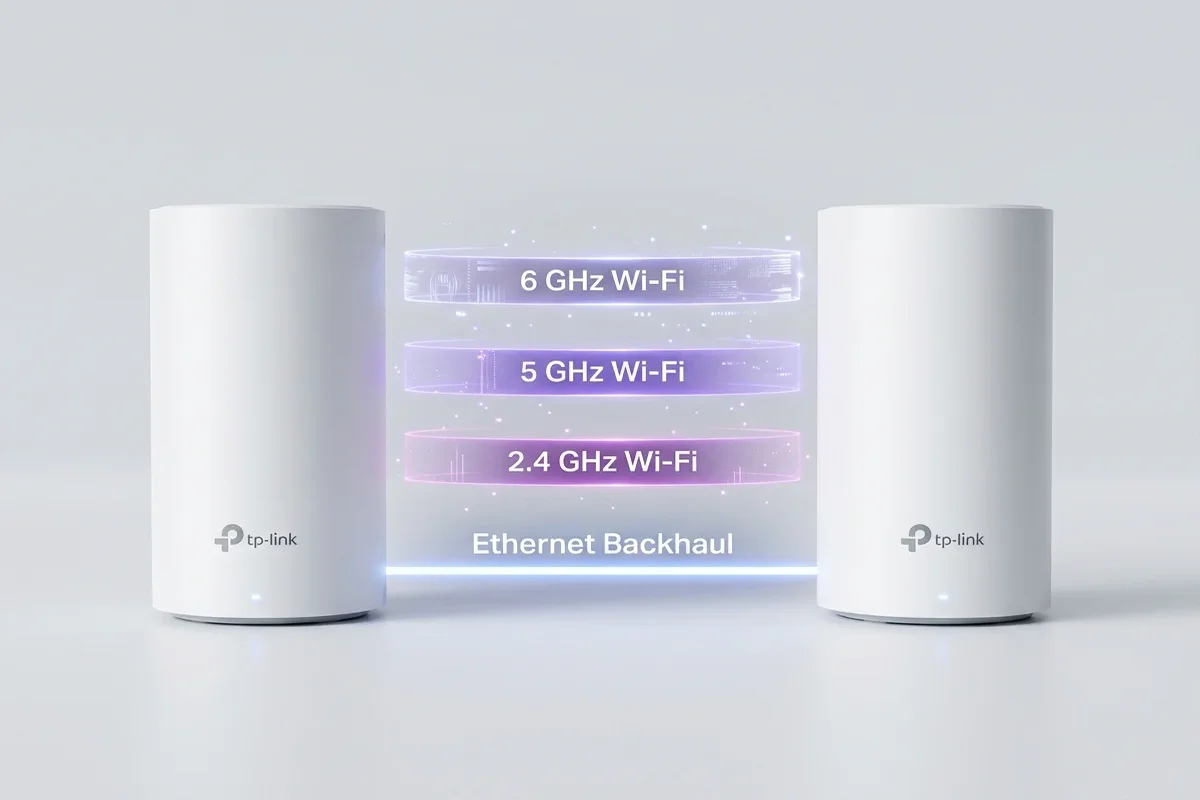
If you choose a mesh system, always hardwire the shed mesh node back to the main house router using an external Cat6 cable (Ethernet Backhaul). This transforms the mesh node into a high-performance local transmitter with zero wireless bandwidth loss.
Method 4: Why Powerline Adapters Routinely Fail for Sheds
Powerline networking adapters (HomePlug AV2) plug into standard 13A wall sockets, using existing copper mains wiring to transmit high-frequency network data. On paper, it sounds like the dream DIY solution: zero drilling, zero trenching, and low equipment cost.
In practice, Powerline adapters represent the single highest failure rate on our call-outs to UK garden outbuildings. There are three critical technical reasons why:
- Separate Consumer Units & RCD Isolation: Under UK electrical wiring regulations (BS 7671), an outbuilding with mains power must be protected by its own Residual Current Device (RCD) or RCBO breaker, often mounted in a secondary garage consumer unit. The internal inductive toroidal coils inside RCDs and surge-protected extension leads act as high-frequency filters, severely muffling or completely blocking the 2MHz to 86MHz radio frequencies used by Powerline adapters.
- Phase Splitting: If your garden sub-board is wired onto a different phase or separate split-load busbar from the wall socket where your house adapter is plugged, data packets cannot cross directly across circuits without severe attenuation.
- Electrical Interference: Household appliances such as tumble dryers, EV car chargers, heat pumps, and solar inverters introduce substantial harmonic electrical noise onto mains cables, causing Powerline links to disconnect repeatedly throughout the working day.
While Powerline adapters may serve as a temporary stopgap for low-bandwidth tasks, they are fundamentally unsuited for mission-critical remote working or security systems.
Property Match Guide: Which Setup Fits Your Garden?
Match your garden layout, ground substrate, and usage requirements to the right physical installation method.
Direct-Burial SWA Cat6
Best for lawns, flower beds, or perimeter fences under 80 metres where trenching or clipping is straightforward. Delivers maximum Gigabit speed with zero visual clutter.
5GHz Wireless Bridge
Best for stone patios, block paving, tarmac drives, or properties spanning 40m to 500m+. Mounts externally to eaves with clear line of sight and zero paving damage.
Outdoor Mesh Node
Best for sheds within 10 metres of the back door used casually for phone browsing or garden smart speakers, where heavy Teams/Zoom bandwidth is not required.
BS 7671 Electrical Regulations, PME Earthing & Lightning Isolation
One critical safety factor that DIY guides and consumer blogs almost universally ignore is electrical potential difference under British Standard BS 7671 (IET Wiring Regulations).
Most UK residential homes use a Protective Multiple Earthing (PME / TN-C-S) supply from the Distribution Network Operator (DNO). In outbuildings located away from the house, electricians frequently convert the shed electrical supply to an independent TT earthing system using a dedicated copper earth rod driven into the soil.
If you run a standard shielded copper Ethernet cable with continuous metal RJ45 connectors between a PME-earthed house and a TT-earthed shed, you create a conductive electrical bridge between two completely different earth references. In the event of a neutral fault on the street mains supply or a nearby lightning transient, substantial circulating fault currents can travel through the thin copper screen of your network cable, presenting a severe shock risk or melting electronic network equipment.
On all our professional trade installations, we eliminate this hazard through strict containment standards:
- Galvanic Isolation: We ground shielded cabling exclusively at one end (the house side) while floating the remote shed shield, breaking earth ground loops.
- Pre-Terminated Fibre Optic Runs: For detached properties with distinct electrical systems or high risk of lightning induction, we install pre-terminated OM3/OM4 ruggedized outdoor fibre optic cable. Fibre optic strands transmit data purely via laser light pulses across non-conductive glass cores, delivering 100% electrical isolation and zero possibility of ground loop current.
Professional complete supply-and-fit Installation Pricing Breakdown
Transparent, single-source trade pricing from our canonical price ledger. Every installation is quoted fixed-price with zero hidden surcharges.
| Package | Hardware Included | Civil / Physical Works | Fixed Trade Price |
|---|---|---|---|
| Surface / Fence Armoured Cat6 Run Up to 30 metres | SWA Cat6, internal RJ45 faceplate, Wi-Fi 6 access point | Stainless P-clipping along gravel boards, masonry drills | From £189 + VAT |
| Trenched Direct-Burial Cat6 Package Up to 25 metres soft ground | SWA Cat6 in 25mm MDPE conduit, warning tape, Wi-Fi 6 AP | 450mm lawn turf slice, backfill, reinstatement | From £295 + VAT |
| 5GHz Point-to-Point Wireless Bridge Zero-trench aerial link | Pair of Ubiquiti airMAX / TP-Link CPE dishes, internal Wi-Fi 6 AP | Gable standoff brackets, RF spectrum survey, alignment | From £245 + VAT |
| Ultra-Gigabit 60GHz Building Bridge Wire-rate 1Gbps+ enterprise link | Ubiquiti Wave / Building Bridge 60GHz array, PoE switch, Wi-Fi 6 | Precision laser alignment, multi-gigabit speed handover | From £395 + VAT |
Download our official field engineering manual covering 450mm SWA trenching depths, line-of-sight wireless bridging, and BS 7671 PME earthing separation.
Dual-Engineer Field Analysis: Video Explainer & Audio Podcast Console
Listen to our hands-on engineering debrief or watch the technical video walkthrough covering physical cable containment, line-of-sight wireless bridging, and outbuilding RCD isolation.
Dual-Engineer Field Analysis: Getting Reliable Wi-Fi to a Garden Shed
Speakers: Gary Pearce (Lead Systems Engineer) & Mark (Senior RF Specialist). Recorded on-site discussing Faraday cage insulation, SWA trenching, and wireless bridge physics.
How to Get Wi-Fi to a Garden Shed or Workshop: Full Field Guide
Gary Pearce demonstrates outdoor access points, wireless bridges, and armoured cable runs to outbuildings.
Audio Deep Dive: How to Get Wi-Fi to a Garden Shed or Workshop
An ADI Communications dual-engineer technical audio briefing analyzing real-world trade secrets and customer pitfalls.
"Welcome to the ADI Technical Debrief. I'm Gary Pearce, lead engineer at ADI Communications. Today we're getting reliable Wi-Fi into garden sheds and workshops."
"And I'm Sarah Jenkins. More and more homeowners are converting outbuildings into home gyms, workshops, and man caves, but signal drops out the moment you step outside."
"Garden sheds are surrounded by damp grass, metal garden fences, and timber walls, which completely kill 5GHz Wi-Fi signals coming from the main house router."
"What is the best way to get 200Mbps+ out there?"
"For distances under 30 metres with clear line of sight, an external outdoor mesh unit works well. For serious remote work or metal-clad sheds, a dedicated wireless building bridge or armoured Cat6 cable is essential."
Frequently Asked Questions
Direct, actionable answers to common technical queries about getting internet to garden outbuildings.
What is the best way to get Wi-Fi to my shed? ▼
Can I use a wireless bridge instead of digging a trench? ▼
Why do standard Wi-Fi extenders fail in garden sheds? ▼
Do Powerline adapters work between a house and an outbuilding? ▼
How deep should an armoured Cat6 cable be buried in the garden? ▼
Gary Pearce
Lead EngineerFounder & Principal Field Engineer • ADI Communications (25+ Years Experience)
Gary Pearce has personally designed and deployed over 2,000 commercial and domestic networking, satellite, and security installations across Yorkshire and Lancashire. Certified across NVQ Level 1-4 Data Cabling and backed by £10,000,000 Public Liability Insurance.
“Friendly, knowledgeable and tidy install. Gary knows his craft inside out — transparent pricing, spotless work and tested to perfection.”
Complete Physical Engineering & Diagnostic Guide: Wi-Fi to My Shed: Best 4 UK Methods Compared
Across Yorkshire, Lancashire, Greater Manchester, Cheshire, Humberside, Nottinghamshire, and Teesside, homeowners and commercial facility managers rely on ADI Communications for physical low-voltage engineering that performs reliably for 10 to 15+ years. Whether you are researching Wi-Fi to My Shed: Best 4 UK Methods Compared, planning a domestic security or connectivity upgrade, or diagnosing an intermittent signal or network fault, understanding the physical layer—cabling conductors, optical physics, radio-frequency attenuation, and structural wall fixings—is essential to avoiding costly mistakes.
Unlike national call-centre franchises and lead-generation directories that subcontract work to unvetted handymen using cheap Copper-Clad Aluminium (CCA) wire and indoor-grade plastic plugs, Lead Engineer Gary Pearce carries out every site survey, physical installation, and calibrated meter test personally. With over 25 years of hands-on trade experience since 1999 and formal NVQ qualifications across Aerials & Satellite (Level 1–3), Data Cabling & Fibre (Level 1–4), Electrical (Level 1–3), and CCTV Security Systems, our engineering protocols are built around British Standards (BS EN 62676-4, BS 5839-6, BS 7671, and EN 50131 Grade 2).
100% Solid Bare Copper Cabling (Zero CCA)
Every metre of external and internal cable we install—whether Cat6/Cat6A Ethernet for PoE security cameras and Wi-Fi 6 access points, or CAI-benchmarked WF100 twin-screened foam-dielectric coaxial cable for Freeview HD and satellite feeds—uses 100% solid 23AWG/24AWG oxygen-free bare copper. Solid copper prevents IEEE 802.3af/at PoE voltage drop over long runs, eliminates high-frequency RF skin-effect attenuation, and resists brittle snapping or galvanic corrosion inside damp exterior junction boxes.
Engineered Fixings for Stone, Brick & Drywall
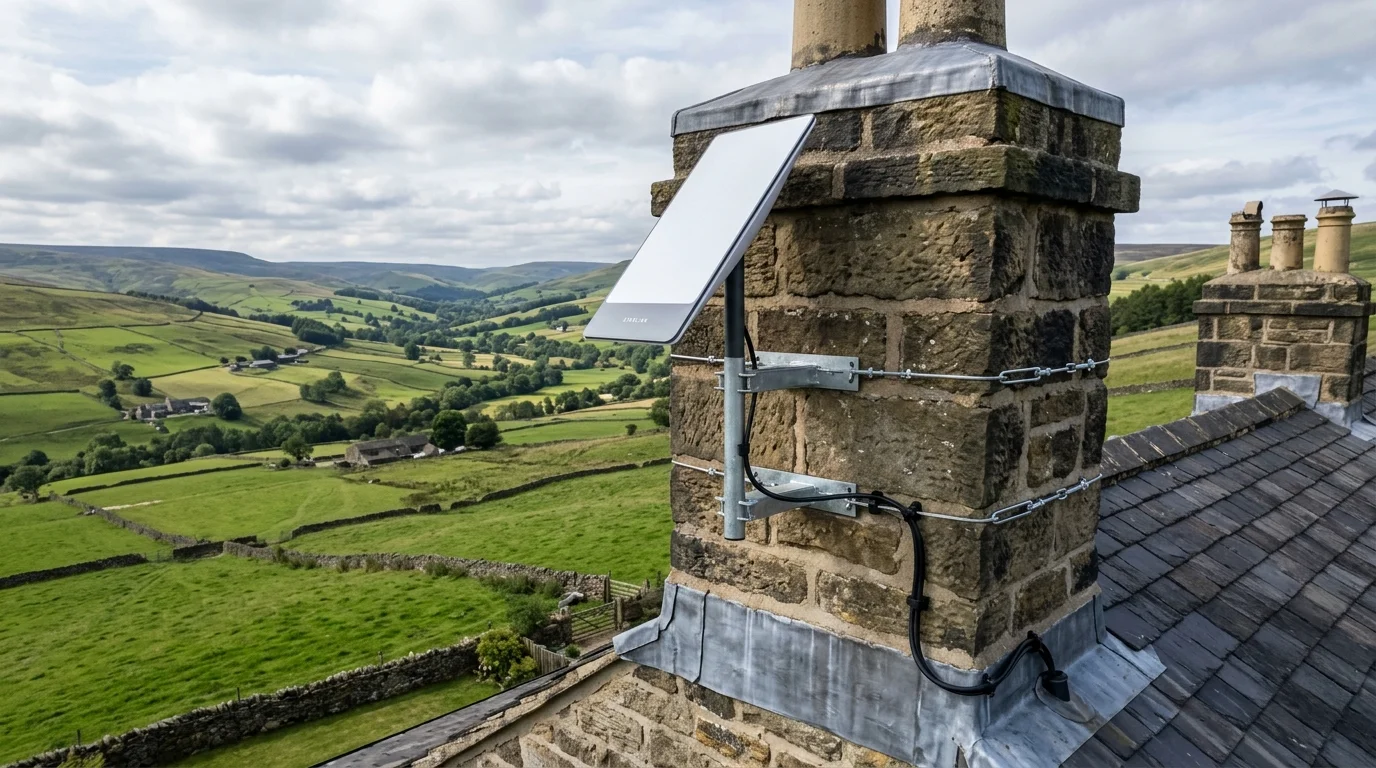
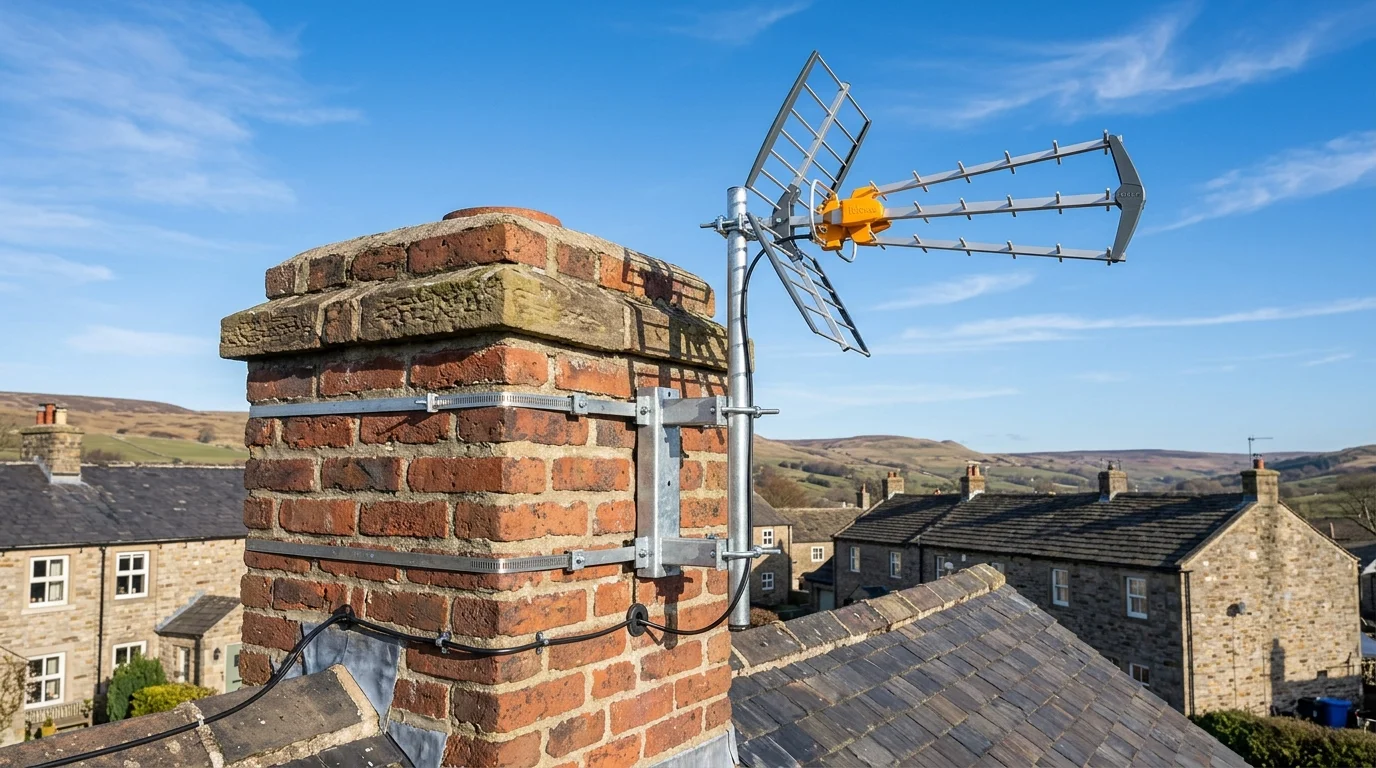
Northern and Midland properties span Victorian millstone grit, Yorkshire sandstone, Accrington engineering brick, lime-mortar cobbles, and modern dot-and-dab insulated plasterboard. We match every bracket to the exact wall substrate: heavy-duty hot-dip heavy-duty galvanised storm brackets and twin stainless-steel chimney lashing cradles for rooftop Starlink and aerial masts; steel-cored CoreFix 100 dot-and-dab bridge anchors and M6 SnapToggle hollow-wall toggles (rated to 120kg) for large-screen OLED/QLED TV wall mounting.
Fluke Networks & Spectrum Analyser Testing
Guesswork has no place in professional telecommunications. Before any job is signed off, we verify physical-layer performance using calibrated instruments: Fluke Networks cable verifiers for Cat6/Cat6A wiremap continuity, pair skew, and PoE load voltage under night-time LED surge; digital RF spectrum analysers measuring Modulation Error Ratio (MER ≥ 32dB) and pre-Viterbi Bit Error Ratio (BER) across UHF Freeview multiplexes; and SpaceX Starlink 110° phased-array sky-obstruction telemetry.

Domestic Home Priority vs Commercial & Industrial Specification
Over 70% of our day-to-day work across Yorkshire and the North West involves domestic residential homes—terraced properties, semi-detached family houses, detached executive homes, rural farmhouses, and residential apartments. In a domestic setting, homeowners care deeply about two things: rock-solid reliability and spotless aesthetics. Nobody wants ugly white cables draped over roof tiles, trailing across bay windows, or tacked loosely along internal skirting boards. When Gary Pearce installs a 4K CCTV system, SpaceX Starlink dish, Cat6 Ethernet point, or wall-mounted television in your home, exterior cables are matched to your brickwork or render (black, white, or brown UV-stabilised PE sheath), tucked behind rainwater downpipes, and drilled on an upward internal incline with a weather-shedding drip loop and high-modulus silicone seal.
We also provide full installation and troubleshooting support for customer-supplied equipment. Many homeowners purchase a Hikvision, HiLook, Swann, Reolink, Annke, TP-Link Tapo, EZVIZ, Ring, or Eufy kit online or from a retail store, only to discover that working safely at roof height, drilling through 18-inch stone walls, crimping 8-pin RJ45 connectors, or configuring router port-forwarding and NVR storage requires specialist trade tools. Whether you want us to supply and fit a complete trade-grade system or professionally install hardware you have already bought, you receive the exact same calibrated testing and workmanship care.
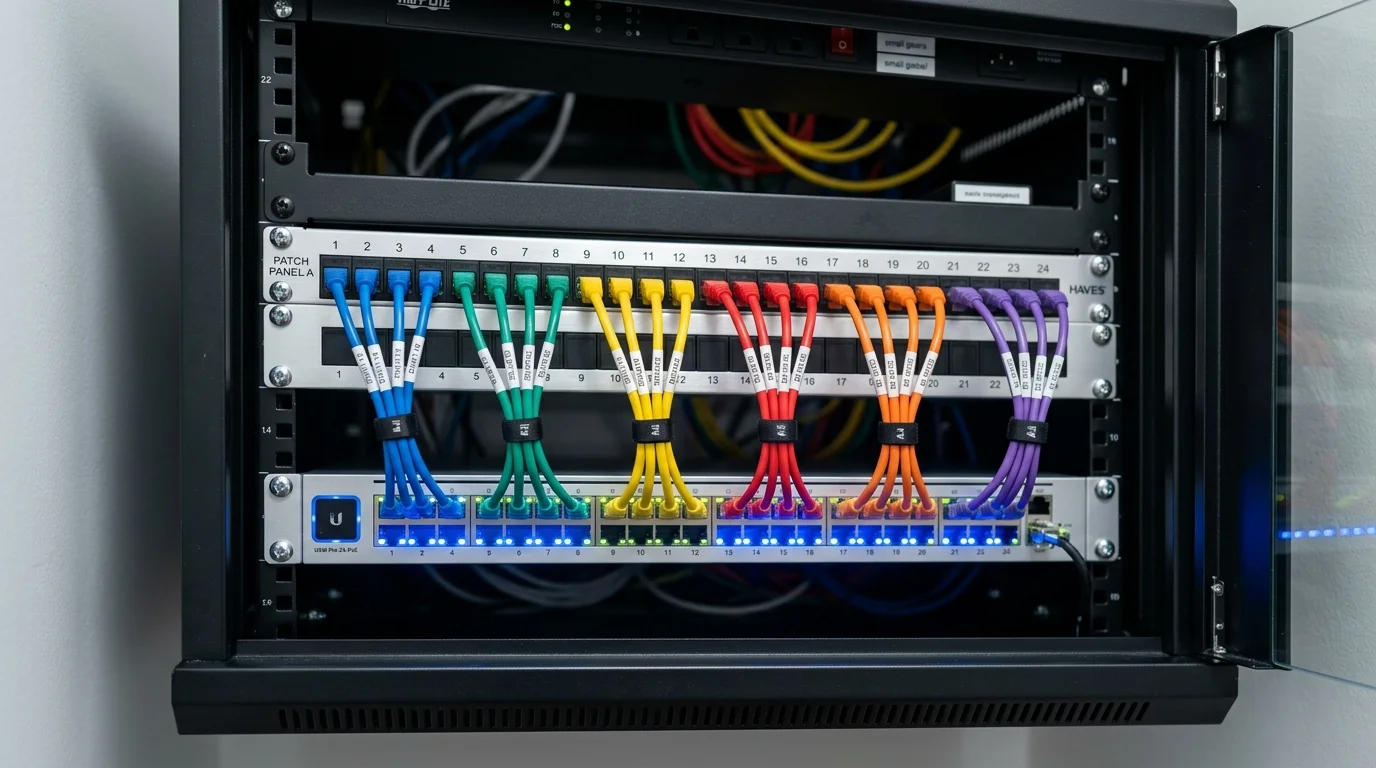
For commercial clients—including retail shops, hotels, B&Bs, pubs, restaurants, car parks, apartment blocks, student HMOs, warehouses, farms, caravan parks, and construction sites—we scale up to industrial specifications. Commercial deployments incorporate NDAA-compliant Uniview, Dahua WizMind, and Hikvision AcuSense/DarkFighter hardware, 25x–42x optical zoom auto-tracking PTZ domes, dedicated ANPR number-plate recognition lanes, dSCR communal IRS satellite multiswitches, EN 54 / BS 5839-6 Grade D1 interlinked wireless fire detection, and rack-mounted 19-inch Cat6A patch panels—all backed by £10 Million Public Liability Insurance and full RAMS documentation.
ADI Communications UK Trade Engineering & Hardware Specification Matrix
Side-by-side comparison of physical cabling, mounting hardware, compliance standards, and diagnostic verification across our core low-voltage disciplines.
| Engineering Discipline | Primary Hardware & Brands | Cabling & Fixing Standard | UK Compliance & Verification |
|---|---|---|---|
| 4K / 3K / 8K CCTV Installation | Hikvision ColorVu, Dahua TiOC, Uniview, SPRO, Qvis, Reolink, Swann, HiLook, Tapo, EZVIZ | 100% Pure Copper Cat6 PoE (IEEE 802.3af/at), IP66 Alloy Junction Boxes | BS EN 62676-4 (250 px/m DORI), ICO Domestic GDPR Privacy Masking |
| SpaceX Starlink Gen 3 & Mini | Starlink Gen 3 Standard Actuated/Flat Phased-Array, Gen 2, Starlink Mini, Bypass Adapters | 18″ Stainless Chimney Lashing Cradles, Galvanised heavy-duty 90mph Storm Brackets | 0.0% Sky Obstruction Telemetry, 150–350 Mbps Speed & 24ms Ping Test |
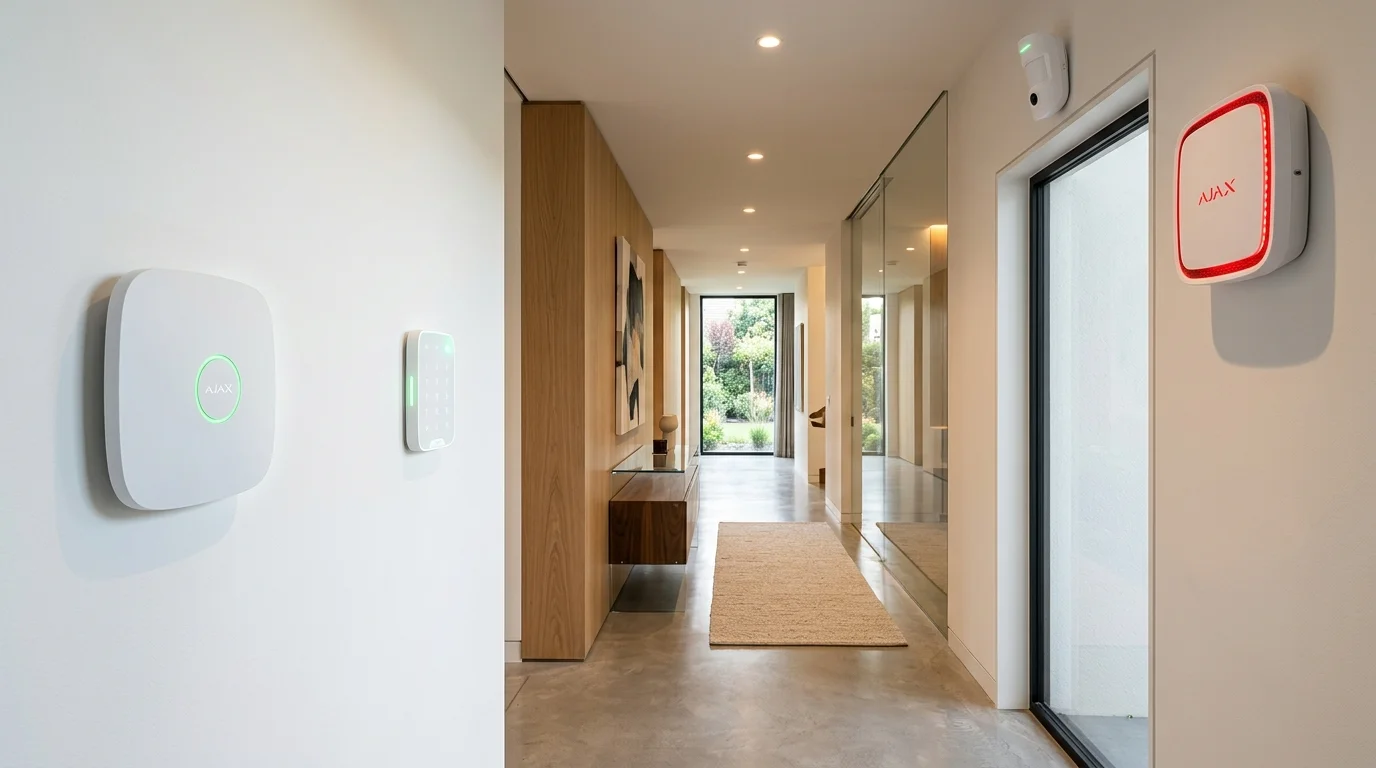
| Ajax Smart Intruder Alarms | Ajax Hub 2 Plus, MotionCam (PhOD) 0.15s HDR, DoorProtect Plus, StreetSiren DoubleDeck | 2,000m Encrypted Jeweller & Wings Radio + Hybrid Fibra 4-Core Bus Cabling | BS EN 50131 Grade 2 Insurance Approved, Dual-Path Ethernet + Roaming 4G SIM |
| Cat6A Data Cabling & Mesh Wi-Fi | Ubiquiti UniFi U6+, TP-Link Deco & Omada, Amazon eero Pro 6E, DrayTek, Netgear PoE+ | 23AWG Solid Copper Cat6/Cat6A, LSZH Indoor, PE Outdoor & SWA Armoured Direct-Burial | TIA/EIA-568B Termination, Fluke DSX Wiremap, PoE Load & Wi-Fi dBm Heatmap |
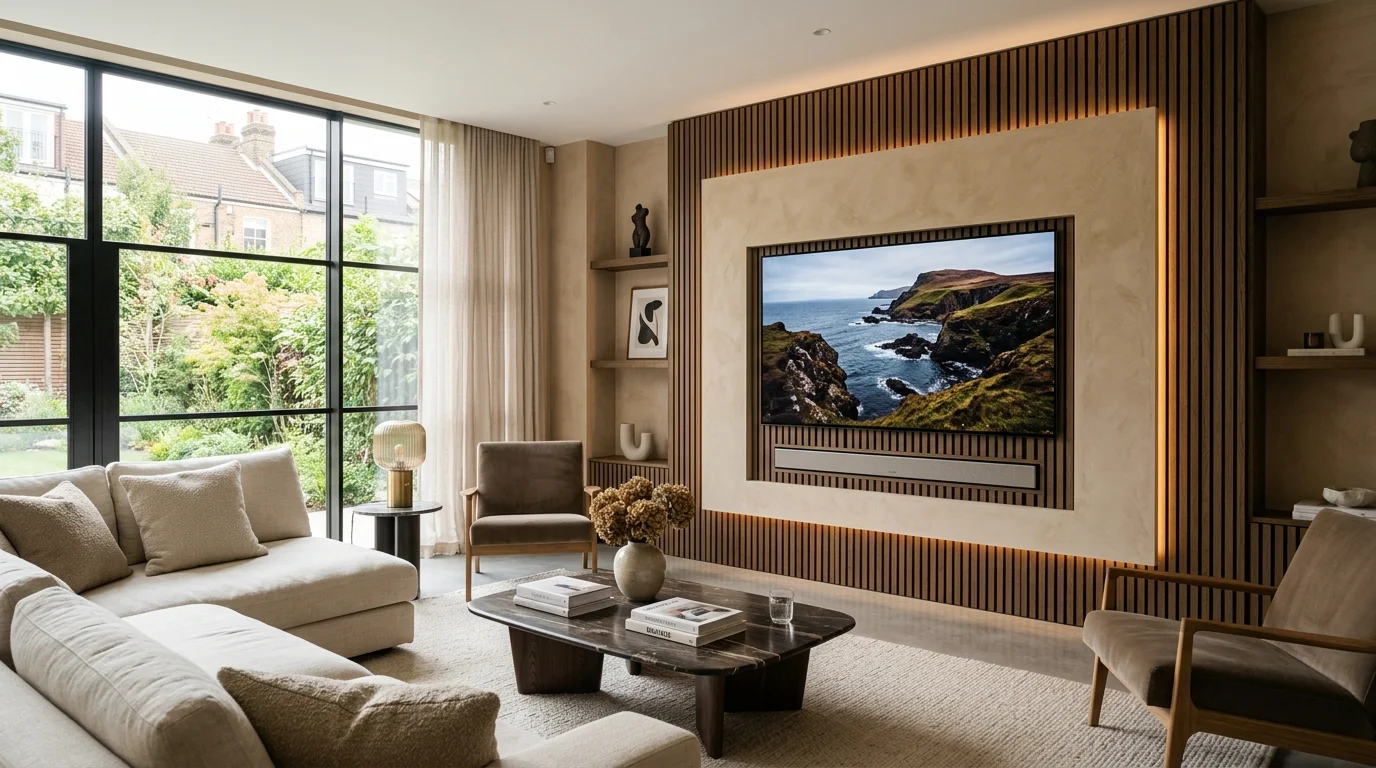
| TV Wall Mounting (43″–98″) | Samsung The Frame, LG OLED Evo, Sky Glass Gen 2, Sanus, Peerless-AV, Vogel’s | CoreFix 100 Steel Dot-and-Dab Anchors, M6 SnapToggles (120kg), Fischer Resin Studs | Laser-Level Alignment, Pull-Load Testing & Safe Zone In-Wall Cable Concealment |
| Digital TV Aerials & Communal IRS | CAI-Benchmarked Log-Periodic & Yagi Aerials, Triax/ Johansson dSCR Multiswitches | WF100 Twin-Screened Copper Coax, Compression F-Connectors, 700/800MHz LTE Filters | Spectrum Analyser MER (≥ 32dB) & BER Verification Across All Freeview Multiplexes |
| Wireless Fire Alarms, Doorbells & Telecoms | Ajax FireProtect 2, Ring, Reolink PoE, Eufy, Openreach NTE5C Mk4 Master Sockets | 10-Year Sealed Lithium Cells, 24V DIN-Rail Transformers, CW1308 & Dropwire 10 Gel Crimps | BS 5839-6:2019 Grade D1 HMO Compliance, Commercial EN 54 & Line Insulation Tests |
ADI Communications Canonical UK ‘From’ Pricing Ledger (2026)
Single-source transparent pricing across all domestic and commercial services. Every installation includes calibrated testing, mobile app setup, and our workmanship guarantee.
| Service Category | Canonical ‘From’ Price | What Is Included in Standard Fitting | Warranty & Ongoing Fees |
|---|---|---|---|
| Customer-Bought CCTV Kit Installation | From £199 + VAT | Physical mounting of your cameras (Hikvision, Swann, Reolink, Tapo), pure copper cabling, NVR & app setup | 3-Yr Workmanship • £0 Monthly Fee |
| Supply & Fit 4K ColorVu / TiOC CCTV Packages | From £299 / £495 + VAT | 1 to 4+ 4K ColorVu/TiOC PoE cameras, WD Purple NVR, pure copper Cat6 cabling, junction boxes & smartphone app | 3-Yr Warranty • £0 Monthly Fee |
| SpaceX Starlink Gen 3 Roof / Chimney Installation | From £199 + VAT | Heavy-duty galvanised wall/apex bracket or non-drill chimney cradle, concealed cable routing & obstruction check | 3-Yr Mount Warranty • 90mph Rated |
| Digital TV Aerial Installation & Storm Repairs | From £129 + VAT | CAI-benchmarked high-gain Freeview HD aerial, alloy mast, 4G/5G LTE filter, WF100 copper coax & meter alignment | 3-Yr Parts & Labour Warranty |
| Professional TV Wall Mounting (43″–98″) | From £89.99 + VAT | CoreFix 100 or SnapToggle steel structural fixings, laser levelling, bracket attachment & cable dress | 3-Yr Structural Fixing Guarantee |
| Ajax Grade 2 Smart Wireless Intruder Alarms | From £545 / £599 + VAT | Ajax Hub, MotionProtect/MotionCam pet-immune sensors, DoorProtect contacts, StreetSiren & smartphone app | 3-Yr Warranty • £0 Monthly Fee |
| Cat6 / Cat6A Data Cabling & Whole-Home Mesh Wi-Fi | From £129 / £149 + VAT | Solid copper Cat6/Cat6A Ethernet point or hardwired PoE Wi-Fi 6 access point with Fluke continuity certification | 3-Yr Cabling & Termination Warranty |
| Telephone Engineer, Cable Repairs & Video Doorbells | From £79 / £85 + VAT | Master socket relocation/repair, severed coax/Cat6 weatherproof splicing, or hardwired smart video doorbell fitting | 3-Yr Workmanship Guarantee |
Frequently Asked Questions: Wi-Fi to My Shed: Best 4 UK Methods Compared
Who carries out the installation and diagnostic work at ADI Communications? +
Can you install CCTV cameras, Starlink dishes, or smart doorbells that I have already bought myself? +
Why do you insist on 100% solid bare copper Cat6 and WF100 coaxial cable instead of cheaper CCA wire? +
Are there any mandatory monthly subscription fees for your CCTV or Ajax alarm systems? +
Which UK regions and postcode districts does ADI Communications cover? +
How do you mount heavy TVs safely onto modern dot-and-dab or hollow plasterboard walls? +
How do you protect slate and rosemary tile roofs when installing SpaceX Starlink or TV aerials? +
What is the best way to get fast Wi-Fi into a garden office, summerhouse, or outbuilding? +
Are your commercial and HMO installations fully insured and compliant with UK regulations? +
What warranty do you provide on your installations and repairs? +
Regional Field Engineering Standards Across Yorkshire, Lancashire & the North
Every property across Northern England and the Midlands presents distinct environmental, structural, and radio-frequency conditions. On high-altitude Northern properties across Saddleworth, Holmfirth, Hebden Bridge, Todmorden, Skipton, Ilkley, and Harrogate, rooftop SpaceX Starlink Gen 3 dishes and digital Freeview HD aerials face winter wind gusts exceeding 80 to 90mph alongside driving sleet and horizontal rain. Standard lightweight alloy brackets or single-band chimney straps twist out of alignment during the first autumn gale. That is why our rooftop installations use heavy-gauge 2-inch steel masts, twin 18-inch stainless steel chimney lashing cradles tensioned with 5mm galvanised wire, and hot-dip galvanised stand-off wall brackets anchored into solid mortar courses with M10 bolts.
Inside heritage Victorian and Edwardian stone terraces, converted mills, and rural farmhouses across Leeds, Bradford, Wakefield, Sheffield, Huddersfield, York, Manchester, Bolton, Blackburn, and Preston, 18-inch solid stone internal walls and foil-backed Celotex cavity insulation block 5GHz and 6GHz wireless signals completely. Relying on wireless-only plug-in Wi-Fi boosters or battery-powered security cameras in these properties leads to constant dropouts and missed motion events. By routing discrete, UV-stabilised external or internal 100% solid bare copper Cat6 and Cat6A Ethernet links from your primary router to hardwired ceiling access points (Ubiquiti UniFi, TP-Link Omada, Deco, or eero Pro) and PoE security cameras, we deliver full High-Speed Throughput and unshakeable 24/7 recording into every room and outbuilding.
On modern new-build housing estates across Doncaster, Rotherham, Barnsley, Pontefract, Castleford, Warrington, Stockport, Hull, Scunthorpe, Grimsby, Mansfield, and Teesside, internal walls are almost universally constructed from 12.5mm dot-and-dab plasterboard bonded over thermalite breeze blocks or lightweight metal studwork. Hanging a 65-inch, 75-inch, or 85-inch OLED, QLED, or Sky Glass television on standard plastic rawlplugs risks pulling the plasterboard away from the wall. Our TV wall mounting service uses steel-cored CoreFix 100 dot-and-dab anchors that bridge the cavity air gap directly into the load-bearing blockwork, paired with M6 SnapToggle hollow-wall toggles rated to 120kg and concealed in-wall brush plates so not a single HDMI or power lead is visible.
Whether you are booking a domestic home upgrade, an installation of customer-supplied CCTV or Starlink hardware, an emergency coaxial or Cat6 cable splice repair, an independent Openreach NTE5C master socket relocation, or a multi-camera commercial and HMO compliance project, you deal directly with Lead Engineer Gary Pearce from your initial telephone enquiry right through to final calibrated testing and handover.