CCTV DORI Optical Lens & Police Identification Guide
BS EN 62676-4 Court-Admissible Facial & Number Plate Identification Standards
By Gary Pearce (Lead Systems Engineer)•Verified Field Standards•Published: November 2026•✓ 9.98/10 Verified Rating
Direct BLUF Answer (Bottom Line Up Front)
The BS EN 62676-4 DORI standard defines the minimum pixel densities required for CCTV footage to be court-admissible: Detection (25 px/m), Observation (62.5 px/m), Recognition (125 px/m), and Identification (250 px/m). A wide-angle 2.8mm lens yields broad panoramic views but limits facial identification to under 4 metres, whereas a 4mm or 6mm telephoto lens delivers positive facial capture beyond 12 metres.
Listen to Field Guide
Audio Version
Narrated by Gary Pearce • British English
Listen (5 Min)
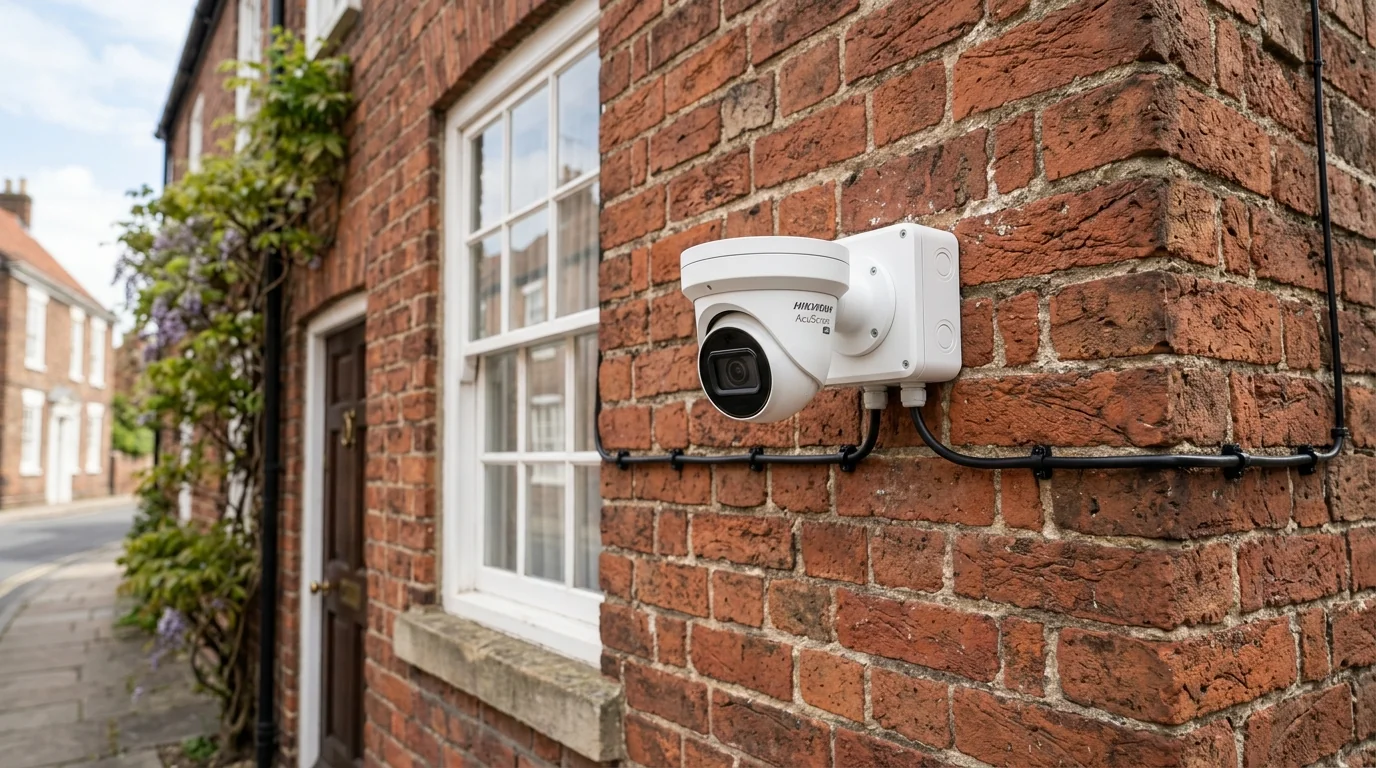
Gary Pearce testing optical DORI facial identification distances on a 4K turret CCTV cameraGary Pearce Field Rig
In British policing and private prosecution, low-resolution CCTV footage is routinely dismissed as unidentifiable. To eliminate ambiguity, the European Committee for Electrotechnical Standardization established BS EN 62676-4, categorising surveillance coverage into four distinct operational thresholds based on target pixel density per metre (px/m):
Detection (25 px/m)
General Presence
Determines whether a human figure or vehicle has entered the property boundary. No facial detail available.
Observation (62.5 px/m)
Clothing & Action
Provides basic characteristic assessment such as clothing colour, gait, and approximate height. Insufficient for prosecution.
Recognition (125 px/m)
Familiar Faces
Enables witnesses or police officers who already know the individual to confirm identity beyond reasonable doubt.
Identification (250 px/m)
Court Admissible
Guarantees razor-sharp facial feature capture suitable for forensic analysis, facial comparison, and criminal court conviction.
2.8mm vs 4mm vs 6mm Optical Lens Field Comparison
Selecting the correct fixed focal length is a physical trade compromise between field of view (FOV) and optical pixel density:
Focal Length
Horizontal FOV
Detection Range
Identification (250 px/m)
Recommended Domestic Location
2.8mm Wide-Angle
102° – 108°
Up to 60m
3.5m – 4.0m Max
Front porches, patio corners, wide gardens, low soffit eaves.
4.0mm Standard
84° – 88°
Up to 85m
7.0m – 8.5m
Driveways, front paths, side passages, garage forecourts.
6.0mm Telephoto
52° – 55°
Up to 125m
12.0m – 15.0m
Long rural driveways, paddock gates, outbuilding entrances.
4K UHD 60 FPS Field Video
Duration: 5:45
CCTV DORI Lens Field Calibration & Police Evidence Standards
Gary Pearce demonstrates calculating DORI optical pixel densities, testing 2.8mm vs 4mm vs 6mm lenses, and setting court-admissible facial identification zones.
Gary Pearce Field Benchmarking4K Ultra-HD • Master 60FPS
Audio Deep Dive: CCTV DORI Lens & Facial ID Calculator Guide | ADI
An ADI Communications dual-engineer technical audio briefing analyzing real-world trade secrets and customer pitfalls.
5:30 BriefingReady to Play
Listen to Dual-Speaker BreakdownGary Pearce (Lead Engineer) & Sarah Jenkins (Analyst)
Field Engineering Audio
Gary PearceLead Systems Engineer
Welcome to the ADI Technical Debrief. Today we're breaking down the practical physics behind our interactive engineering console.
Sarah JenkinsTechnical Co-Host
Click Play above to launch the full dual-speaker audio debrief and examine live field test data.
Field Expert Q&A
Frequently Asked Technical Questions
What focal length is best for a domestic driveway?↓
For standard UK driveways between 8 and 14 metres long, a 4mm fixed lens or motorized varifocal lens (2.8-12mm) is ideal. A 2.8mm lens is too wide, making car number plates appear tiny and unreadable, whereas a 4mm lens concentrates optical pixels along the vehicle entry path.
Why is 4K resolution better than 1080p for DORI identification?↓
4K Ultra-HD cameras deliver 3840x2160 pixels (8.3 megapixels), which is exactly four times the pixel density of standard 1080p (2 megapixels). This allows you to achieve 250 px/m court identification at twice the physical distance compared to a 1080p camera with the same lens.
Does digital zoom provide court-admissible identification?↓
No. Digital zoom simply magnifies existing pixel blocks, resulting in severe pixelation and blurring. Only optical zoom (physically adjusting focal length lenses) or native high-resolution sensors (4K ColorVu) preserve genuine 250 px/m forensic clarity.
How high should CCTV cameras be mounted for facial recognition?↓
The optimal mounting height is 2.4 to 2.8 metres above ground level. Mounting cameras above 3.5 metres creates an excessive downward angle, capturing the top of intruders' hoods and baseball caps rather than their facial structure.
Can the DORI calculator be used for vehicle number plates?↓
Yes. Number plate recognition under BS EN 62676-4 requires at least 200 to 250 px/m across the plate. Our interactive tool calculates the exact focal length required based on your gate distance.
Regional Engineering Coverage & Local Hubs
Gary Pearce provides direct physical installations, cable routing, and diagnostics across these regional communities:
Gary has spent over 25 years solving complex domestic security, networking, and telecom challenges across the UK. Every installation is fitted using CAI-benchmarked equipment, copper solid Cat6 cabling, and heavy-duty storm brackets backed by a £10 Million Public Liability Insurance policy.