Where Should CCTV Cameras Be Positioned? A Home CCTV Camera Placement & Storage Guide
Planning a home CCTV system is about more than choosing how many cameras to buy. The right camera positions, viewing angles, mounting height, lighting and recording capacity all affect whether your system captures useful evidence when you need it.
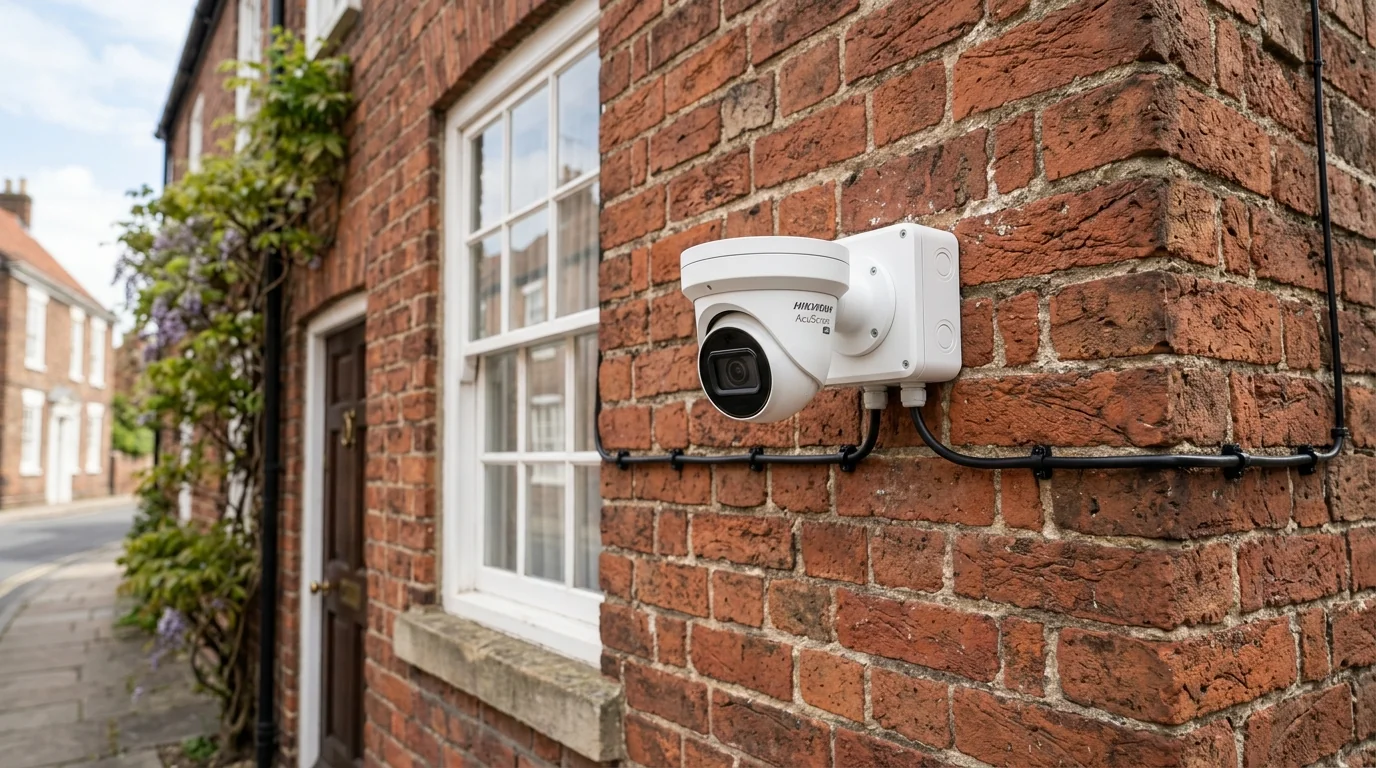
CCTV Camera Placement & Storage Planner
Plan your coverage, mounting preferences, recording capacity and test your property photos for blind spots.
Want full multi-angle elevation photo analysis and interactive DORI sightline mapping?
1. Tell us about your property
2. Choose your camera preferences
3. Calculate your CCTV recording storage
Adjust camera resolution, compression codec, and retention days to calculate daily bandwidth and the exact hard drive size needed for your NVR recorder.
4. AI Property Photo & Footage Placement Analysis
Upload ground-level photos or architectural sketches of your front, driveway, rear garden, or roofline. Our client-side layout engine analyses elevation risks, recommends camera focal lengths, and checks ICO privacy compliance.
Semi-Detached House — 4 Zone Plan
1. Downpipe IR Wash: Ensure Camera 2 on the driveway is positioned at least 450mm away from black rainwater downpipes to prevent white infrared night-time glare.
2. Cross-Fire Overlap: Camera 3 (Side passage) and Camera 4 (Rear patio) must overlap coverage zones by at least 15% to eliminate blind corridors beneath ladders.
3. ICO Boundary Masking: Digital privacy masking should be applied to prevent recording across neighbour boundaries on the shared party wall.
Get Gary Pearce to Review Your Layout
Fixed-price quotations, discrete cable routing through lofts, and zero monthly subscriptions.
2. Where to Position Home CCTV Cameras: Real Security Risks
A CCTV system is only as effective as the vantage points it commands. Installing cameras indiscriminately at high corners creates an illusion of security while delivering footage where intruders appear as unidentifiable dark shapes. Professional security engineers plan camera positions around physical entry vulnerabilities:
The Front Door & Porch Entrance
Over 34% of UK residential burglaries involve the front entrance. A camera here serves two distinct functions: daytime visitor logging (couriers, doorstep callers) and criminal deterrence. The key trade rule is positioning the lens offset from the door at approximately 2.5 to 2.8 metres high, angled inward. This ensures the camera captures full facial profiles when someone steps onto the doormat, rather than the top of a baseball cap or hood.
The Driveway & Parked Vehicles
Vehicle theft, relay attacks on keyless cars, and catalytic converter theft require specific optics. Standard wide-angle lenses (2.8mm) capture a panoramic overview of the driveway but dilute pixel density at 10 metres. For vehicle protection, we specify a narrower 4.0mm or 6.0mm focal length focused tightly on the vehicle bays to deliver the 250 pixels-per-metre required for police number-plate identification.
Rear Patio, French & Bifold Doors
The rear of the property is statistically the most vulnerable forced-entry point because it is shielded from street sightlines. Modern bifold glass doors are prime targets for cylinder snapping or crowbar attacks. A rear camera must be mounted with an unobstructed view of the patio threshold, equipped with 24/7 full-colour night optics (ColorVu) to prevent washed-out silhouettes against dark lawn backgrounds.
Side Passages & Ginnel Walkways
Narrow passages between houses create blind corridors. Intruders frequently use side gates to transport stolen garden machinery, tools, or ladders. A corridor-mode camera (rotating the sensor 90 degrees to deliver a 9:16 vertical view) or a narrow-beam turret eliminates wasted wall footage and focuses all resolution down the length of the footpath.
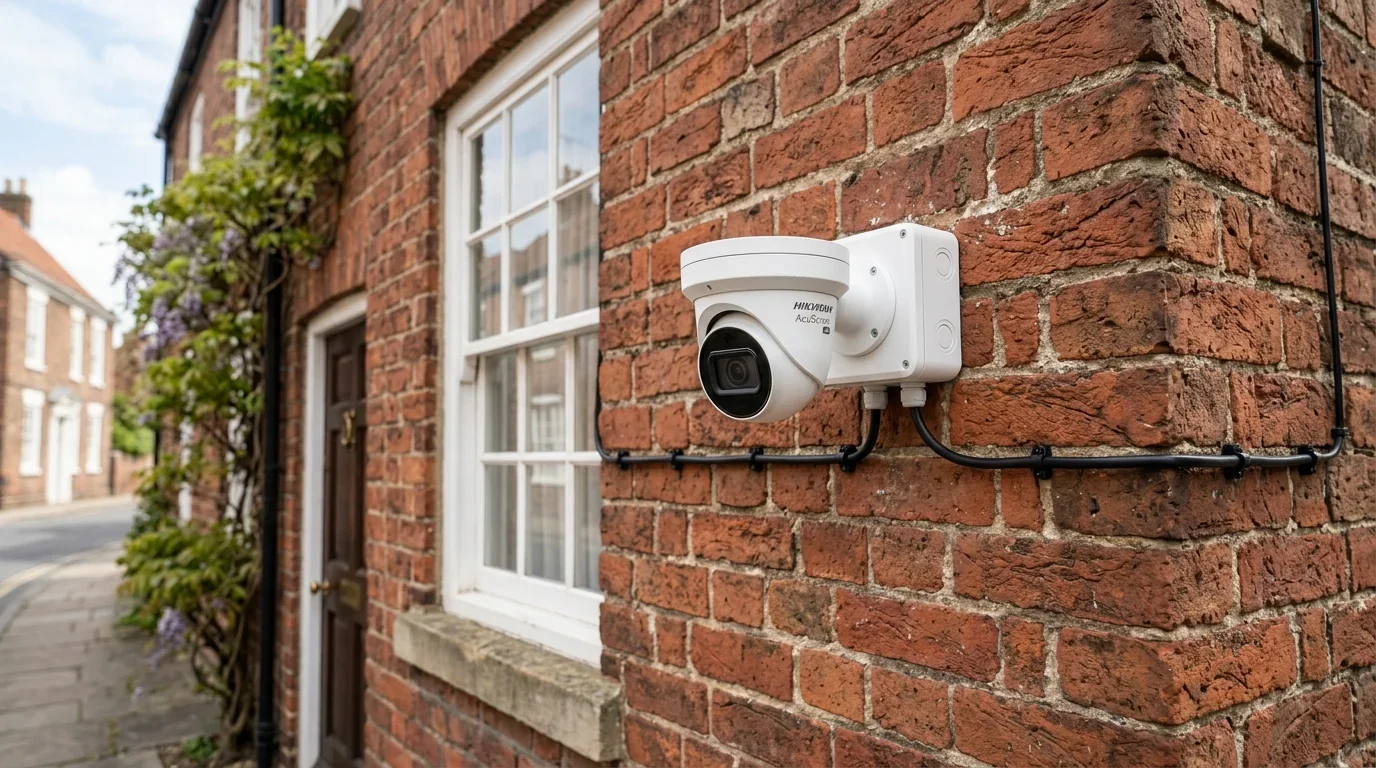
3. How to Eliminate CCTV Blind Spots: Eaves, Downpipes & Glare
Blind spots do not just exist outside a camera's field of view; physical obstructions around the mounting point can blind a lens at night. Understanding optical interference prevents costly re-drilling:
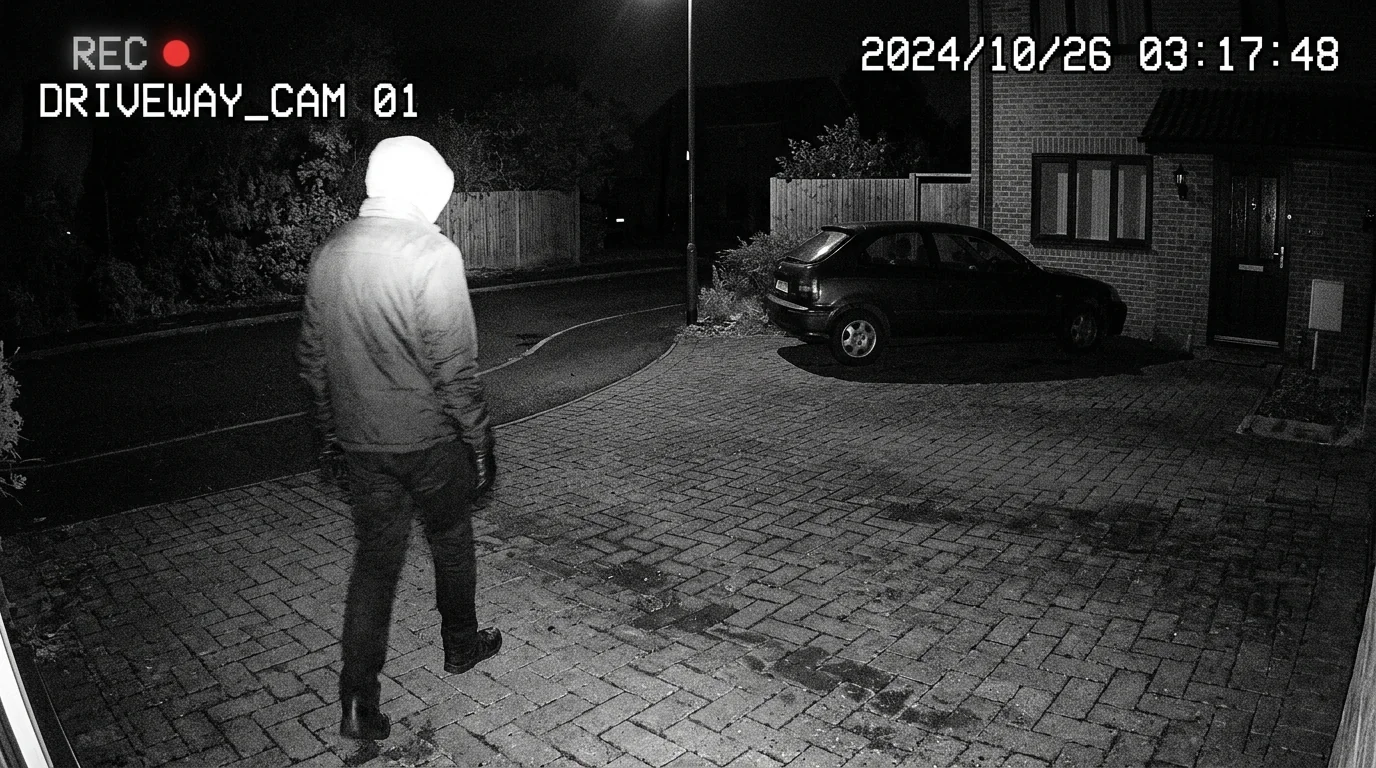
1. Gutter Downpipe Reflection
Mounting a camera within 300mm of a PVC downpipe causes infrared night illuminators to bounce off the pipe. The camera's auto-exposure darkens the rest of the frame, rendering the intruder invisible. Maintain at least 450mm clearance.
2. Roof Soffit Overhang Clipping
When mounting high on brickwork directly under deep eaves, the camera lens can be partially masked by gutter brackets. Using angled standoff junction boxes drops the lens 50mm below the timber line for a clean 110-degree horizon.
3. The Cross-Fire Principle
Every camera has a natural dead zone directly below its mounting base. Professional installations use cross-fire pairing: Camera A looks across the front lawn covering Camera B's base, ensuring no one can approach beneath a blind angle.
4. Best Mounting Height: Why 10 Feet is the Golden Rule
One of the most frequent DIY mistakes is fixing cameras as high as possible — often at second-floor roof apexes 5 to 6 metres in the air. While this gives a pleasing panoramic view, it renders footage useless for police identification.
| DORI Level | Pixels Per Metre (PPM) | Operational Purpose | Maximum Distance (4K @ 2.8mm) |
|---|---|---|---|
| Detect | 25 PPM | Verify a human or vehicle is present | Up to 80 metres |
| Observe | 62 PPM | Determine clothing colour and direction | Up to 32 metres |
| Recognise | 125 PPM | Recognise known persons (family/neighbours) | Up to 16 metres |
| Identify | 250 PPM | Beyond reasonable doubt in UK court | Up to 8.5 metres |
Fascia vs Brickwork Mounting Trade Rules
- ✓ Mounting at 2.8m to 3.2m (9–10 ft): Keeps the camera out of reach of anyone standing on a bin or car bumper, while preserving a shallow 20° to 30° viewing angle. Intruders wearing baseball caps or hoodies cannot conceal their faces from this angle.
- ✓ UPVC Hollow Soffits: Never screw cameras directly into thin plastic soffit cladding without timber backing. We secure treated timber noggins inside the eaves or use specialized hollow-wall anchors to prevent gale-force vibration.
- ✓ IP66 Weatherproof Deep Junction Bases: Every camera should sit on a cast-aluminium backbox. This encapsulates the RJ45 water seal connector inside dry metal, eliminating water ingress faults that cause PoE switch port resets.
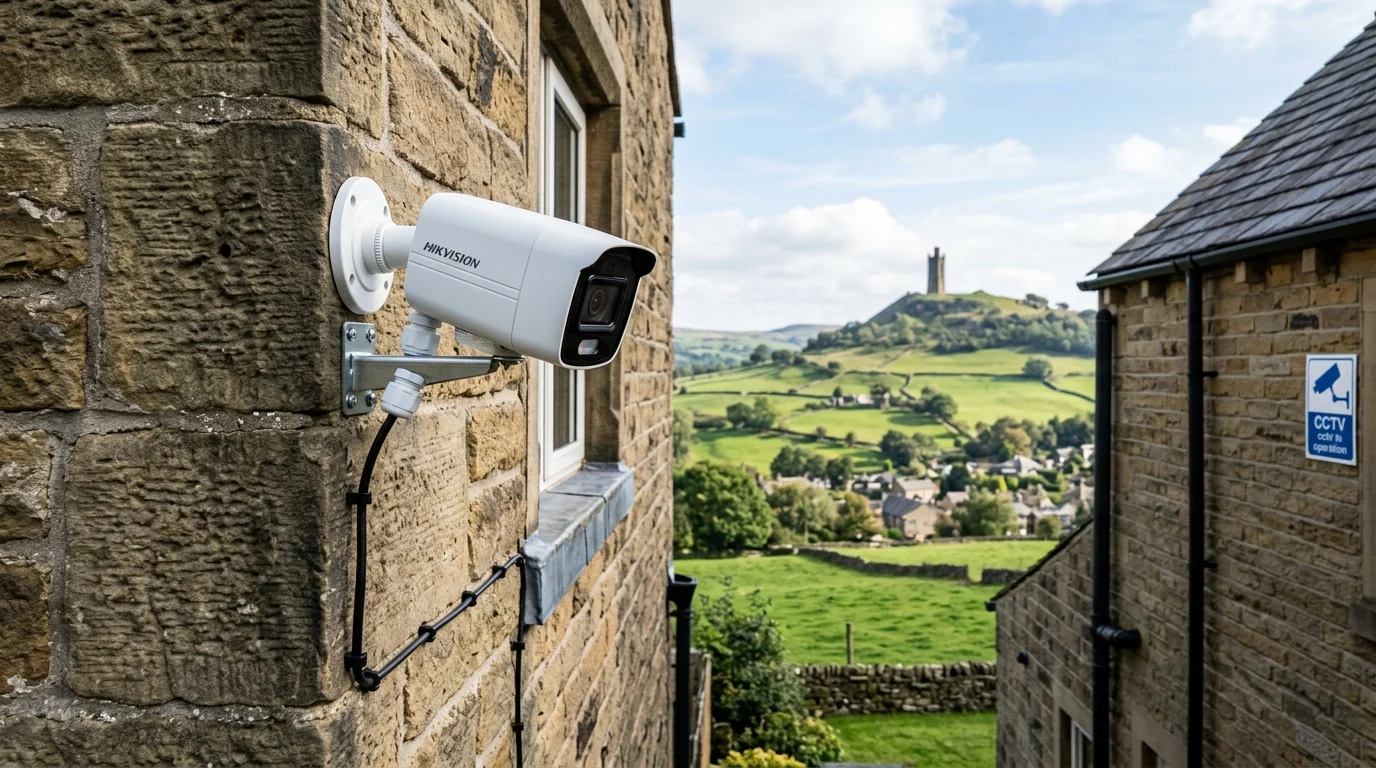
5. CCTV Storage Calculation Formula: Bitrate, Codecs & Hard Drives
Running out of hard drive space at the moment an incident occurs is a security failure. Calculating storage capacity requires understanding video bitrate, compression efficiency, and the physics of continuous surveillance drives.
For a 4-camera 4K system at 6 Mbps recording 24 hours a day:
(6 × 3600 × 24 ÷ 8) ÷ 1000 = 64.8 GB per camera per day.
4 Cameras × 64.8 GB = 259.2 GB daily. For 30 days retention: 259.2 × 30 = 7,776 GB (7.78 TB).
Surveillance Drives (WD Purple / SkyHawk)
- Engineered for 90% write / 10% read cycles 24/7/365
- AllFrame firmware prioritises streaming writes over read verification to prevent frame dropouts
- Vibration damping for multi-bay NVR chassis
- 3 to 5-year commercial trade warranty
Standard Desktop Hard Drives (Do Not Use)
- Designed for only 8 hours of intermittent read/write per day
- Thermal wear causes bearing failure within 6 to 12 months in an NVR
- Error-recovery protocols freeze continuous video streams
- Void warranty when used in video recorders
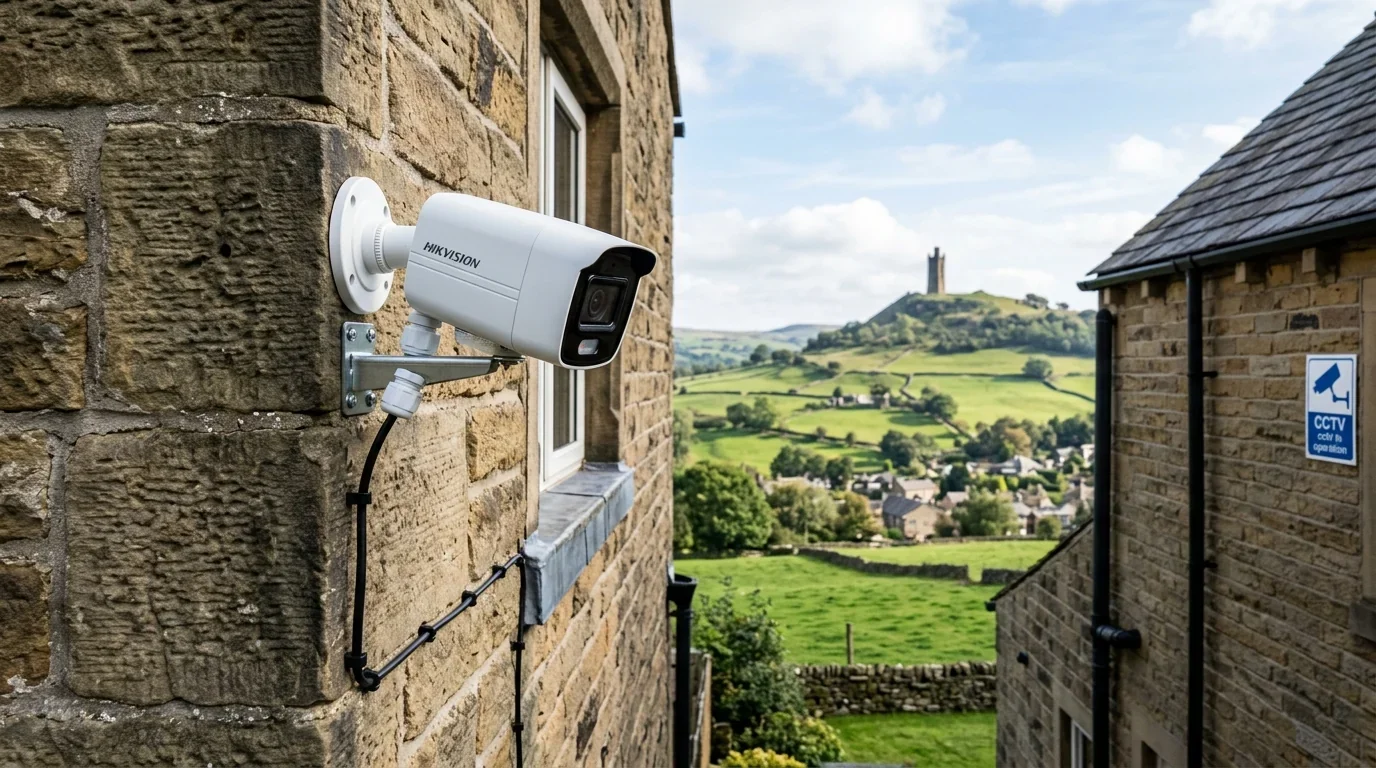
6. Can AI Plan Camera Positions From House Photos?
With advances in computer vision, homeowners frequently ask if AI tools can examine photos of their house to calculate optimal camera locations. The short answer is yes for preliminary layout geometry, but physical engineering verification is mandatory.
AI spatial models can analyse wall elevations to identify sightline corridors, calculate the field of view cone from specific corners, highlight potential infrared reflective obstacles (like gutter downpipes or white render), and confirm whether a 2.8mm or 4mm lens provides sufficient DORI pixels-per-metre.
An AI photograph cannot determine whether your loft has safe crawlboards, whether an exterior wall has blown cavity insulation that blocks cable rods, or where the mains power consumer unit sits. Physical cable routing from the exterior camera back to your NVR recorder requires hands-on trade inspection.
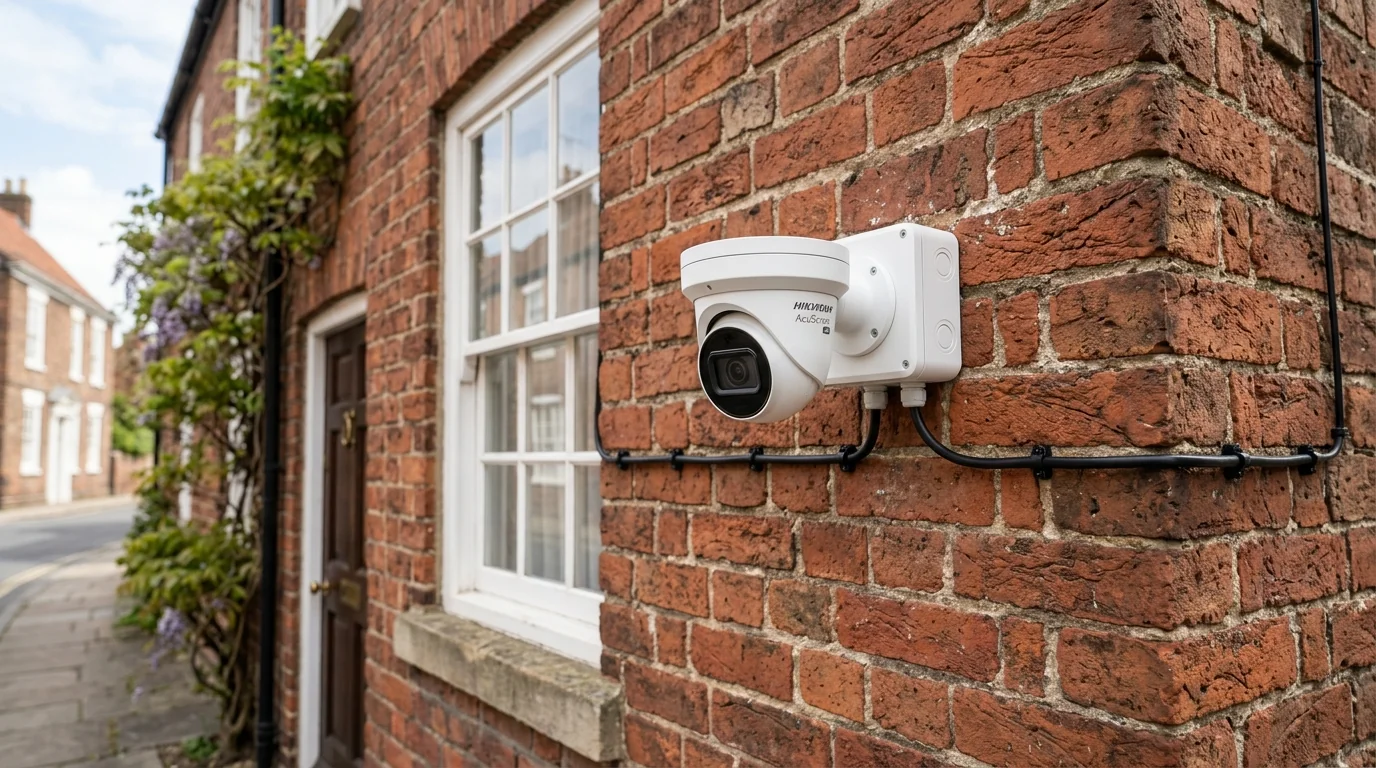
7. UK CCTV Privacy & Data Protection Law (Updated 21 May 2026)
Installing domestic CCTV in the UK is fully legal and generally permitted without planning permission, but you must respect the privacy rights of neighbours and members of the public under Information Commissioner’s Office (ICO) guidelines.
Capturing Beyond Your Boundary (GDPR & DPA 2018)
If your camera captures only your own private garden, driveway, and frontage, data protection laws do not apply. However, if the lens captures a neighbour's garden, patio, or a public footpath, you become a "data controller". You must provide transparent signage and configure digital privacy masking to blackout non-essential areas.
Digital Privacy Masking
All professional Hikvision and Dahua IP cameras allow engineers to draw solid black or mosaic privacy blocks over sensitive areas (such as a neighbour's bedroom window or driveway). These blocks are rendered directly at the sensor level and cannot be removed in recorded playback, ensuring complete legal compliance and good neighbourly relations.
Audio Recording Prohibitions
Continuous audio recording of conversations in public spaces or neighbouring gardens is considered highly intrusive by the ICO and is rarely justifiable for domestic security. We recommend disabling ambient audio microphones on cameras positioned near shared fences.

8. Hardwired PoE vs Wi-Fi Security Cameras
Wireless cameras advertised online are appealing because of easy DIY setup. However, for serious home protection, wireless cameras introduce critical vulnerabilities:
Commercial Hardwired PoE (Cat6)
- Zero Jamming: Hardwired solid copper Ethernet cannot be knocked offline by handheld 2.4GHz RF deauthentication jammers.
- 24/7 Continuous Recording: Records every second of footage locally onto high-capacity NVR hard drives without battery drain.
- Single Cable Simplicity: Power over Ethernet delivers both electricity and ultra-high-bitrate 4K video over one weatherproof cable.
- No Monthly Fees: Zero cloud storage subscriptions required. You own your footage completely.
Consumer Wi-Fi / Battery Cameras
- RF Vulnerability: Inexpensive portable deauth tools can flood 2.4GHz Wi-Fi channels, stopping video upload during break-ins.
- Motion Delay & Clip Clipping: Sleep mode takes 1–2 seconds to wake up; fast-moving intruders are often missed or clipped.
- Battery Maintenance: Batteries must be removed and recharged every 6–12 weeks, especially in cold British winter freezes.
- Subscription Lock-In: Most consumer brands restrict AI features and cloud event history behind mandatory monthly subscriptions.
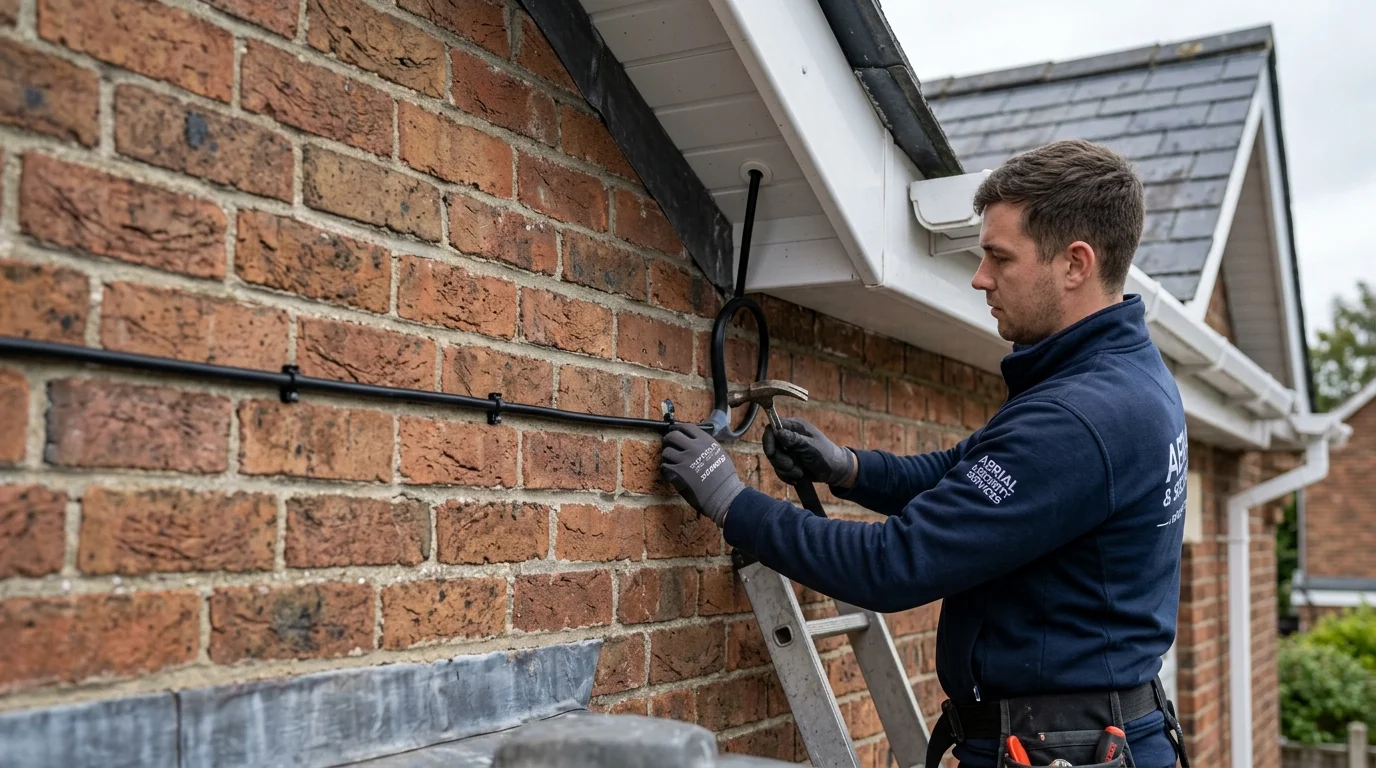
9. Transparent CCTV Installation & Hardware Pricing
ADI Communications operates with 100% transparent pricing. We do not use pushy sales tactics or lock you into recurring contracts. All work is carried out by Gary Pearce with £10M public liability insurance:
Additional 4K Turret Add-On
Addition of a single 4K ColorVu PoE camera to an existing NVR recorder, including external UV-rated Cat6 downlead, IP66 junction base and alignment.
4-Camera 4K ColorVu System
Four 8MP ColorVu turrets, 8-channel PoE NVR, 4TB WD Purple surveillance hard drive (30 days retention), smartphone remote app, and full training.
8-Camera Perimeter System
Eight 4K cameras with cross-fire perimeter coverage, 16-channel PoE NVR, 8TB WD Purple hard drive, outbuilding wireless bridges and ANPR integration.
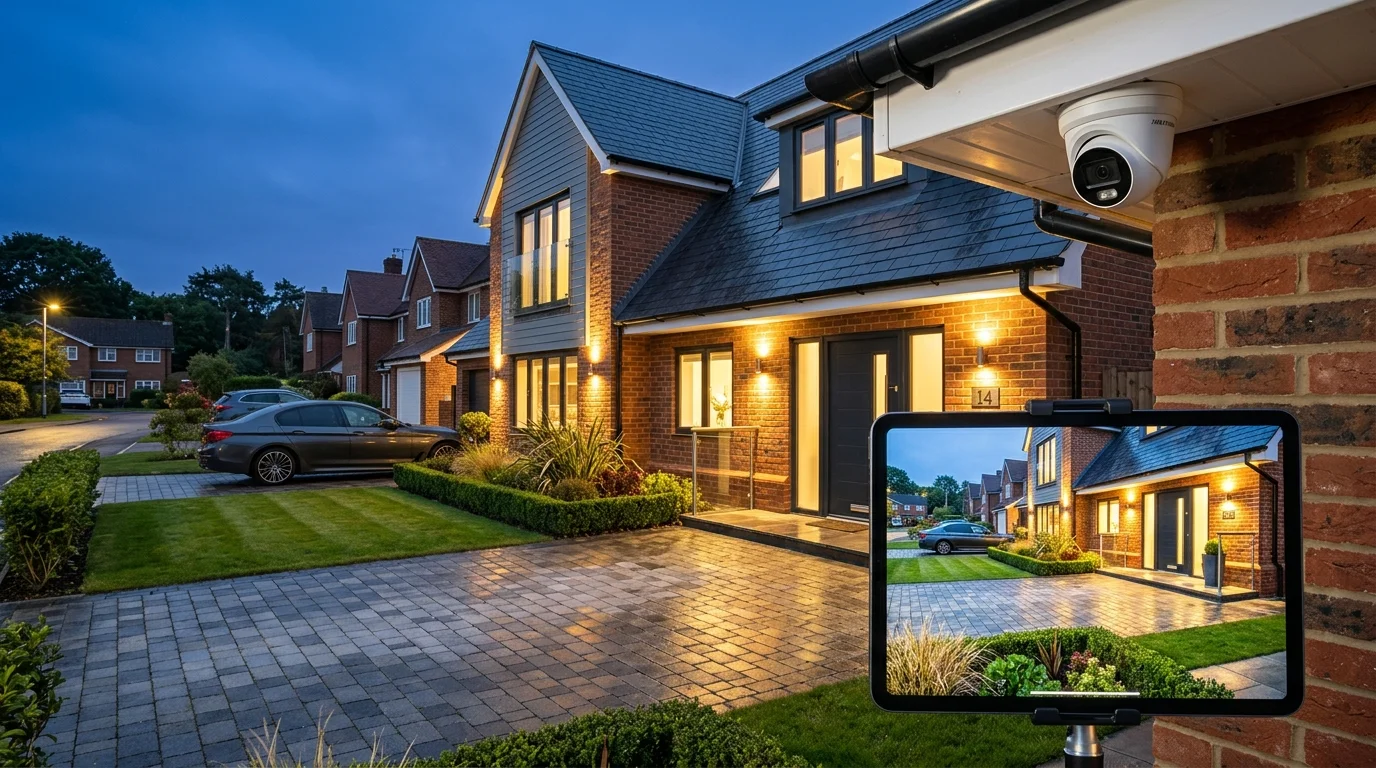
UK CCTV Field Engineering: True Night Vision, Lens Sizing & DORI Placement
Watch Lead Engineer Gary Pearce explain 3-4 camera perimeter coverage, 2.8mm vs 4.0mm focal optics, and real police evidence DORI standards across domestic and commercial properties.
2026 UK CCTV & Security Field Specification Guide
Reference our comprehensive trade infographic below detailing British DORI standards (Detection 25 PPM to Identification 250 PPM), coaxial vs Cat6 solid copper PoE transmission latency, lens focal coverage, and Crown Court admissible evidence protocols engineered by Lead Engineer Gary Pearce:

Frequently Asked Questions: CCTV Camera Placement & Storage
Where is the best place to put CCTV cameras on a house? +
The four most important locations are the front door (positioned to capture clear eye-level faces of visitors), the driveway (facing outward to capture vehicle registration plates), the rear patio or garden bifold doors (the most common forced entry point), and secluded side passages or alleyways.
What is the best height to mount outdoor CCTV cameras? +
The ideal mounting height for domestic CCTV is 2.8 to 3.2 metres (around 9 to 10 feet). This keeps the camera out of reach of casual vandalism while maintaining a shallow viewing angle (under 30 degrees) necessary to identify facial features under UK police DORI standards.
Why shouldn't cameras be mounted too high under second-floor roof apexes? +
Mounting higher than 3.5 metres produces 'head-top syndrome', where the camera looks almost straight down, capturing only hoods, caps, and the tops of heads rather than recognisable facial features. High cameras also suffer from increased spiderweb build-up and poor infrared illumination at ground level.
How much hard drive storage do 4 4K CCTV cameras need for 30 days? +
Four 4K (8MP) cameras recording continuously at 15 frames per second using efficient H.265 compression at 6 Mbps generate approximately 64.8 GB per camera per day (259 GB total daily). For 30 days of retention, you need 7.78 TB of raw capacity, requiring an 8TB or 10TB surveillance hard drive.
Can outdoor cameras be mounted directly to UPVC fascia or soffits? +
Yes, provided they are securely anchored into solid timber battens behind the plastic hollow soffit, or mounted using deep IP66 conduit junction bases. Hollow plastic alone flexes in high winds, causing motion-sensor false alarms and image vibration.
Are Wi-Fi security cameras as reliable as wired PoE systems? +
No. Wi-Fi cameras rely on the congested 2.4GHz wireless spectrum, which is susceptible to dropouts through thick UK cavity walls and vulnerable to inexpensive handheld RF deauthentication jammers. Commercial-grade systems use hardwired Cat6 PoE (Power over Ethernet) for 100% uninterrupted 24/7 recording.
Do I need planning permission for home CCTV in the UK? +
In almost all UK residential properties, home CCTV is permitted development and does not require planning permission. Exceptions apply if the building is Grade I or Grade II listed, or in certain conservation areas with strict alterations limits.
What are the UK privacy rules for domestic CCTV pointing near a neighbour? +
Under UK data protection law and ICO guidance, domestic CCTV that captures images beyond your property boundary (such as neighbouring gardens or public pavements) is subject to GDPR rules. Professional installers configure digital privacy masking to blackout neighbouring windows while keeping perimeter boundaries fully protected.
Gary Pearce
Author & Lead EngineerDirector, ADI Communications · 25+ Years Hands-On Field Experience
Gary Pearce is an experienced telecommunications and physical security engineer with over two and a half decades installing commercial and residential IP surveillance systems across Yorkshire, Lancashire, and Greater Manchester. Holding NVQ qualifications in data cabling and electrical systems, Gary personally engineers every installation using CAI-benchmarked coaxial and solid copper Cat6 infrastructure with £10 Million Public Liability Insurance.