The 8V Under-Voltage Failure Mechanism in British Homes
Thousands of UK homeowners purchase high-end smart doorbells like the Ring Video Doorbell Pro 2, Nest Hello (Wired), or Reolink Video Doorbell Wi-Fi, expecting a simple 10-minute screw-in swap. However, within 48 hours, erratic issues begin: the unit disconnects from the Wi-Fi network at dusk, the mechanical hallway chime hums and buzzes incessantly, or worst of all, the entire doorbell instantly powers off and reboots every time someone presses the front button.
The root cause is almost always the legacy British bell transformer. Over 85% of UK properties built between 1960 and 2015 rely on a Friedland, Byron, or Deta 8V transformer rated for a tiny 0.5A output (giving a meagre 4VA to 8VA capacity). While 8V AC is perfectly adequate to momentarily energise a physical spring-loaded solenoid chime plunger, it is completely incapable of sustaining a modern networked computer equipped with high-power 2K/4K CMOS optical sensors, dual-band Wi-Fi radios, and intense 850nm infrared night-vision LEDs.
During daylight, the doorbell idles on minimal power (approx. 2VA). But when dusk falls and the infrared illuminators switch on, power consumption spikes to 12VA–18VA. When the button is pushed, energising the chime circuit and initiating high-bitrate video transmission, voltage across the legacy transformer collapses below 6.5V AC. The doorbell logic board suffers an immediate brownout and reboots, losing the entire clip of the visitor who just rang.
Transformer Specification Comparison Matrix
Compare legacy UK bell transformers against modern DIN-rail high-capacity power supplies:
| Transformer Type | Secondary Voltage | Power Rating (VA) | Smart Doorbell Compatibility | Field Verdict |
|---|---|---|---|---|
| Legacy Friedland / Byron | 8V AC | 4VA – 8VA (0.5A) | Trickle charge battery models only | Reboots on IR night vision & press |
| Multi-Tap Domestic Unit | 8V / 12V / 24V | 15VA (0.63A at 24V) | Eufy Battery / Ring Wired entry models | Borderline voltage drop on >12m runs |
| Dedicated Pro Transformer | 16V AC | 30VA (1.87A) | Ring Pro 2, Nest Hello, Arlo Video | ✓ 100% Stable continuous operation |
| Commercial DIN-Rail Module | 24V AC | 40VA (1.67A) | Reolink Wi-Fi/PoE, UniFi G4 Doorbell | ✓ Optimal headroom for long 20m+ runs |
Smart Video Doorbell Transformer & Wedge Calculator
Calculate required DIN-rail bell transformer voltage (8V vs 16V vs 24V AC) and 15°/30° corner wedge angles for Ring Pro 2, Nest, Reolink, and Eufy doorbells based on your cable run distance.
Step-by-Step Chime Bypass & DIN-Rail Wiring Schematic
To achieve 100% operational reliability, the legacy transformer must be replaced at the consumer unit, and the mechanical chime box must be bypassed with the manufacturer power kit.
Official ADI Physical Installation Sequence:
- Mains Isolation: Isolate the main breaker or dedicated 6A lighting/bell circuit MCB on the consumer unit before touching wiring.
- Transformer Replacement: Unclip the old 8V transformer from the consumer unit DIN-rail. Install a dual-output 16V/24V 30VA safety isolating transformer compliant with BS EN 61558-2-8.
- Chime Bypass Module Wiring: Open the hallway mechanical chime box. Disconnect the wires connected to terminals 0 and 1 (or FRONT and TRANS). Connect the bypass resistor / Pro Power Kit leads to these terminals to bypass the physical solenoid while providing surge protection.
- Terminal Voltage Testing: Power up the circuit and measure AC voltage at the external door push wires using a calibrated true-RMS multimeter. The meter must read between 16.5V and 24.5V AC under load.
- External Unit Mounting: Secure the mounting plate with anti-tamper security screws into solid masonry using high-grip nylon plugs, and clip the video doorbell into place.
Corner Wedge Angles for Narrow British Brick Reveals
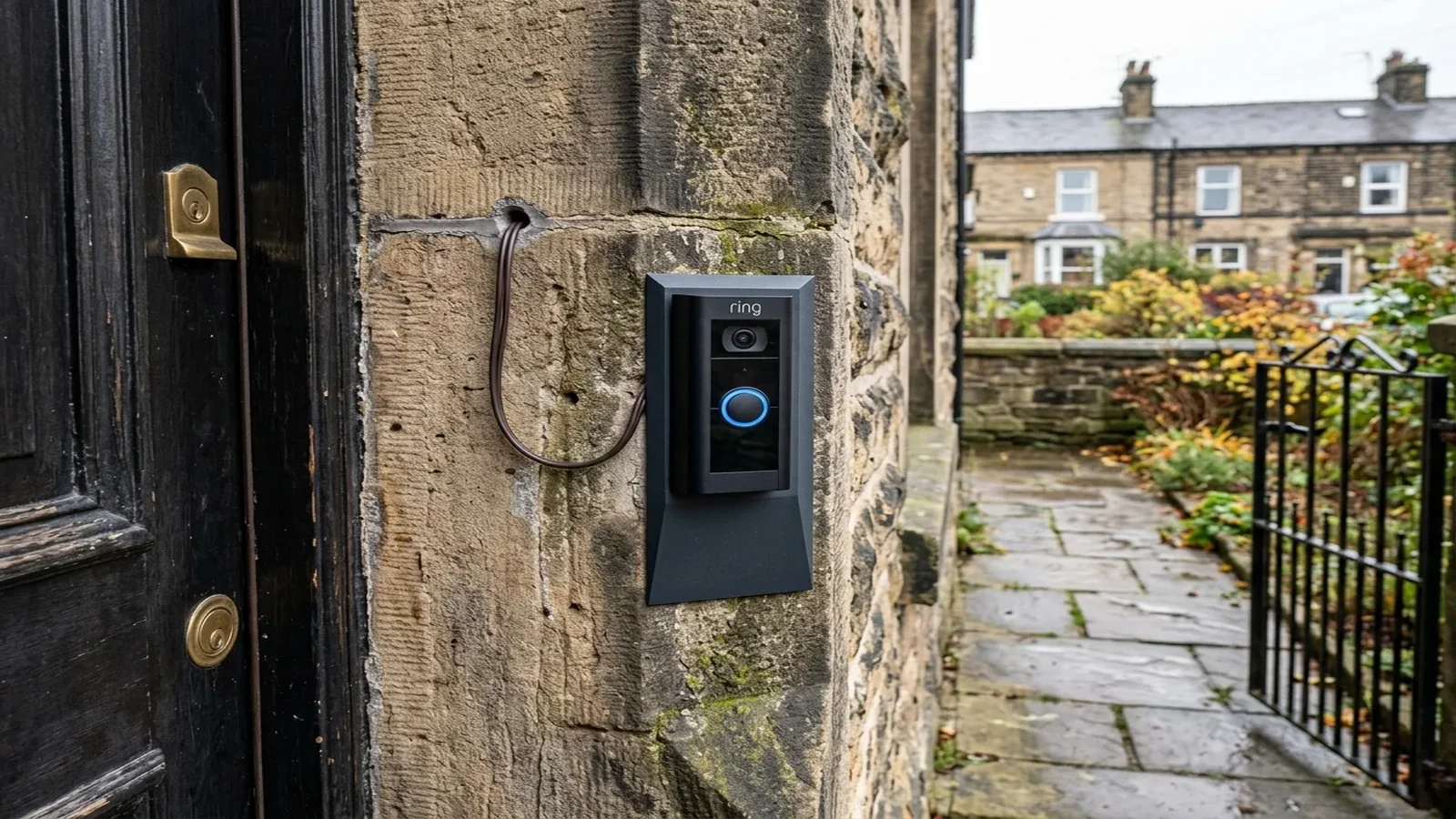
British architecture features distinct physical mounting challenges compared to American timber-framed properties. In Victorian terraces and 1930s semis, front doors are deeply recessed within a 100mm to 150mm brick reveal. Mounting a 160-degree wide-angle smart doorbell flat against the side brickwork results in half the camera's sensor looking directly at rough brick mortar.
This causes two severe flaws: first, visitors walking up the central garden pathway are clipped at the edge of the frame; second, at night, the powerful infrared illuminators reflect violently off the white mortar, auto-adjusting the camera's exposure and casting the rest of the driveway into pitch blackness. Fitting an engineered 15-degree or 30-degree corner wedge tilts the optical axis outward into the path of approach, recovering up to 45% more usable forensic surveillance area.
Hands-On Masterclass: 24V Doorbell Transformer & Chime Bypass Wiring
Join lead engineer Gary Pearce as he demonstrates isolating consumer units, fitting DIN-rail bell transformers, bridging mechanical chime coils, and eliminating IR night-vision glare with corner wedges.
Click to Watch Engineering Field Debrief
Recorded live on British Consumer Units & Smart Doorbell Hardware
Interactive Chapter Index:
Why Your Smart Doorbell Drops Offline at Night
Read Complete Field Podcast Transcript (Verbatim Audio Recording) ↓
Gary Pearce: "Welcome back to the ADI Technical Debrief. I'm Gary Pearce. Today we're looking at one of the common domestic callouts we get across Yorkshire: a homeowner installs a brand-new Ring Pro 2 or Nest Hello, and everything works during the day, but every evening around 8pm, the doorbell drops off the Wi-Fi or shuts down completely when someone presses the button."
Sarah Jenkins: "And that sounds like a Wi-Fi issue at first glance, Gary. Why does everyone blame their router when it's actually an electrical problem inside the consumer unit?"
Gary Pearce: "Because people look at the app and see 'Device Offline'. But in 95% of cases, the Wi-Fi signal is fine. The culprit is the old 8V Friedland bell transformer in their consumer unit. Those transformers were designed 30 years ago to push 0.5 amps for half a second to ding-dong a physical chime. When night falls, the doorbell turns on its infrared LEDs. That quadruples the power draw. The voltage collapses to 6 volts, and the doorbell browns out."
Sarah Jenkins: "So what is the permanent physical solution?"
Gary Pearce: "We install a certified 16V or 24V AC transformer rated for 30VA right onto the DIN rail, and we install the manufacturer power kit inside the hallway chime. That completely bypasses the chime solenoid so it stops humming, while giving the doorbell clean, continuous high-current power 24/7."
Property Substrates & Door Frame Rigging Standards
Mounting video doorbells requires tailored fixings and wedge geometries depending on the property construction:
Recessed Brick Reveals
Deep 120mm brick reveals cause 50% wall flare. Requires a 30-degree horizontal corner wedge and discrete 5mm masonry drilling through the mortar joint to avoid cracking red clay bricks.
uPVC & Composite Frames
Reinforced steel door frames can short-circuit bell wires if not grommeted. Requires insulated nylon cable pass-throughs and flush 15-degree wedge positioning away from door handles.
Uneven Millstone Grit
Uneven, textured stonework prevents flat mounting, causing weather seals to fail. Requires an exterior silicone backing plate or mounting patress to prevent water ingress.
Frequently Asked Questions on Doorbell Transformers
Practical electrical answers for homeowners and property managers upgrading UK doorbell power:
Why does my smart video doorbell reboot every time the button is pressed? ↓
When a visitor presses the button, the doorbell activates its high-definition video transmitter, microphone, and internal chime trigger simultaneously. If powered by an under-rated 8V 0.5A (4VA) transformer, the surge current causes the voltage to drop below 6.5V AC, forcing the unit logic board to brown out and restart.
What transformer voltage and VA rating is required for a Ring Video Doorbell Pro 2? ↓
Ring Pro 2 requires a transformer supplying 16V to 24V AC with a minimum rating of 30VA (Volt-Amperes). Using a standard 8V bell transformer or an under-powered 15VA unit will result in continuous internal battery degradation and frequent night-time offline dropouts.
Why is my mechanical hallway chime buzzing continuously after installing a smart doorbell? ↓
Smart doorbells draw a constant trickle current (around 50mA to 100mA) to maintain Wi-Fi and keep their internal battery topped up. This current constantly flows through the solenoid coil of a traditional mechanical chime, causing the electromagnetic plunger to vibrate and hum. Fitting the manufacturer bypass resistor or power kit across the chime terminals eliminates the buzzing.
Can existing UK 2-core bell wire be reused for a 24V smart doorbell? ↓
Yes, provided the solid copper conductors are intact and the cable run does not exceed 25 metres. Because a 24V AC circuit carries lower current for the same wattage compared to an 8V circuit, standard 0.5mm² bell wire experiences minimal voltage drop when powered by a 30VA transformer.
When should an angled corner wedge be fitted behind a video doorbell? ↓
An angled corner wedge (15° or 30°) should always be fitted when the doorbell is installed on a side wall reveal or recessed door frame. Without a wedge, the wide-angle camera lens captures excessive adjacent brickwork, reflecting infrared light back into the sensor and blinding the night-vision view.
Regional Smart Doorbell & Access Engineering Hubs
Gary Pearce installs and upgrades hardwired smart video doorbells and intercom systems across Yorkshire:
Gary Pearce
Lead Physical Security & Telecoms Engineer • ADI Communications
Gary has spent over 25 years solving domestic electrical, access control, and telecom wiring challenges across Yorkshire and the UK. Every installation complies with BS 7671 electrical wiring standards, using heavy-duty DIN transformers and discrete conduit backed by £10 Million Public Liability Insurance.