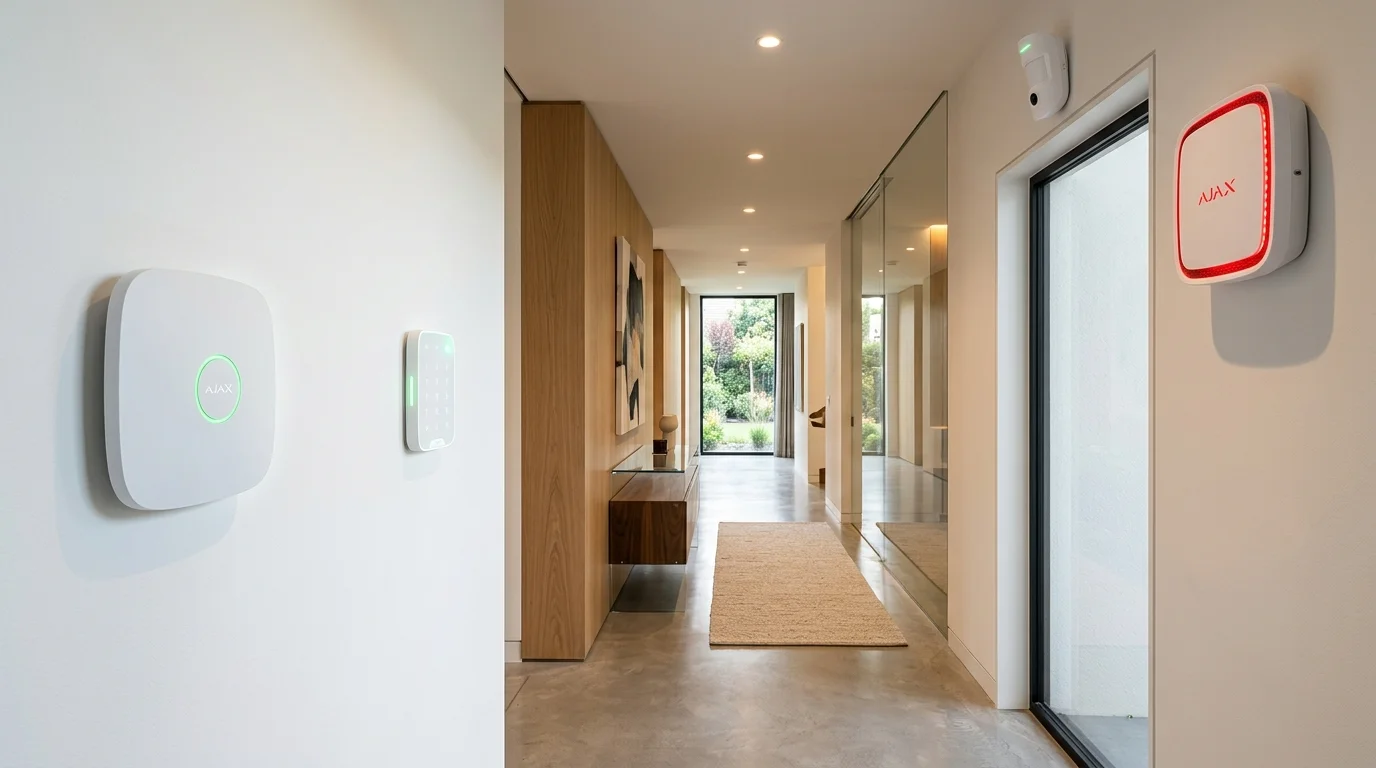

As wireless smart alarms have surged in popularity across the UK, a chilling crime trend has gained widespread media attention: opportunistic and organised burglars using cheap, handheld radio frequency (RF) jammers to disable home security systems. Can a criminal really walk up to your front door with an illegal £30 gadget bought online and prevent your alarm from triggering? The alarming truth is: yes, on cheap uncertified DIY alarms. However, against commercial Grade 2 wireless security platforms, RF jamming is not only rendered completely useless, but actually triggers an immediate alarm. In this technical security briefing, lead engineer Gary Pearce exposes the radio physics behind RF jamming and explains how the Ajax 868MHz Jeweller protocol defeats attacks within 0.15 seconds.
🚨 The 433MHz DIY Alarm Blindspot
Budget DIY alarm systems sold on Amazon or eBay (and cheap Wi-Fi smart plugs) communicate on a single, unencrypted 433.92MHz or 2.4GHz radio frequency. A handheld RF jammer broadcasts continuous white noise across this single frequency band, overwhelming the base station receiver like a deafening air horn. When the burglar opens the door, the magnetic contact transmits its alert, but the signal is drowned out by radio noise. The base station hears nothing, and no siren sounds.
1. Radio Warfare: How Frequency Jammers Operate
Radio frequency jamming relies on signal-to-noise ratio (SNR) suppression. When an intruder activates a jamming transmitter within 10 to 20 metres of a house:
- Broadband Noise Flooding: The jammer transmits high-power electromagnetic radiation across specific frequencies, preventing the central hub from decoding digital packets from peripheral door sensors, window contacts, or motion detectors.
- Roll-Jam Code Grabbing: More sophisticated car and garage thieves use SDR (Software Defined Radio) devices (such as Flipper Zero or HackRF) to intercept and re-transmit rolling security codes.
2. How Ajax 868MHz Jeweller Multi-Frequency Hopping Defeats Jamming
Professional security systems, such as the Ajax smart wireless alarm platform, operate under strict European security standards (EN 50131 Grade 2). The proprietary Jeweller radio protocol was engineered specifically to resist electronic warfare:
| Security Attribute | Generic DIY Alarms (Ring / Yale / Tuya) | Ajax Jeweller (EN 50131 Grade 2) |
|---|---|---|
| Operating Frequency | Single-Band (433MHz or 2.4GHz Wi-Fi) | Multi-Band 868.0 to 868.6 MHz |
| Frequency Hopping | None (Fixed single channel) | Automatic Pseudo-Random Frequency Hopping |
| Jamming Detection Speed | Fails silently (No detection) | 0.15 Seconds (Instantaneous notification) |
| Encryption | Unencrypted or basic 128-bit | AES-128 Block Cipher with Rolling Keys |
| Backup Communications | Home Wi-Fi only (Easily cut/jammed) | Quad-Path: Ethernet + Wi-Fi + Dual 4G SIMs |
3. The 0.15-Second Anti-Jamming Response
Here is what actually happens when a burglar activates an RF jammer near an Ajax-protected property:
- Step 1: Noise Floor Spike Detected: The Ajax Hub constantly monitors the electromagnetic ambient noise floor. The millisecond radio noise exceeds acceptable thresholds, the Hub flags an intentional interference event.
- Step 2: Instant Frequency Hop: The Hub instantly commands all sensors to shift to a clean backup frequency channel within the 868MHz band.
- Step 3: Intentional Jamming Alarm: If broadband noise blankets all channels, the Hub immediately registers a high-priority "Radio Frequency Jamming Detected" incident.
- Step 4: Quad-Path Siren & Alert Dispatch: Even if local radio is completely blocked, the Hub triggers 113dB external sounders and dispatches high-priority push notifications and phone calls to the homeowner and Alarm Receiving Centre (ARC) via hardwired Ethernet and cellular 4G channels within 0.15 seconds.
RF Denial of Service: Tri-Path Failover & Polling Heartbeats
BLUF Direct Answer: Sophisticated burglars use handheld RF jammer devices to flood 433MHz and 868MHz frequencies with white noise, preventing cheap sensors from alerting the hub. Protecting against this requires EN 50131 Grade 2 alarms featuring frequent 12-second hub polling, frequency hopping, and dual-SIM cellular failover.
Radio frequency jamming is an electronic Denial of Service (DoS) attack. When a cheap wireless door sensor trips, it broadcasts a quick radio chirp. If a jammer is flooding the room with high-power electromagnetic noise on that same frequency, the hub never hears the transmission, allowing intruders to enter undetected.
Commercial-grade systems defeat jamming through ping intervals. The Ajax hub pings every detector every 12 to 36 seconds. If a detector fails to respond or if background RF noise suddenly spikes across the band, the hub immediately classifies this as an active jamming attack and sounds external street sirens while pushing alerts over 4G LTE and Ethernet.
| Security Safeguard | Budget DIY Alarm | Professional Grade 2 (Ajax / Pyronix) |
|---|---|---|
| RF Heartbeat Polling | Every 1 - 2 hours (or none) | Every 12 - 36 seconds |
| Communication Channels | Wi-Fi only (Easily deauthed) | Ethernet + Dual 4G SIMs + Jeweller RF |
| Frequency Hopping | Fixed single frequency | Automatic multi-band hopping |
Starlink & Aerial Structural Mount & Gale Tolerance Calculator
Calculate the required steel mast gauge, bracket standoff clearance, and lashing cradle tension needed to withstand up to 90mph UK Atlantic storm gusts with 0.0° beam deflection.
How to Harden a Wireless Alarm Against RF Jamming
Checklist for defeating burglar radio jamming tactics.
Set Hub Polling Ping to 12 Seconds
In the alarm engineering menu, decrease detector polling interval from 36s to 12s for ultra-fast missing device alerts.
Equip Dual Unsteered Roaming SIMs
Install multi-network cellular SIM cards that automatically connect across EE, Vodafone, O2, or Three.
Install High-Decibel Hardwired/Encrypted Sirens
Fit external street sirens with independent tamper triggers that sound instantly if radio communication is interrupted.
4. Insurance Underwriting Standards: Why EN 50131 Grade 2 Matters
In the UK, major insurance underwriters (such as Aviva, Hiscox, and AXA) specifically require an EN 50131 Grade 2 or Grade 3 certified intruder alarm for high-value properties:
Grade 2 certification legally guarantees that the wireless transmission protocol incorporates anti-jamming detection, encrypted signaling, and supervised two-way polling. If your home is burgled and you have an uncertified DIY alarm that was silently jammed, your insurance claim can be challenged or reduced. As reviewed in our in-depth Ajax wireless alarms review, Ajax is fully approved for insurance compliance across the UK.
To protect your perimeter, read our guide to the best smart doorbell cameras in the UK. For integrated visual surveillance, explore our 2026 CCTV installation cost guide or review our commercial CCTV installation services. To book an insurance-approved home security audit, contact our professional Ajax alarm engineers across Yorkshire and Lancashire.