Why Does My CCTV Camera Show a Black Screen at Night? IR Cut Filter & Voltage Drop
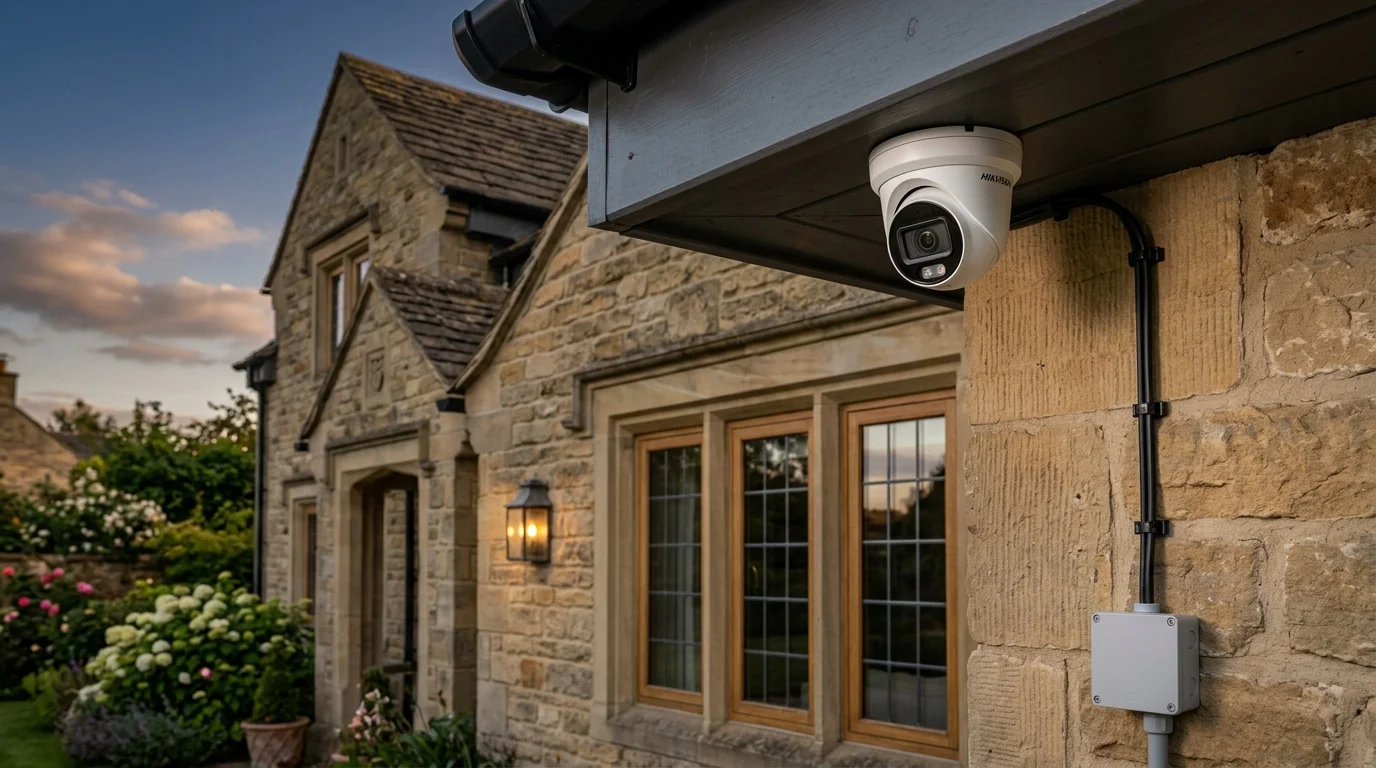
If a CCTV camera delivers a flawless colour image in daylight but turns completely black or shuts down as dusk falls, the fault is almost always mechanical or electrical. The two most common causes are a seized mechanical Infrared (IR) Cut Filter solenoid that fails to switch away from the image sensor, or a sudden power supply voltage collapse when the camera's high-draw 850nm IR LEDs or warm white ColorVu spotlights activate over long, undersized cable runs.
The Day/Night Transition: How Mechanical IR Cut Filters (ICR) Work
To deliver accurate, natural colours during the daytime, all quality security cameras feature an Infrared Cut Filter (ICR). Because silicon CMOS image sensors are naturally sensitive to near-infrared light, ambient infrared during daylight hours would turn grass purple, wash out skin tones, and ruin image contrast.
A mechanical solenoid physically moves a small piece of optical red glass in front of the image sensor during daytime hours to block infrared light. When ambient light drops at dusk, the camera's light sensor triggers the solenoid to mechanically snap the filter out of the optical path, switching the camera to black-and-white night mode and activating the 850nm infrared LEDs.
If this tiny electro-mechanical solenoid seizes due to grease drying out, internal gear wear, or extreme winter cold, the optical filter remains stuck in front of the sensor. The camera turns on its infrared LEDs, but because the filter is still blocking all infrared light, the sensor sees virtually zero photons. The result is an entirely pitch-black screen.
| Observed Visual Symptom | Camera Physical State | Underlying Mechanical/Electrical Fault | Field Verification Test |
|---|---|---|---|
| Completely pitch-black screen | Infrared LEDs glowing red | Mechanical IR Cut Filter (ICR) seized | Shine bright torch directly into lens; listen for click |
| Screen goes black & camera reboots | LEDs flash briefly then die | PoE / 12V voltage collapse under load | Measure voltage at camera pigtail under night load |
| Foggy / milky white blurred screen | LEDs active, IR bleeding | Dirty dome bubble or detached lens foam ring | Clean dome inside/out; reseat lens rubber gasket |
| Image stays in colour but very dark | Day/Night sensor set to 'Day' | Software threshold or CDS photocell failure | Force 'Auto' or 'Night' in camera OSD menu |
| Live view works; recorded video black | NVR bitrate budget exceeded | H.265 night-time noise spike | Increase maximum bitrate; enable 3D DNR |
Hikvision ColorVu vs Infrared CCTV UK: Night Vision, DORI Standards & 4K Police Evidence
Watch Lead Engineer Gary Pearce demonstrate physical trade installation methods, field fault-finding, and certified equipment standards.
Call Gary: 07860 244 274Fault Mode 1: Mechanical Solenoid Jamming & The Torch Test
You can quickly diagnose a seized IR cut filter without dismantling your camera using a simple field diagnostic called 'The Torch Test'.
Wait until dark when the screen is black. Take a high-powered LED torch and shine it directly into the camera lens from about 30 centimetres away. Observe the camera closely and listen for a faint mechanical 'click'.
If the camera is functioning correctly, the sudden blast of light will trick the light sensor into believing it is daytime. The solenoid will click, the image will instantly switch back to full colour, and the infrared LEDs will turn off. If you pull the torch away and the camera fails to click back to black-and-white, your mechanical solenoid is physically jammed and requires replacement.
Fault Mode 2: Power Supply Voltage Droop Under Heavy Night Load
The second most common cause of black screen failure is electrical power starvation. When a camera's infrared LED array energises at dusk, its electrical current draw increases by up to 300%.
In systems powered by a centralised 12V DC power distribution box, ageing electrolytic capacitors lose their capacitance over 3 to 5 years. While the power supply can provide adequate voltage (12.2V DC) under low daytime load, the sudden demand of four or eight cameras switching on their infrared arrays simultaneously causes the DC bus voltage to collapse to 9.5V or 10V.
Without sufficient operating voltage, the camera's video processing chip immediately crashes, killing the video feed. Replacing the ageing power supply with a heavy-duty regulated 12V 5A unit or upgrading to a dedicated PoE switch instantly restores full 24/7 reliability.
Need This Resolved at Your Home or Commercial Property?
Gary Pearce provides professional site visits, precision diagnostics, and turnkey installation across the North of England. All cabling and equipment is certified to British Standards with £10M Public Liability Insurance.
Frequently Asked Questions
Q1. Why does my CCTV picture go foggy or cloudy at night?
This is almost always caused by 'IR reflection'. If the camera's glass cover or dome bubble has greasy fingerprints, dust, or moisture, the infrared LEDs reflect back into the lens. In dome cameras, an improperly seated black rubber foam ring around the lens allows IR light to bleed directly into the sensor.
Q2. Can I replace just the IR cut filter on my CCTV camera?
On commercial cameras, the M12 lens mount and IRC assembly can be replaced. However, on residential cameras under £100, replacing the camera unit with a modern low-light Hikvision ColorVu or Dahua Full-Colour turret is significantly more cost-effective.
Q3. Why do spider webs make my night-vision camera go white?
Spider silk strands are highly reflective to 850nm infrared light. When a spider builds a web across the lens, the camera's auto-exposure sensor focuses on the brilliant white strands, dropping the background exposure into pitch blackness.
Q4. What is the difference between IR night vision and ColorVu?
Traditional IR night vision uses infrared LEDs and displays a black-and-white image. ColorVu technology uses ultra-large F1.0 aperture lenses and warm white supplemental LED lighting to produce vivid, full-colour video 24 hours a day.
Q5. Can Gary Pearce repair night vision faults on my security system?
Yes. ADI Communications diagnoses power supply faults, replaces seized camera modules, and installs ColorVu 24/7 colour cameras across Yorkshire and Lancashire. Contact ADI Communications for professional field assistance.
Gary Pearce
Lead Security, Satellite & Telecommunications Engineer
Gary Pearce is the founder and lead engineer of ADI Communications, with over 25 years of hands-on installation experience across Yorkshire, Lancashire, Greater Manchester, and Cheshire. Gary holds NVQ Level 1-4 certifications in Data Cabling, Electrical & Telecommunications, and operates with £10 Million Public Liability Insurance.
CCTV Night Vision Repairs & ColorVu Upgrades
Jammed IR cut filters, blown infrared LEDs, or voltage droop on long cable runs? Gary Pearce restores night vision clarity or upgrades you to full-colour 24/7 ColorVu optics.