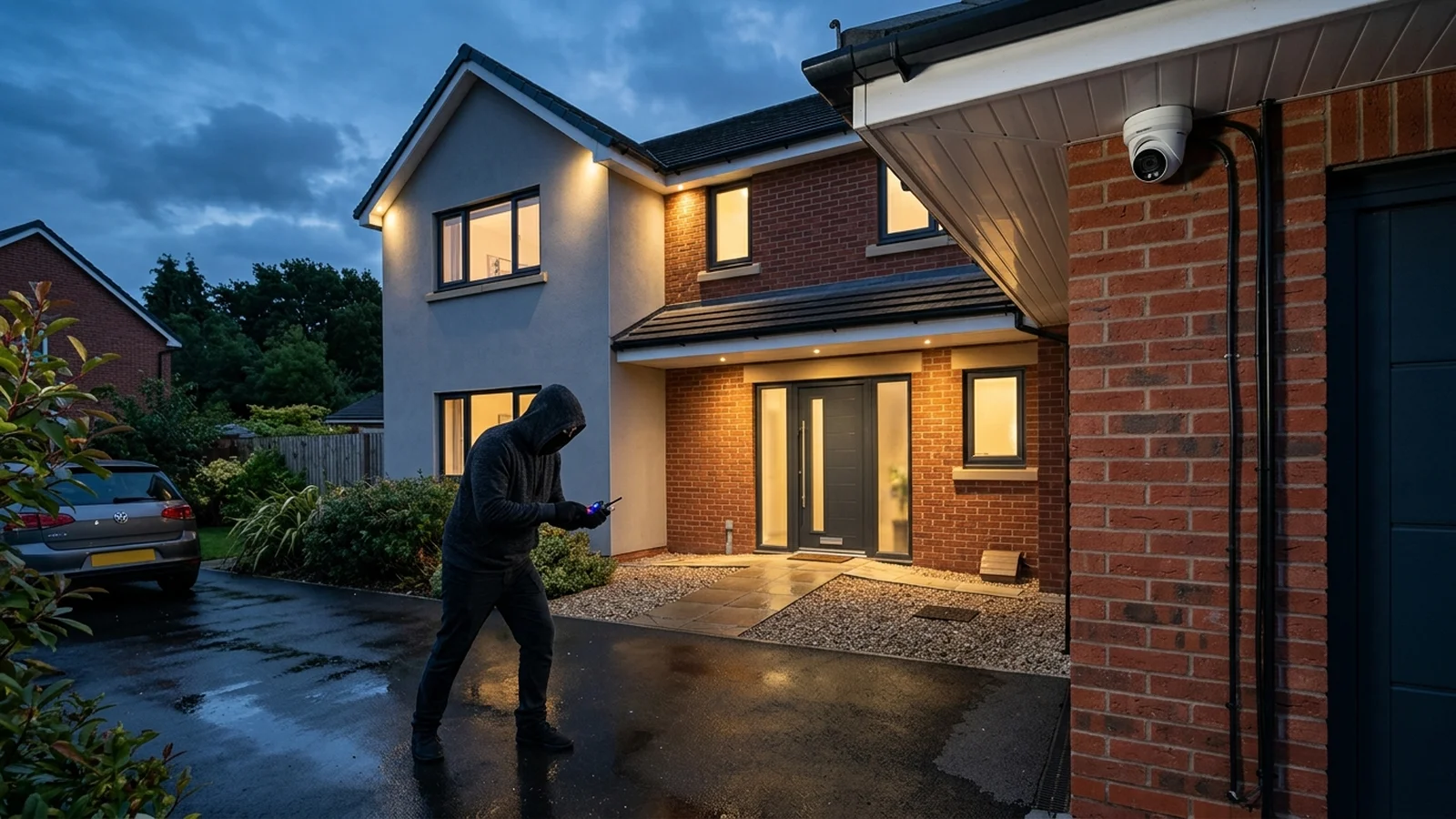
UK home security systems face distinct physical challenges in 2026, from wireless 2.4GHz camera jamming and cold-weather battery drop to strict GDPR privacy laws. While consumer DIY battery gadgets frequently suffer transmission delays and signal disruption, professional Grade 2 encrypted alarms (such as Ajax 868MHz systems with frequency hopping) and hardwired Power over Ethernet (PoE) 4K cameras running Cat6 solid copper isolate data completely from over-the-air interference, providing robust 24/7 security with zero ongoing monthly subscriptions.
Over the past two decades installing perimeter protection, digital CCTV, and smart alarm networks across West Yorkshire and the wider North, our engineers have witnessed a massive shift in how homeowners approach domestic security. Shiny plastic boxes ordered from internet marketplaces promise effortless DIY protection in ten minutes. Yet when an actual nighttime intrusion occurs, victims are all too often greeted by frozen video feeds, false alarm sirens triggered by house cats, or missed alert notifications caused by broadband drops.
To cut through marketing hype with genuine trade reality, we have answered the seven most urgent questions homeowners ask about home security in the UK. Before diving into the technical breakdown of radio frequencies, sensor physics, and legislation, listen to our comprehensive audio debrief below:
Listen to the Technical Home Security Audio Debrief
Prefer listening while driving or on-site? Play this in-depth engineering debrief examining wireless sensor vulnerability, GDPR compliance on boundary fences, power outage failovers, and why solid copper cabling provides permanent peace of mind.
Domestic security in the UK is governed by strict technical standards and legal boundaries that DIY manufacturers rarely mention on their retail packaging. British Standard BS EN 50131 governs intruder alarm grading, while British Standard BS EN 62676 specifies the exact optical resolution required for CCTV evidence to be admissible in a UK Magistrates' or Crown Court.
To help homeowners systematically evaluate their security posture, we have created an interactive technical investigation hub below. Navigate through the modules to inspect video benchmarks, signal flow diagrams, and knowledge testing tools:
Explore our proprietary engineering reference assets below to understand the physical realities of RF jamming, GDPR boundary limits, optical identification, and Grade 2 defense architectures:
Question 1: Can Burglars Really Jam Wireless Alarms and CCTV Cameras in the UK?
Yes. In recent years, radio frequency interference has evolved from theoretical laboratory demonstrations into an everyday tool used by organised car theft and residential burglary gangs across the United Kingdom. Armed with pocket-sized microcontroller transmitters purchased online for under twenty pounds, offenders exploit the architecture of open wireless spectrums to sever device communication silently.
The underlying issue is that consumer smart cameras and entry-level alarm sensors communicate over standard 2.4GHz Wi-Fi or unencrypted 433MHz frequencies. Under the IEEE 802.11 protocol, while data payloads (such as passwords and video streams) can be encrypted with WPA2 or WPA3, the management frames that negotiate device connection status are broadcast openly. By broadcasting spoofed de-authentication frames at rates exceeding 100 packets per second, a handheld transmitter tricks the camera into believing the router has severed the connection, while telling the router the camera has gone offline.
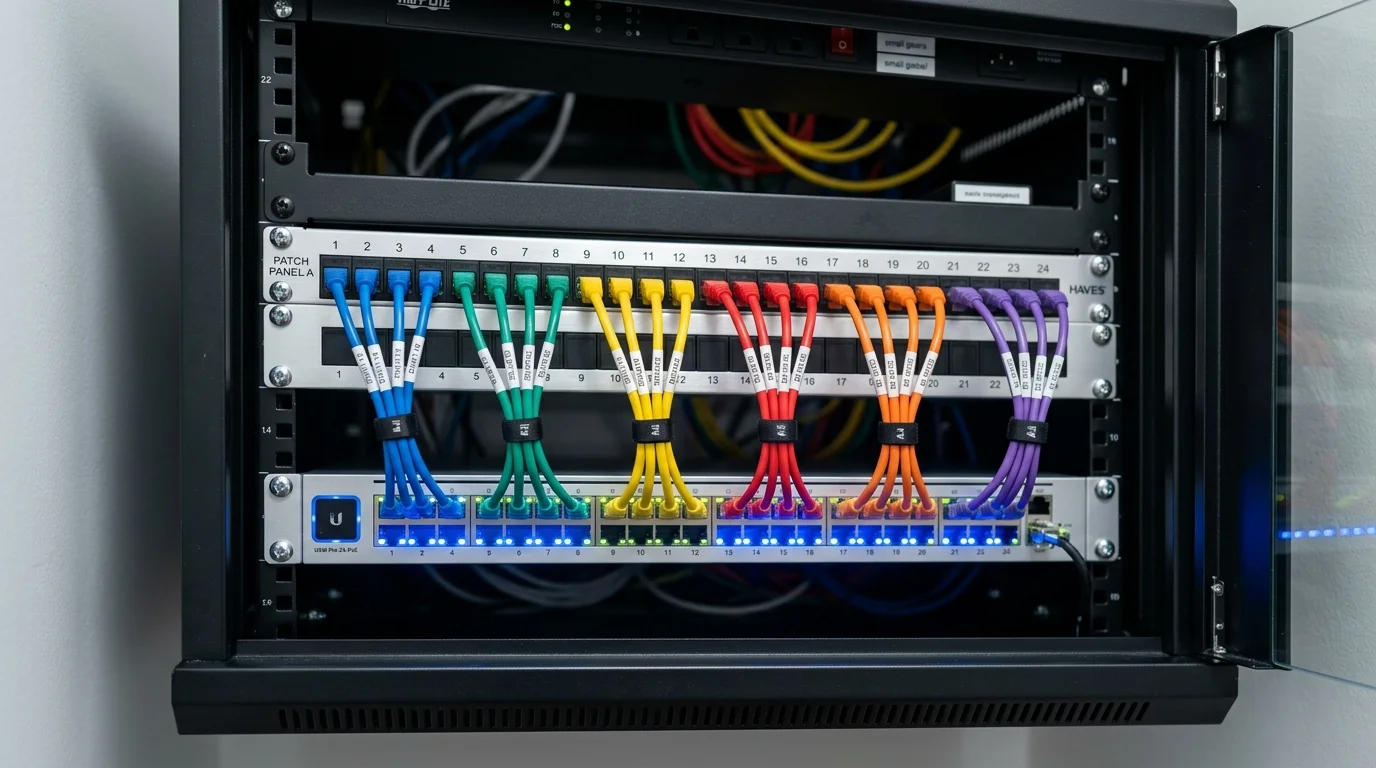
During active de-authentication flooding, cloud-dependent cameras cannot upload footage. Their internal RAM buffers overflow in seconds, dropping video frames before they ever reach off-site storage. In contrast, commercial hardwired Power over Ethernet (PoE) security cameras transmit video over solid copper conductors inside Cat6 cabling, making them completely immune to over-the-air radio frequency interference.
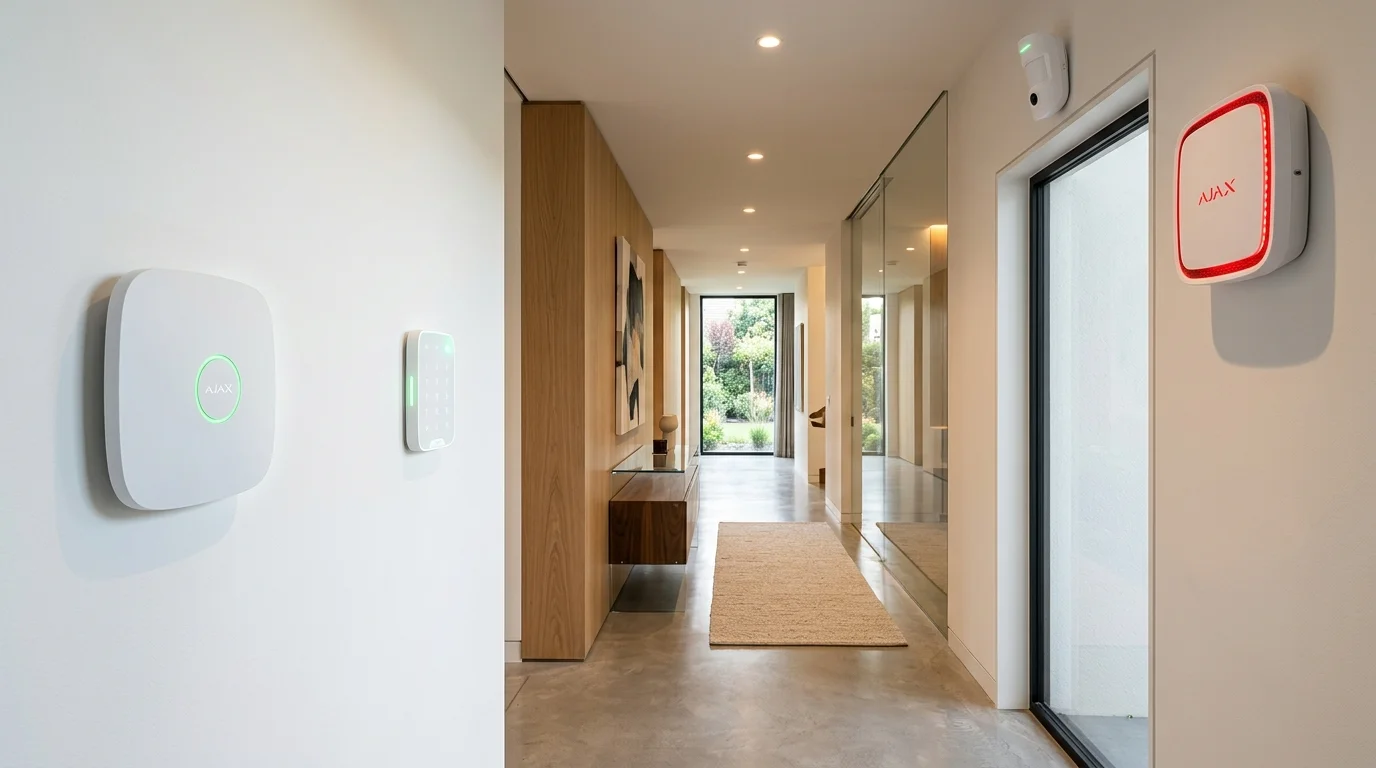
For intruder alarms, the difference between DIY and professional hardware is equally stark. DIY alarms operating on basic 433MHz signals are easily jammed by continuous carrier noise. However, professional Grade 2 systems (such as the Ajax smart alarm platform) utilize proprietary encrypted radio protocols (Ajax Jeweller) across 868MHz. Jeweller incorporates automatic multi-channel frequency hopping; the second a frequency channel experiences intentional interference or jamming, the hub shifts all communication to a backup frequency in milliseconds and triggers an instant "Jamming Detected" alarm to the homeowner's smartphone.
Question 2: Is It Legal to Point Domestic CCTV Cameras at Neighbours' Property or Pavements?
A widespread misconception among UK homeowners is that domestic CCTV can only ever be aimed within the property's legal perimeter. In reality, it is completely legal to position cameras that capture public pavements, highways, or even portions of neighbouring properties—provided you comply with UK data protection legislation.
Under the Domestic Management Exemption of the UK General Data Protection Regulation (UK GDPR) and the Data Protection Act 2018, cameras that film exclusively within your private boundary are exempt from data laws. However, the precise moment your camera's field of view crosses a boundary fence, pavement, or adjacent driveway, you legally become a Data Controller under the regulation of the Information Commissioner's Office (ICO).
As a Data Controller, you must follow four straightforward statutory obligations:
- CCTV Warning Signage: You must place clear, legible signage informing passers-by that CCTV recording is active and stating the purpose of the surveillance (crime prevention).
- Proportionality & Justification: You must have a legitimate security rationale for capturing external areas (e.g. protecting your boundary fence or driveway approach). You cannot deliberately position cameras to peer into a neighbour's private bedroom windows or private patio zones where there is a reasonable expectation of privacy.
- Subject Access Requests (SARs): Any individual whose image is recorded has the legal right to request a copy of the footage. You must provide this footage within 30 calendar days free of charge.
- Data Retention Discipline: Footage should not be stored indefinitely. A standard 30-day retention loop on an on-premises NVR hard drive satisfies ICO guidance on data minimisation.
When our engineers install commercial 4K systems, we use digital Privacy Masking in the camera firmware. This allows us to draw blacked-out geometric privacy zones directly over neighbouring windows or adjacent gardens. The camera physically blinds itself to those sensitive coordinates, maintaining 100% neighbourly harmony while delivering unbroken perimeter protection across your driveway and entrance points.
Audio Deep Dive: UK Home Security FAQ Guide: CCTV, Alarms & Crime Prevention
An ADI Communications dual-engineer technical audio briefing analyzing real-world trade secrets and customer pitfalls.
"Welcome to the ADI Technical Debrief. I'm Gary Pearce from ADI Communications. In this episode, we're answering the top home security questions homeowners ask us across the North."
"And I'm Sarah Jenkins. The #1 question we hear: Is a standalone alarm enough, or do you need both CCTV and an alarm system working together?"
"They perform two completely different jobs. CCTV monitors your exterior perimeter and scares intruders off before they reach the door. Alarms protect internal access points if a window or door is breached. Together, they create total security."
"What is the single most cost-effective security upgrade a UK homeowner can make today?"
"Replacing unrated euro-cylinder door locks with TS007 3-Star Sold Secure Diamond anti-snap locks. It stops 90% of forced burglar entries instantly for under £150."
Question 3: Can CCTV and Smart Alarms Work Without Costly Monthly Subscriptions?
Yes, absolutely. The smart home consumer electronics sector has built a multi-billion-pound business model around recurring cloud subscription fees. When buying DIY cameras like Ring, Arlo, Nest, or Blink, the hardware is sold at relatively low introductory prices, but users quickly discover that without paying £4.99 to £15.99 every month per camera, the devices are stripped of basic utility: cloud recording is disabled, rich notifications are blocked, and video clips cannot be saved.
Over five years, a homeowner with four DIY cameras paying £12.99 monthly shells out over £779 in cloud subscriptions alone—on top of initial equipment and battery replacement costs. Worse, if your home broadband drops or your internet service provider suffers an outage, the cameras stop recording entirely because video streams have nowhere to offload.
The commercial standard used by banks, businesses, and discerning homeowners is Hardwired Power over Ethernet (PoE) with an on-premises Network Video Recorder (NVR). With a professional system from market leaders like Hikvision, Dahua, or UNV:
- Zero Monthly Fees: Video is recorded 24/7 directly to a heavy-duty surveillance hard drive (such as a Western Digital Purple or Seagate SkyHawk) housed inside your own property. You own 100% of your data with no recurring subscriptions ever.
- Continuous 24/7 Recording: Unlike battery units that record short 15-second clips only when triggered, a PoE system records every second of every day. If an incident occurs just outside a motion zone, the footage is preserved.
- Full Offline Capability: If your broadband connection goes down, your cameras continue recording uninterrupted to the local hard drive. Live local HDMI output to your lounge TV or bedroom monitor remains fully operational.
- High-Speed Secure App Access: When connected to your home router, modern NVRs use encrypted peer-to-peer (P2P) mobile applications (Hik-Connect / DMSS) to deliver instant push notifications, multi-camera live playback, and AI human/vehicle filtering directly to your phone without charging a single penny in cloud fees.
Question 4: Why Do Battery Security Cameras Miss the Beginning of Burglaries?
One of the most frustrating phone calls our engineers receive begins with: "My car was broken into on the driveway last night, but my wireless battery camera only recorded the thief walking away down the road—it completely missed them opening the door!"
This common flaw is not a software bug; it is an unavoidable law of electrical physics. A camera that streams high-definition video continuously consumes significant power (between 3 to 7 Watts). If a battery-operated camera remained awake and transmitted continuously, its internal lithium battery would drain completely within 24 to 48 hours.
To make a battery last several months between charges, manufacturers force the camera into a deep, low-power sleep state. The camera's main CPU, image sensor, and Wi-Fi transmitter are completely switched off. The only component powered is a miniature, ultra-low-current Passive Infrared (PIR) heat sensor. When an intruder walks into the driveway, the PIR sensor detects a moving body heat signature and triggers the wake-up cycle:
- The internal CPU initializes its boot routine (takes 0.8 to 1.5 seconds).
- The optical sensor powers up and calibrates exposure and focus (takes 0.5 seconds).
- The Wi-Fi module searches for the home router, executes a radio handshake, and negotiates cloud TLS encryption (takes 1.0 to 2.0 seconds).
By the time the camera actually starts capturing and uploading video data, three to four full seconds have elapsed. A walking human travels approximately 1.4 metres per second. In four seconds, an intruder has covered over five metres, opened your car door, or walked directly beneath the camera's blind spot.
By contrast, hardwired PoE cameras receive continuous low-voltage direct current (48V DC) through solid copper Cat6 cabling. Because they never sleep, they feature Pre-Event Recording Buffers. When a motion alarm is triggered, the saved video clip includes the five seconds *before* the intruder entered the zone, capturing the exact approach vector and physical profile.
Question 5: What Happens to Home Security During a Winter Power Cut?
Severe winter storms across the UK regularly disrupt overhead electrical grids, leaving residential streets without mains electricity for hours. Sophisticated burglars are acutely aware of this vulnerability and frequently target neighbourhoods during stormy blackouts.
In a standard DIY setup, a power cut is catastrophic. The moment the mains power dies, your broadband router switches off, your Wi-Fi network vanishes, and mains-powered security lights go black. Battery cameras mounted outside may have internal battery charge, but without a working Wi-Fi router, they cannot send alerts, upload clips, or sound alarms.
Professional security systems are engineered with mandatory power independence:
- Grade 2 Smart Alarms (Ajax): The central Ajax Hub contains an internal lithium-ion backup battery that powers the system for up to 16 hours during a total mains blackout. All wireless door contacts, motion detectors, and outdoor sirens run on dedicated commercial lithium batteries with 4 to 7-year lifespans.
- Dual-SIM Cellular Failover: When home broadband fails, the alarm hub automatically switches to an integrated 4G/LTE cellular backup path in less than three seconds. Even if the telephone line is cut or broadband is down across the whole town, emergency notifications and siren activations transmit directly to your smartphone.
- Uninterruptible Power Supplies (UPS) for CCTV: For hardwired PoE CCTV systems, our engineers install compact line-interactive UPS battery units beside the NVR. If mains power drops, the UPS cleanly sustains the NVR, surveillance hard drives, and all connected PoE cameras for 60 to 120 minutes without dropping a single frame of video.
Interactive Home Security Knowledge Assessment
Why do consumer wireless battery cameras miss the initial seconds of an intrusion?
Question 6: Do Pet-Friendly Motion Sensors Really Stop False Alarms from Dogs and Cats?
False alarms are the number one reason homeowners stop setting their security systems. When an alarm siren blares at two in the morning because the family Labrador wandered into the kitchen for water, neighbours are infuriated and owners quickly lose confidence in their equipment.
Modern Grade 2 security hardware has completely solved this dilemma through advanced optical physics and digital signal processing. Traditional low-cost PIR sensors simply measure changes in infrared energy across broad lenses; any thermal body moving across the beams trips the relay.
By contrast, commercial pet-immune detectors—such as the Ajax MotionProtect series—use a dual-layered filtering architecture:
- Stepped Optical Fresnel Lenses: The sensor's optical array is divided into distinct upper and lower zones. A human walking upright breaks both the upper and lower optical rays simultaneously. A dog or cat moving across the floor only breaks the lower zones, allowing the sensor to classify the object by physical height.
- SmartDetect Digital Signal Filtering: The detector's microchip evaluates the thermal mass and velocity of the infrared target in real time. A 20kg dog emits a dramatically different heat signature pattern than an 80kg human adult. If the thermal mass falls below programmed thresholds and stays close to the floor, the alarm signal is suppressed.
When fitted by a certified engineer at the correct height (typically 2.4 metres above finished floor level) and positioned away from radiators, direct sunlight, and climbing furniture, professional pet-immune PIRs deliver 99.9% false-alarm immunity while remaining hair-trigger sensitive to genuine human intruders.
Question 7: How Much Does Professional Home Security Installation Cost in the UK?
Pricing transparency is essential when planning home security. While door-to-door salesmen and national franchise chains often use high-pressure tactics, hidden annual contracts, and inflated monitoring fees, ADI Communications provides transparent, up-front pricing based on canonical trade standards:
Ajax StarterKit Hub
Ideal for semi-detached homes, flats, and rental properties. Encrypted 868MHz Jeweller radio with 4G dual SIM failover.
- ✓ Ajax Hub 2 (4G Cellular & IP)
- ✓ 1x Pet-Immune Motion Sensor
- ✓ 1x Magnetic Door Contact
- ✓ 1x Wireless Keypad & Outdoor Siren
- ✓ Smartphone App Setup (Zero Subs)
4K ColorVu 2-Camera System
Solid copper Cat6 PoE architecture. 24/7 continuous local recording with full-colour nighttime identification.
- ✓ 2x 4K Ultra HD Turret Cameras
- ✓ F1.0 Full-Colour Night Vision
- ✓ Dedicated 4-Channel PoE NVR
- ✓ 1TB Surveillance Hard Drive
- ✓ In-Wall Discrete Cable Concealment
Total Perimeter Defence
Comprehensive security for detached residences, farmsteads, and high-value properties across the North.
- ✓ 4 to 8 4K ColorVu Cameras
- ✓ Full Grade 2 Ajax Alarm Network
- ✓ Outdoor Perimeter Curtain Motion
- ✓ UPS Battery Backup System
- ✓ 5-Year Physical Trade Warranty
Unlike national franchise providers that lock homeowners into £40-a-month rolling contracts over three to five years, all ADI Communications installations feature 100% equipment ownership from day one. You own the cameras, cables, alarm sensors, and local recording hardware with zero ongoing monthly liabilities.
Security Engineering Concepts & Standards
What minimum pixel density is mandated by BS EN 62676 for positive suspect identification in court?
BS EN 62676 mandates at least 250 pixels per metre (ppm) for positive suspect identification beyond reasonable doubt, ensuring facial features and iris details are admissible.
8. The 5-Point Burglary Defense Decision Tree Checklist
Before committing your budget to domestic security hardware, use this interactive assessment tool to evaluate your property's perimeter resilience against modern physical and radio-frequency vulnerabilities:
Interactive Property Security Audit: Is Your Setup at Risk?
Audit Score: 0/5 (Critical Vulnerability)Tick each feature your current perimeter security setup actually possesses:
Your current security setup relies heavily on unencrypted wireless transmissions or cloud storage links vulnerable to handheld radio transmitters, broadband cuts, and winter battery drop.