Can I Use an Old Sky Satellite Cable for Freeview TV? CT63 vs WF100 Loss
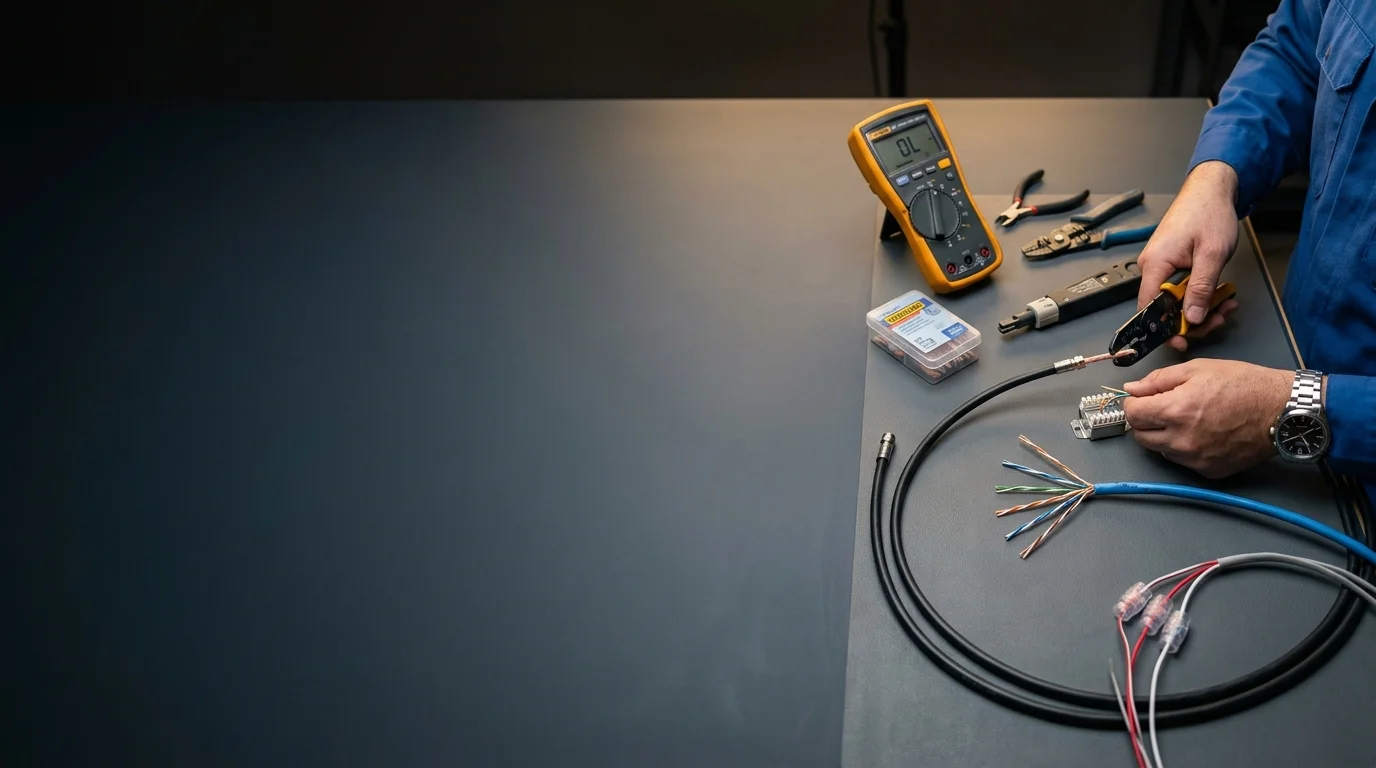
Yes, you can physically reuse an old Sky satellite cable for Freeview TV, but the result depends heavily on the specific cable type installed. While standard satellite WF100 coaxial cable works exceptionally well for Freeview UHF frequencies, thin twin 'shotgun' cable (CT63) suffers significant signal attenuation over longer runs and lacks the dense copper shielding needed to block 4G/5G mobile mast interference. Fitting proper 75-ohm Belling-Lee connectors is essential.
Cable Anatomy: Satellite L-Band vs Freeview UHF Frequencies
When homeowners cancel their Sky satellite subscription, they often find two black or white coaxial cables hanging down behind their main television or emerging from the exterior soffit. A very common question is: Can I disconnect these from the Sky dish, connect them to a digital TV aerial, and receive free terrestrial Freeview HD?
The physical physics of RF coaxial transmission is identical whether carrying satellite or terrestrial signals: both require 75-ohm characteristic impedance. However, the operating frequency bands are completely different.
Satellite L-Band signals from an LNB operate between 950MHz and 2,150MHz. Freeview terrestrial television operates on Ultra High Frequency (UHF) bands between 470MHz and 694MHz. Because lower frequencies experience less physical attenuation (signal loss per metre) than higher frequencies, any cable that was capable of carrying 2GHz satellite signals can easily carry UHF Freeview signals—provided the cable is in sound physical condition.
| Technical Metric | Thin Twin Shotgun (CT63/CB63) | CAI Benchmarked Full-Bore (WF100) |
|---|---|---|
| Outer Cable Diameter | 4.8mm per leg (Twin bonded) | 6.8mm Single Cable |
| Centre Conductor Diameter | 0.65mm Thin Copper Core | 1.00mm Pure Solid Bare Copper |
| UHF Signal Loss (600MHz) | ~21dB per 100 metres | ~13.8dB per 100 metres (35% less loss) |
| Shielding Construction | Thin foil + 40% braid coverage | Copper foil tape + 100% pure copper braid |
| 4G / 5G Interference Shielding | Poor; prone to cellular breakthrough | Class A+ Screened; 100% cellular rejection |
| Recommended Max Run for Freeview | Under 10 metres only | Up to 50 metres with zero loss |
freeview pixelation lte waterlogged coaxial masterclass
Watch Lead Engineer Gary Pearce demonstrate physical trade installation methods, field fault-finding, and certified equipment standards.
Call Gary: 07860 244 274The Thin Shotgun Cable Trap: Why CT63 Struggles on Weak Freeview
The critical catch is determining which type of satellite cable Sky installed at your property. In older Sky+ HD and modern Sky Q installations, installers almost universally used twin 'shotgun' cable (classified as CT63 or CB63).
Shotgun cable consists of two miniature 4.8mm cables joined together like a double-barrelled shotgun. To keep the cable thin enough to fit through a single 10mm drill hole, manufacturers reduced the centre copper core to a skinny 0.65mm and drastically reduced the thickness of the shielding braid.
Over a short run of 5 to 8 metres from a roof aerial into an upstairs bedroom, shotgun cable will generally carry adequate Freeview signal. However, if that cable runs 15 to 25 metres from a chimney stack, around the outside of the house, and into a ground-floor living room, the signal attenuation can exceed 6dB to 8dB. In medium or fringe Freeview reception areas, this loss is enough to push your signal over the digital cliff, causing chronic picture freezing and pixelation.
The Connector Swap: Converting Screw-On F-Plugs to Belling-Lee TV Plugs
Satellite receivers use threaded screw-on 'F-Connectors'. Terrestrial television tuners use push-fit 'Belling-Lee' coaxial sockets (IEC 169-2).
You cannot simply jam an F-connector into a television socket. You have two options: (1) screw an inexpensive female F-to-male Belling-Lee adapter onto the existing cable end, or (2) cut off the old F-connector and terminate a high-shielding metal Belling-Lee plug directly onto the cable.
If using an adapter, inspect the centre copper stinger. If the copper wire is bent, tarnished black with oxidation, or pushed back into the plug, it will fail to make solid contact inside the TV tuner, leading to intermittent signal loss.
Need This Resolved at Your Home or Commercial Property?
Gary Pearce provides professional site visits, precision diagnostics, and turnkey installation across the North of England. All cabling and equipment is certified to British Standards with £10M Public Liability Insurance.
Frequently Asked Questions
Q1. Can I plug my TV directly into a Sky satellite dish to get Freeview?
No. A satellite dish receives satellite signals (Freesat), not terrestrial Freeview. To get Freeview, the other end of the cable on your roof must be connected to a digital UHF TV aerial, not a satellite dish.
Q2. Can I get free TV from my old Sky dish without an aerial?
Yes! You can get Freesat. If your TV has a built-in satellite tuner (look for a threaded screw socket on the back of the TV labelled 'SATELLITE' or 'LNB') or you have an old Freesat box, you can watch over 150 free satellite channels using your existing dish.
Q3. Why does my TV say 'No Signal' when plugged into the Sky cable?
Because the other end of that cable is still plugged into the satellite dish on your roof, or the cable was cut at the external splitter. It must be connected to an active TV aerial to receive Freeview.
Q4. Can one leg of a twin Sky cable feed Freeview and the other feed Freesat?
Yes! If you have twin shotgun cable, you can connect one leg to a terrestrial aerial on your roof for Freeview, and leave the second leg connected to the dish for Freesat, giving you both services down one tidy cable.
Q5. Can Gary Pearce re-terminate my old Sky cabling for Freeview?
Yes. ADI Communications tests existing cable runs with a digital RF spectrum analyser, fits screened connections, and installs digital aerials across Yorkshire and Lancashire. Contact ADI Communications for professional field assistance.
Gary Pearce
Lead Security, Satellite & Telecommunications Engineer
Gary Pearce is the founder and lead engineer of ADI Communications, with over 25 years of hands-on installation experience across Yorkshire, Lancashire, Greater Manchester, and Cheshire. Gary holds NVQ Level 1-4 certifications in Data Cabling, Electrical & Telecommunications, and operates with £10 Million Public Liability Insurance.
Freeview Aerial Fitting & Cable Repurposing
Ditching satellite subscriptions? Gary Pearce tests redundant coax cables with professional spectrum analysers, replaces waterlogged CT63 with benchmarked WF100, and aligns high-gain Freeview aerials.