Can I Move My TV Aerial Socket to Another Wall? Coax Rerouting & Signal Guide
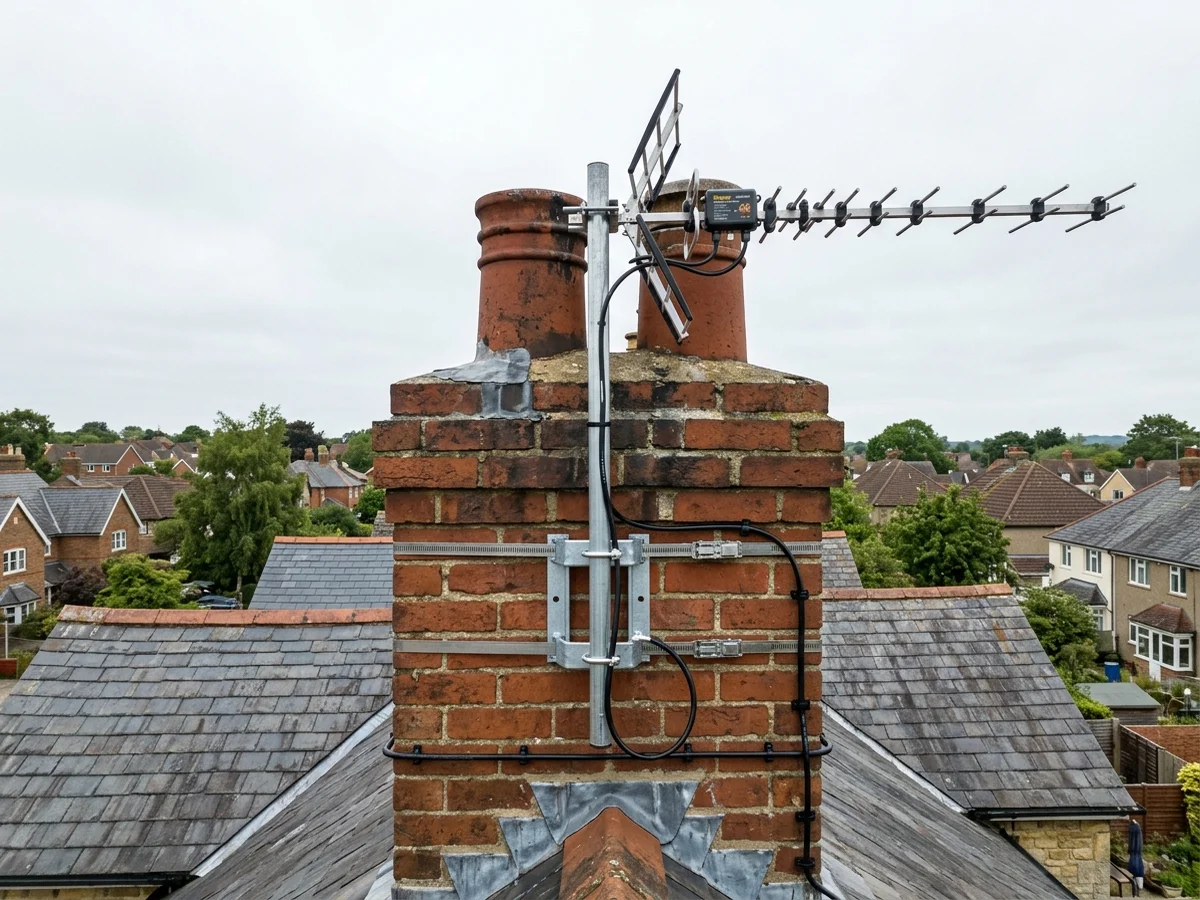
Moving a TV aerial socket to another wall in your home is entirely possible without losing Freeview HD picture quality, provided the extension uses screened CAI-benchmarked WF100 coaxial cable and shielded F-type couplers. Twisting bare copper conductors together with electrical tape or using unshielded brown coax will cause severe signal loss, impedance mismatches, and 4G/5G mobile interference, resulting in pixelation or missing Freeview multiplex channels.
Freeview Signal Dynamics: Why Bad Cable Joints Cause Pixelation
Unlike old analogue television where a weak signal merely caused a 'snowy' picture that you could still watch, digital Freeview television operates on the 'digital cliff'. A digital TV receiver requires an RF signal level of at least 45 to 50 dBuV with a high Carrier-to-Noise ratio (C/N > 26dB) and a low Bit Error Rate (BER).
If the signal drops even 1dB below this threshold, the television tuner cannot decode the digital transport stream packets. The picture does not become fuzzy—it instantly disintegrates into macro-blocking digital pixelation, screeching audio squeals, or displays a complete 'No Signal' banner.
When extending an aerial socket to another wall, every physical joint and every metre of cable introduces attenuation. In particular, poor joints cause impedance mismatches (deviating from the required 75 Ohms), which sets up standing wave reflections inside the cable. This reflection specifically notches out certain broadcast UHF frequencies, explaining why you might lose BBC One and ITV while Channel 4 continues to work.
| Cable Type | Centre Conductor | Shielding Construction | Freeview & 5G Performance |
|---|---|---|---|
| Budget Low-Loss (Brown/White) | 0.6mm Copper-Coated Steel | Single loose foil, 30% braid | Fails CAI Benchmark. Vulnerable to 4G/5G pixelation |
| RG6 Standard Commercial | 1.0mm Copper-Clad Steel | Aluminium foil, 60% braid | Acceptable for short runs; high attenuation |
| CAI Benchmarked WF100 | 1.0mm Solid Bare Copper | Copper foil tape + 100% copper braid | Gold Standard. Zero signal loss, full 4G/5G shielding |
| CT63 Twin Shotgun Cable | 0.65mm Thin Copper Cores | Double copper foil / braid | High UHF attenuation over 10m; not recommended for aerials |
freeview pixelation lte waterlogged coaxial masterclass
Watch Lead Engineer Gary Pearce demonstrate physical trade installation methods, field fault-finding, and certified equipment standards.
Call Gary: 07860 244 274Cable Routing Pathways: Under Floors, Stud Cavities & External Brickwork
There are three primary pathways for rerouting a television aerial socket across a room:
Pathway 1: Under Floorboards. In ground-floor suspended timber floors or upstairs rooms, lifting floorboards allows an engineer to route the new WF100 cable beneath the floor joists, bringing it up inside the hollow plasterboard cavity of the destination wall into a flush metal back box.
Pathway 2: Plasterboard Stud Cavities. In modern timber-frame homes or stud partition walls, an engineer can fish the cable horizontally or vertically through the hollow void without cutting visible channels in your plaster.
Pathway 3: External Masonry Routing. In homes with solid concrete ground floors and solid brick walls, routing a cable around the interior perimeter requires unsightly surface trunking. The superior aesthetic solution is drilling out through the exterior brickwork, clipping black UV-rated WF100 neatly along the exterior mortar line, and drilling back into the new wall position directly behind your television.
The Golden Rule of Coaxial Joints
Never join coaxial cables with terminal block 'chocolate blocks' or electrical tape! Always use high-frequency 75-ohm F-type compression plugs connected via a metal barrel coupler (female-to-female F-81) to preserve impedance matching.
Screened Flush Outlets & 4G/5G LTE Mast Filtering
When fitting the new aerial wall plate, avoid cheap unshielded plastic faceplates where the coaxial cable connects via a bare screw terminal on an open circuit board. These open terminals act as open microphones for electromagnetic interference from nearby mobile phone masts.
Modern mobile networks transmit high-power 4G (800MHz band) and 5G (700MHz band) signals in frequency spectrum that was formerly reserved for digital television. When these powerful signals bleed into unshielded aerial sockets, they overload the television tuner's front-end amplifier.
Always specify a fully screened, die-cast metal modular Euro-module faceplate. The die-cast enclosure provides 360-degree RF shielding, locking out cellular interference completely.
Need This Resolved at Your Home or Commercial Property?
Gary Pearce provides professional site visits, precision diagnostics, and turnkey installation across the North of England. All cabling and equipment is certified to British Standards with £10M Public Liability Insurance.
Frequently Asked Questions
Q1. Can I move a TV aerial socket without losing picture quality?
Yes. By using solid copper WF100 cable and screened F-type compression connectors, signal loss is less than 0.5dB across a typical room run, maintaining pristine Freeview HD reception.
Q2. Can you install an aerial socket directly behind a wall-mounted TV?
Yes. We install flush recessed media boxes or low-profile right-angle connectors directly behind the TV mount so cables stay 100% hidden without pushing the television away from the wall.
Q3. Can I split one TV aerial socket to feed two televisions?
Yes, but you must use a screened inductive splitter or a powered distribution amplifier. Using a cheap plastic Y-splitter halves the signal power (-3.5dB loss) and frequently causes pixelation on both TVs.
Q4. Why did my TV lose channels after I moved the aerial cable?
This indicates an impedance mismatch or severed shielding braid in your cable joint, which reflects and cancels out specific UHF multiplex frequencies. A professional re-termination will restore all channels.
Q5. How much does it cost to move a TV aerial socket?
A standard aerial socket relocation by ADI Communications typically costs between £75 to £110, including commercial WF100 cabling, screened faceplates, and signal meter verification.
Gary Pearce
Lead Security, Satellite & Telecommunications Engineer
Gary Pearce is the founder and lead engineer of ADI Communications, with over 25 years of hands-on installation experience across Yorkshire, Lancashire, Greater Manchester, and Cheshire. Gary holds NVQ Level 1-4 certifications in Data Cabling, Electrical & Telecommunications, and operates with £10 Million Public Liability Insurance.
TV Aerial Cable Rerouting & Flush Socket Fitting
Moving living room furniture or redesigning your space? Gary Pearce reroutes double-screened CAI-benchmarked WF100 coax cable with F-type compression couplers and flush wall plates.