Can I Have a TV Aerial Socket Installed Behind a Wall-Mounted TV? Flush Cavity Plates
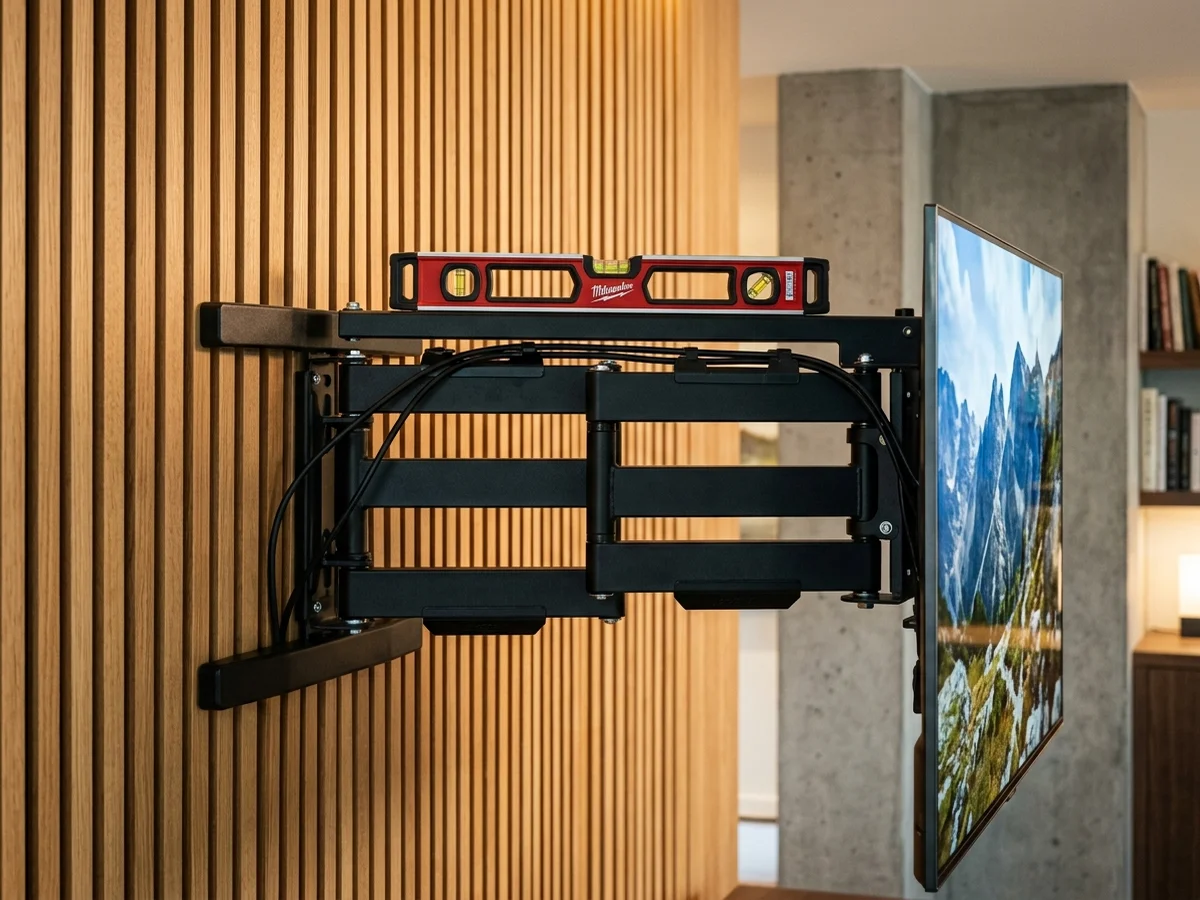
Yes, installing a TV aerial socket directly behind a wall-mounted television is the cleanest way to achieve a completely cable-free, floating aesthetic. However, standard surface-mounted aerial sockets protrude 25mm to 35mm from the wall, which will physically collide with ultra-slim TV brackets. The professional engineering solution is installing a recessed media back box (Syncbox) or low-profile right-angle 90-degree screened coaxial connectors flush inside the wall cavity.
The Bracket Collision Problem: Ultra-Slim TV Mount Clearances
Modern OLED and Neo QLED televisions are designed to sit virtually flush against the wall. Premium ultra-slim fixed or low-profile tilting brackets offer a wall clearance of just 15mm to 22mm. Samsung's 'Slim Fit' wall mount positions the TV a staggering 7.5mm from the plaster.
If a builder or homeowner installs a standard surface-mounted aerial socket or a standard plastic dry-lining back box behind the television, disaster strikes. A standard coaxial Belling-Lee plug plugged into a wall plate sticks out roughly 35mm to 40mm into the room.
When you attempt to hook the television onto its bracket, the delicate rear casing of the TV smashes directly into the protruding aerial plug. This prevents the TV from locking into place, bends the chassis, or cracks the display panel. To achieve a seamless installation, specialized flush-mounting engineering is required.
| Cable Management Method | Wall Clearance Required | Aesthetic Cleanliness | Cable Concealment Level |
|---|---|---|---|
| Surface Mini-Trunking (D-Line) | Any (Plugs sit low down) | Tidy but visible plastic strip | External surface routing |
| Standard Flush Faceplate | 35mm to 50mm Bracket Clearance | Visible if slim mount used | Plugs collide with slim brackets |
| Right-Angle 90-Degree Plugs | 20mm to 25mm Bracket Clearance | Clean; tight clearance | Hides standard depth sockets |
| Recessed Media Box (Syncbox) | 0mm (Plugs sit inside the wall) | Ultimate floating aesthetic | 100% Flush; zero collision risk |
| Brush Plate Cable Pass-Through | 15mm to 20mm Bracket Clearance | Very clean for cavity walls | Cables drop directly inside stud void |
freeview pixelation lte waterlogged coaxial masterclass
Watch Lead Engineer Gary Pearce demonstrate physical trade installation methods, field fault-finding, and certified equipment standards.
Call Gary: 07860 244 274Recessed Media Boxes: Syncbox & Flush Wall Solutions
The ultimate trade standard for high-end TV wall mounting is the installation of a recessed media enclosure, such as a Syncbox or Hafele media enclosure.
A recessed box is set deep inside the wall plasterboard void. It houses standard modular Euro-modules—allowing you to combine a 230V double mains socket, a CAI-benchmarked digital TV aerial outlet, an RJ45 Cat6 data socket, and two HDMI 2.1 leads within a single unified recessed frame.
Because the faceplates sit 60mm back inside the wall cavity, all bulky power cords, aerial plugs, and HDMI heads remain completely flush with or recessed behind the front plaster line. The television can snap back completely flush against the wall without touching a single cable.
BS 7671 Electrical Safety Standard Note
Under UK Wiring Regulations (BS 7671 Section 528.1), low-voltage aerial and data cables must be physically partitioned from 230V mains cables by a continuous insulating barrier or metal divider inside multi-compartment back boxes.
Stud Cavities vs Dot-and-Dab Plasterboard on Solid Brick
The installation technique varies depending on your property's wall construction:
Stud Partition Walls: In modern timber or metal stud walls, the hollow 70mm to 100mm cavity provides ample space to install a dual-gang recessed box and drop cables vertically down to floor-level power points without any plaster channel cutting.
Dot-and-Dab Masonry: In UK homes where plasterboard is affixed to thermal blockwork or brick using adhesive dabs, the void behind the board is typically only 10mm to 15mm deep. To install a recessed box or drop cables behind the board, our engineer carefully chases the underlying masonry blockwork using dust-extracted wall chasers, preserving the strength of the wall while ensuring a 100% flush finish.
Need This Resolved at Your Home or Commercial Property?
Gary Pearce provides professional site visits, precision diagnostics, and turnkey installation across the North of England. All cabling and equipment is certified to British Standards with £10M Public Liability Insurance.
Frequently Asked Questions
Q1. Can you hide all cables behind a wall-mounted TV without seeing any wires?
Yes. By installing a recessed media box or a brush faceplate cable pass-through directly behind the TV and dropping cables through the wall cavity, 100% of power, aerial, and HDMI cables remain completely invisible.
Q2. What height should a TV aerial socket be installed behind a television?
We typically install the media box roughly 1,000mm to 1,200mm from the finished floor level, positioned just above or below the central VESA mounting bracket plate to avoid physical obstruction.
Q3. Can I plug my TV power and aerial into the same wall plate?
Yes, provided the media plate uses a partitioned dual-compartment box that maintains physical separation between 230V mains power and low-voltage coaxial/data cabling in accordance with BS 7671.
Q4. Can you mount a TV and hide cables on an external brick wall?
Yes. We can either route cables externally along the mortar line and enter directly behind the TV, or chase a neat vertical channel into the interior plaster and brickwork, capping it with steel conduit.
Q5. Does Gary Pearce provide full TV wall mounting and socket installation?
Yes. ADI Communications provides turnkey TV wall mounting, heavy-duty bracket installation, and concealed aerial/power wiring across Yorkshire and Lancashire. Contact ADI Communications for professional field assistance.
Gary Pearce
Lead Security, Satellite & Telecommunications Engineer
Gary Pearce is the founder and lead engineer of ADI Communications, with over 25 years of hands-on installation experience across Yorkshire, Lancashire, Greater Manchester, and Cheshire. Gary holds NVQ Level 1-4 certifications in Data Cabling, Electrical & Telecommunications, and operates with £10 Million Public Liability Insurance.
TV Wall Mounting & Concealed Cable Engineering
Achieve a clean, floating TV installation with flush-mounted recessed aerial plates, HDMI brush plates, and compliant 230V mains isolation fitted by Gary Pearce.