Starlink Chimney Mount in UK High Winds: Storm-Proof Guide
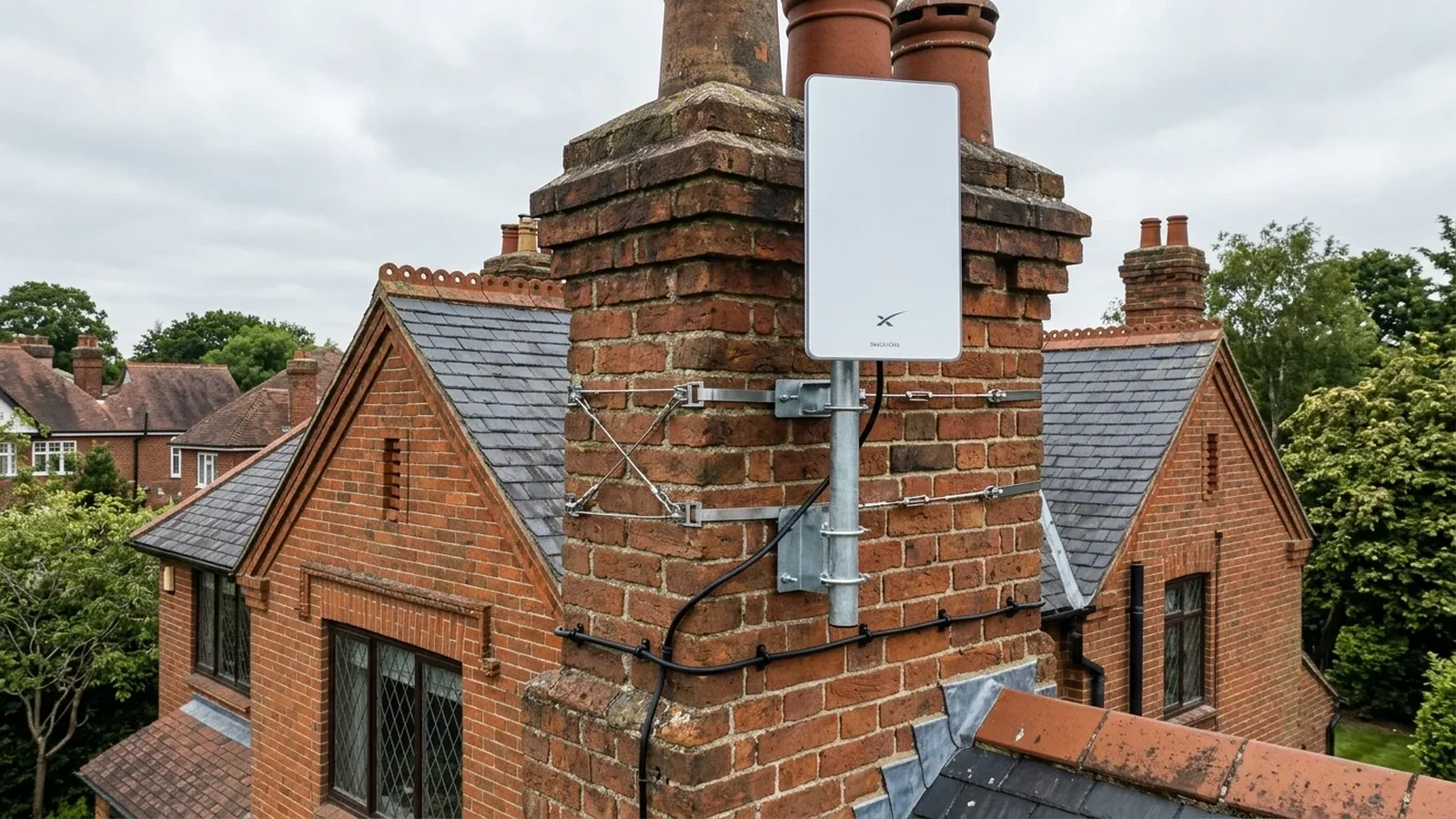
Bottom Line Up Front: Surviving UK Gales on a Chimney
Fitting a Starlink chimney mount in UK high winds requires wide-span dual galvanised lashing cradles with corner buffer plates, a 2-inch structural steel mast kept under 600mm, and dual M8 mechanical clamp bolts. Budget single-wire kits and long poles flex under 380N wind drag, twisting the dish and causing severe satellite packet dropouts during winter storms.
1. Aerodynamic Drag Physics: The Starlink Kite Effect
Unlike traditional compact TV aerials which present minimal solid surface area to the wind, a SpaceX Starlink dish represents a substantial aerodynamic sail. The standard Gen 3 flat panel measures 594mm by 383mm, presenting an active surface area of approximately 0.228 square metres. When tilted at standard 25-to-35 degree satellite elevations toward the northern horizon, this panel acts as an aerodynamic kite, generating substantial lateral drag force combined with upward aerodynamic lift.
In the UK, autumn and winter Atlantic depressions frequently funnel gusts through exposed valleys and high Northern moorlands at speeds exceeding 75 to 85mph. Applying fluid dynamic drag formulas (drag force equals half the air density multiplied by the velocity squared, drag coefficient, and surface area), an 80mph (35.8m/s) wind gust against a tilted Starlink dish generates a continuous lateral load of between 210 Newtons and 380 Newtons (roughly 38.7kg of dynamic force).
FIELD MOMENT CALCULATION:
Overturning Moment (M) = Force (F) × Mast Distance (h)
With a standard 1.2-metre pole: 380 N × 1.2 m = 456 Newton-metres (N·m) of rotational torque applied continuously to the uppermost course of chimney masonry.
This rotational torque acts like a crowbar against the top chimney bricks. If the mast is excessive in length, the mechanical leverage multiplies rapidly, placing tremendous tension across old lime mortar joints and causing unbraced hardware to twist or work loose.
2. Why Budget Single-Wire Lashing Kits Fail in UK Storms
Many homeowners and general handymen attempt to mount Starlink dishes using budget TV aerial chimney brackets purchased from online retail marketplaces. These kits almost universally utilise a single 7/20 or 7/18 strand galvanised steel lashing wire wrapped once around the brick stack, tightened by two small J-bolts. While perfectly adequate for a 2-pound lightweight aluminium TV aerial, they are completely unsuitable for the dynamic wind forces of a satellite phased array.
Field inspections across Yorkshire and Lancashire consistently reveal three fatal failure modes with single-wire setups during storm conditions:
- Rotational Mast Slippage: High-speed turbulence creates alternating vortex shedding around the dish edges. This cyclic oscillation causes the single wire to walk up or down the mortar line. A displacement of just 3mm allows the vertical mast to twist up to 15 degrees, pointing the dish away from its satellite orbital corridor and creating severe 30-to-60 second connection dropouts.
- Wire Sawing & Spalling: When raw steel wire sits directly against soft Victorian red brick or Yorkshire gritstone corners without corner plates, continuous wind vibration causes the wire to act like a cheese wire, chewing through the outer masonry faces and degrading the structural corner bricks.
- Aluminium Mast Whipping: Budget kits typically supply 1.25-inch or 1.5-inch thin-walled aluminium conduit. Under 350N loads, aluminium poles flex up to 45mm at the tip. Phased array beams operate on high-frequency Ku and Ka microwave bands; excessive pole flex causes beam-pointing jitter and rapid packet loss even if the bracket itself remains intact.
3. Dual Galvanised Cradle Architecture: The 90mph Standard
To withstand genuine UK upland weather without drilling into heritage masonry, professional satellite engineers utilise a welded 5-stud or 6-stud heavy-duty galvanised chimney cradle system. This assembly distributes loads across the entire chimney structure rather than concentrating stress on a single brick line.
The core components of a storm-certified chimney installation include:
Dual High-Tensile Steel Strapping
Two separate 5-ply braided steel lashing wires spaced at least 350mm to 450mm apart vertically. Each wire is independently tensioned via heavy-duty forged turnbuckles and locking nuts, providing built-in redundancy.
Cast Corner Protectors
Heavy-gauge steel corner buffer plates fitted to all four chimney corners. These distribute compressive tension over 16 individual bricks and completely isolate the wire from raw brickwork or lime pointing.
2-Inch OD Galvanised Mast
Strictly 50.8mm (2-inch) outer diameter 16-gauge hot-dip galvanised structural steel tubing. Kept to the shortest possible clearance length (typically 450mm to 600mm above the chimney pot) to minimise rotational leverage.
Precision Machined Pipe Adapter
A precision-milled cast aluminium pipe sleeve replacing the flexible plastic factory click-in base. Locked to the 2-inch steel mast using dual M8 stainless steel hex grub screws torqued to 12 Newton-metres.
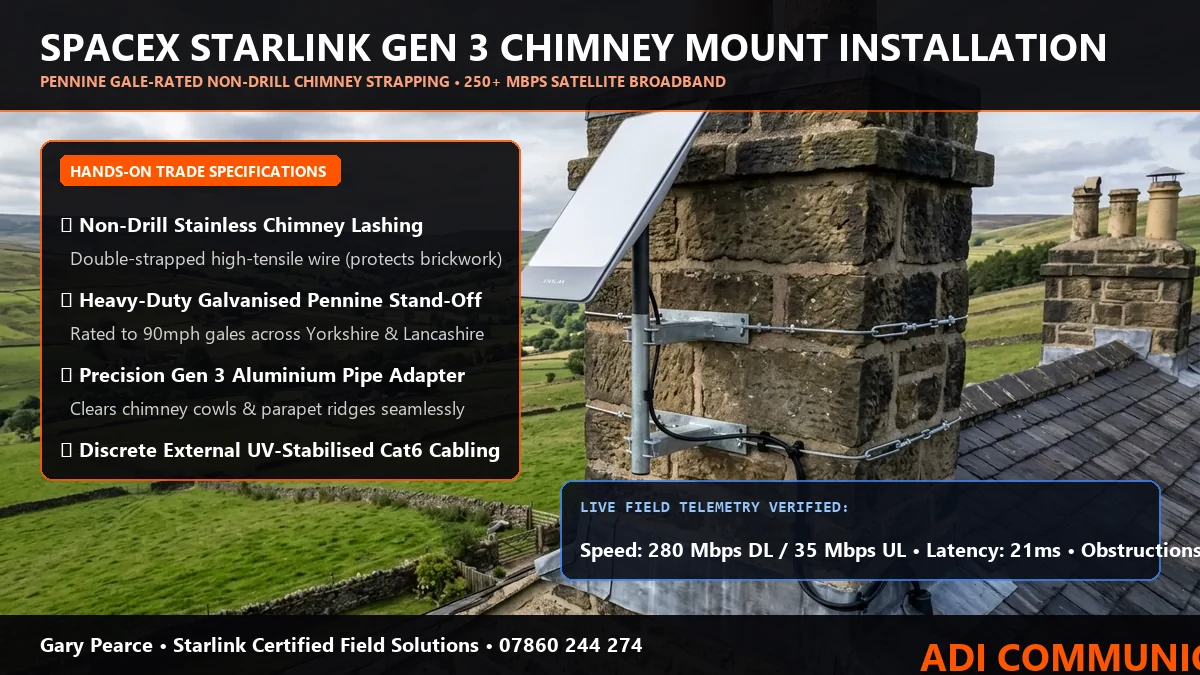
Fig 1.1: Mechanical blueprint of a high-wind dual-strapped Starlink chimney cradle showing turnbuckle placement and stand-off clearance.
4. Hardware Benchmark: Mounting Configurations Compared
Selecting the correct mounting architecture depends on property elevation, coastal exposure, and chimney structural condition. The benchmark matrix below details the structural tolerances of each approach:
| Mounting Method | Max Wind Rating | Deflection Tolerance | Masonry Stress | Expected Lifespan |
|---|---|---|---|---|
| Budget Single-Wire Kit | 45 – 55 mph | High (15–35mm flex) | Severe (Point load) | 6 – 18 Months |
| Dual-Wire Galvanised Cradle | 85 – 95 mph | < 1.5mm rigidity | Distributed (Corner plates) | 12 – 15+ Years |
| Heavy Gable Stand-Off Bracket | 100+ mph | < 0.5mm zero-wobble | Structural Wall (M10 anchors) | 20+ Years |
5. Chimney Mortar Health: The 4-Point Scratch Test
Before applying any tensioning straps to a chimney, an experienced engineer always conducts an on-roof structural assessment. Older properties in the UK, particularly Victorian terraces and stone cottages built before 1930, were laid with hydraulic lime mortar rather than modern Portland cement. Over decades of exposure to acidic chimney smoke and frost cycles, lime mortar can degrade into soft sand.
The Pre-Installation Safety Gate:
- The Mortar Scratch Test: Using a cold chisel or steel key, scratch firmly across a bed joint between courses 2 and 4 from the top. If the mortar crumbles away to powder with light finger pressure, the chimney stack cannot safely accept high-tension lashing wire.
- The Plumb & Lean Check: Inspect the stack with a 600mm spirit level. Stacks exhibiting a noticeable lean or outward belly cannot tolerate dynamic lateral wind loads.
- Lead Flashing Inspection: Ensure the apron and step flashing around the base are intact. Lashing brackets must sit at least 250mm above the roofline lead so strap tension does not pinch or distort lead soakers.
- Shared Chimney Flue Protocol: On semi-detached and terraced dwellings, verify that lashing wire passes strictly around your own flue boundary or has formal party-wall agreement with neighbouring owners.
If a chimney fails the structural scratch test, you must never force a lashing strap onto it. Doing so risks dislodging chimney pots or pulling top courses loose during a storm. In these scenarios, transferring the installation to a heavy-duty gable wall stand-off bracket provides total stability and zero roof stress.
6. External Cat6 Drip Loops & Weatherproofing
Mechanical stability is only half the battle during severe weather. High winds drive horizontal rain against brickwork, and satellite data cables can act as conduits channeling rainwater directly into your loft space or internal living areas if routed incorrectly.
Professional cable routing protocols for storm resilience:
- UV-Resistant Polyethylene (PE) Jacket: Standard indoor PVC ethernet cables degrade under solar UV exposure within 18 months, becoming brittle and cracking under freezing winds. Always use outdoor-rated black UV-stabilised Cat6 cable.
- The 150mm Low Drip Loop: Before the cable enters any external wall or soffit hole, it must drop at least 150mm lower than the entry point and curve back upwards in a smooth loop. Surface water flowing down the cable gathers at the lowest point of the curve and drips harmlessly onto the roof or ground, rather than running inside the drill hole.
- Upward-Angled 45-Degree Wall Penetration: Drill bit penetrations through brickwork must be drilled with a 15-to-45 degree upward incline from outside to inside. Water cannot run uphill.
- External Silicone Blast Bushing: Fit a weather-rated silicone cable entry cover (blast plate) over the masonry hole, filled with non-setting external silicone sealant to create a permanent air and moisture barrier.
7. Property Substrate Suitability: Matching Your Roof
Every UK home presents distinct architectural substrates and wind exposure profiles. Here is how professional installation engineers evaluate mounting viability across typical UK property styles:
Victorian & Edwardian Brick
Solid 9-inch brick stacks with lime pointing. Highly suited for dual-lashing cradles with cast corner protectors. Protects soft red facing bricks from wire wear and achieves complete 90mph gale resistance.
solid gritstone masonry Cottages
Heavy irregular stone blocks with wide mortar beds. Wide-span corner brackets are essential to bridge irregular stone faces. Mortar scratch test required to verify lime mortar integrity before tensioning.
Modern Timber Frame & Render
Prefabricated lightweight stacks or properties without chimneys. Best served by galvanised gable-end stand-offs bolted directly into structural timber plates or external masonry walls.
Starlink Chimney Mount UK: Gale-Proof Fitting Guide Video Debrief
Watch Gary Pearce demonstrate hands-on physical installation techniques, common trade failure modes, and hardware calibration.
Call Gary: 07860 244 2748. Frequently Asked Questions (Direct Answers)
Direct trade answers to the most common questions regarding chimney mounting and storm performance:
Will mounting a Starlink dish damage my chimney stack? ▼
Why does my Starlink drop connection during winter gales? ▼
What mast diameter is required for Starlink in high-wind zones? ▼
How much does a professional storm-proof Starlink installation cost? ▼
What is the best alternative if my chimney mortar is too weak? ▼
Gary Pearce
Lead Field EngineerFounder and Senior Systems Engineer at ADI Communications with over 25 years of hands-on physical infrastructure experience across Yorkshire and the North West. Fully certified in aerials, satellite systems, structural data cabling, and commercial CCTV installation. Carrying £10 Million Public Liability Insurance and backed by a verified 9.98 / 10 customer rating across 84+ reviews.
Starlink Satellite Broadband & heavy-duty storm mountsing
Living in an exposed upland valley or coastal high-wind zone? Gary Pearce installs heavy-duty galvanised chimney cradles, steel brackets, and storm-rated Starlink Gen 3 hardware.